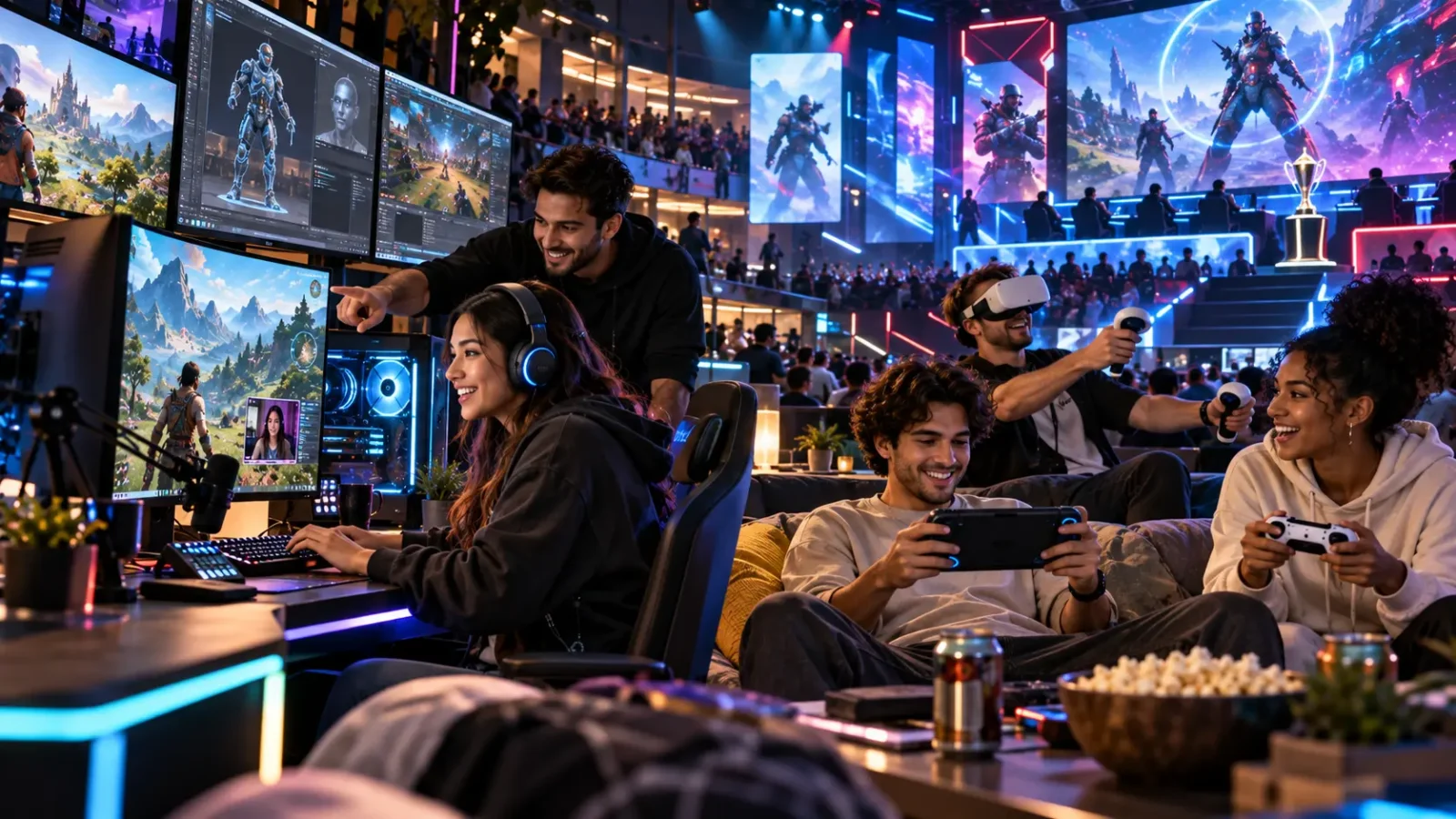
Gaming has become much more than a form of entertainment.
It is now a global cultural ecosystem connecting technology, entertainment, esports, streaming, creators, communities and digital commerce.
In 2026, that ecosystem is changing again.
Artificial intelligence is entering game development.
Cloud gaming is making high-end games more accessible without requiring expensive hardware.
Portable gaming devices are becoming increasingly important.
Creators and streamers are turning gameplay into entertainment.
Esports continues to build professional communities.
And game publishers are increasingly focused not simply on attracting players, but on keeping them engaged.
Newzoo’s 2026 market data puts the global games market at an estimated $213.9 billion, with approximately 3.70 billion players worldwide and 1.65 billion people expected to spend money on games.
At the same time, Twitch reported more than 8.6 billion hours of gaming content watched between January 1 and September 1, 2026, showing how closely gaming is connected with live entertainment and creator culture.
So what are the biggest gaming trends shaping 2026?
1. AI Is Changing How Games Are Developed
Artificial intelligence is becoming part of the game-development workflow.
Developers are exploring AI for:
- Concept development
- Prototyping
- Code assistance
- Testing
- Animation workflows
- Dialogue generation
- Asset creation
- Localization
- Quality assurance
Recent industry surveys show that AI adoption varies significantly by region. A 2026 CESA report cited by PC Gamer found that 85.8% of Japanese game developers surveyed were using AI tools, while a GDC survey found much lower adoption among North American respondents.
This shows that AI is not being adopted uniformly.
Developers are also debating questions around quality, originality, copyright and employment.
2. AI Could Make Games More Responsive
The most interesting possibility is not simply using AI to make games faster.
It is using AI to make games more dynamic.
Future games could potentially use AI to create:
- More responsive NPC conversations
- Adaptive difficulty
- Personalized quests
- Dynamic environments
- Procedural content
- More reactive game worlds
Imagine an NPC that can respond differently depending on how a player has behaved throughout the game.
That could create experiences that feel less scripted and more personal.
However, developers still need strong control over quality, narrative consistency and player safety.
3. Cloud Gaming Is Reducing Hardware Barriers
Cloud gaming is one of the biggest technology shifts in gaming.
Instead of running an entire game locally, cloud infrastructure can handle much of the processing and stream the experience to a connected device.
This can potentially allow players to access high-end games without purchasing extremely expensive hardware.
In India, cloud gaming is attracting attention because it could make premium gaming more accessible beyond traditional high-end PC and console audiences. Recent Indian industry coverage describes cloud gaming as a way to access AAA-style games with a suitable internet connection rather than necessarily owning a high-end gaming setup.
The biggest limitation remains network quality.
4. Gaming Is Becoming More Platform-Agnostic
The traditional boundaries between:
PC
Console
Mobile
are becoming less rigid.
Players increasingly expect games to be available across multiple platforms.
Cross-platform ecosystems can allow players to:
- Play with friends on different devices
- Continue progress across platforms
- Access the same game ecosystem from multiple devices
BCG’s 2026 gaming research identifies platform convergence as a major industry trend, with cloud gaming and cross-platform access helping reshape distribution.
5. Handheld Gaming Is Becoming a Major Category
Portable gaming is experiencing renewed attention.
Modern handheld PCs combine:
- Portable hardware
- PC game libraries
- High-resolution displays
- Controller-based gameplay
The Steam Deck has also become increasingly important to developers.
The 2026 GDC State of the Game Industry survey reported that 28% of developers were making or optimizing games for Steam Deck, while another 40% expressed interest in developing for it.
This indicates that handheld gaming is no longer simply a niche side category.
6. Mobile Gaming Still Leads by Scale
Mobile remains the largest gaming ecosystem globally.
Newzoo estimates around 3.10 billion mobile players in 2026, representing roughly 83.9% of the global player base, with mobile gaming revenue forecast at approximately $121.1 billion.
Mobile gaming’s biggest advantage remains accessibility.
A smartphone is already in the hands of billions of people.
That makes mobile gaming particularly important in emerging markets.
7. But Mobile Game Growth Is Becoming More Competitive
The mobile market is not simply about acquiring more downloads.
Newzoo’s 2026 data indicates that mobile downloads declined significantly in the first half of the year while acquisition costs increased, putting greater emphasis on retention and monetization.
For developers, this means:
Getting a player is only the beginning.
Keeping the player engaged is becoming more important.
That is increasing the importance of:
- Live events
- Updates
- Community features
- Personalization
- Social systems
- Player rewards
8. Live-Service Games Are Focusing on Retention
Live-service games continuously evolve after launch.
Developers may release:
- New characters
- New maps
- Seasonal content
- Events
- Challenges
- Cosmetic items
- Gameplay updates
The model creates ongoing engagement.
But it also creates pressure.
Players have limited time.
A game must provide enough value to justify returning regularly.
This is why player retention is becoming one of the industry’s most important metrics.
9. Gaming Communities Are Becoming Entertainment Platforms
Gaming communities are no longer limited to players inside a game.
They exist across:
- Twitch
- YouTube
- Discord
- Social media
- Fan forums
- Esports communities
A player may spend as much time watching a game as playing it.
Twitch’s 2026 State of Gaming report shows the scale of this ecosystem, with billions of hours watched across gaming content.
This means gaming is increasingly becoming a form of participatory entertainment.
10. Streamers Are Becoming Major Gaming Influencers
Streamers can influence:
- Game discovery
- Player behaviour
- Community culture
- Competitive scenes
- Game popularity
A game can become popular because a creator makes it entertaining to watch.
This creates a new marketing model:
Play → Stream → Watch → Discover → Play
The distinction between gamer and entertainment creator is becoming increasingly blurred.
11. Esports Is Becoming More Connected to Mainstream Entertainment
Esports continues to evolve beyond traditional tournaments.
Modern esports events increasingly combine:
- Competitive gaming
- Live audiences
- Streaming
- Music
- Sponsorship
- Creator participation
- Fan communities
India is also exploring the intersection of AI, esports, technology and careers. Jio Institute’s GameForge 2026 event focused specifically on how AI is reshaping the esports ecosystem and its wider opportunities.
12. AI Is Entering Esports Too
AI can potentially support esports through:
- Match analytics
- Player performance analysis
- Coaching tools
- Anti-cheat systems
- Automated highlights
- Broadcasting
- Tournament operations
AI could make competitive gaming easier to analyse for both professionals and viewers.
But competitive integrity remains critical.
Technology should improve competition without undermining fairness.
13. User-Generated Content Is Expanding
Players increasingly want to create, not just consume.
User-generated content can include:
- Custom maps
- Characters
- Mods
- Levels
- Game modes
- Experiences
BCG’s gaming research highlights UGC and the creator economy as major engagement drivers, with platforms such as Fortnite and Roblox demonstrating how players can become creators.
This changes the relationship between developers and players.
The player becomes part of the content ecosystem.
14. Gaming Is Becoming More Social
Many modern games are designed around social interaction.
Players can:
- Play with friends
- Join communities
- Communicate through voice
- Create teams
- Participate in events
- Watch tournaments
For some players, the social experience is just as important as the gameplay.
This connects gaming with the broader trend of digital communities.
Internal Link Opportunity: Link this section to your Community Trends 2026 article.
15. Games Are Becoming Cross-Media Franchises
Gaming and entertainment are increasingly connected.
A successful game can become:
- A movie
- A television series
- Merchandise
- Music
- Live events
- Animated content
Likewise, entertainment franchises can become games.
This creates a much larger ecosystem around intellectual property.
Gaming is therefore becoming an increasingly important part of the broader entertainment industry.
16. Indie Games Are Getting More Attention
Large AAA games require enormous budgets.
This creates opportunities for smaller studios.
Indie developers can experiment with:
- New gameplay mechanics
- Unusual stories
- Unique visual styles
- Smaller game worlds
- Experimental formats
The recent PC Gaming Show Tokyo Direct showcased dozens of upcoming titles across genres, highlighting the diversity of smaller and independent projects alongside major releases.
Players are not always looking for the biggest game.
Sometimes they are looking for the most original one.
17. AAA Games Are Becoming More Expensive to Produce
High-end games can require huge teams and long development cycles.
This creates pressure on publishers.
Studios need to balance:
Visual quality + development cost + player expectations + time to market
This is one reason why smaller AA and indie projects are receiving greater attention.
It also helps explain the industry’s growing interest in AI-assisted development and reusable technology.
18. Retro Gaming Is Returning
Nostalgia remains powerful.
Classic games are returning through:
- Remasters
- Remakes
- Retro collections
- Re-releases
- Modern hardware
September 2026 gaming trend data also shows renewed interest in retro gaming alongside new hardware and PC handhelds.
Retro gaming works because it combines familiarity with modern convenience.
19. Gaming Hardware Is Becoming More Diverse
Gamers now have more hardware choices than ever.
The ecosystem includes:
- Gaming PCs
- Consoles
- Handheld PCs
- Smartphones
- Tablets
- Cloud-enabled devices
- VR headsets
This gives players more flexibility.
Instead of asking:
“Which platform is best?”
players increasingly ask:
“Which device fits how I play?”
20. Gaming Is Becoming More Immersive
Virtual reality, augmented reality and advanced display technology continue to explore new forms of interaction.
Immersive gaming can create experiences where players feel physically present inside a digital environment.
But adoption depends on:
- Hardware cost
- Comfort
- Game quality
- Content availability
The technology is evolving, but mainstream gaming remains strongly focused on conventional screens and controllers.
21. Gaming and AI Companions Could Converge
AI-powered characters could eventually become more sophisticated companions inside games.
Instead of fixed dialogue trees, characters could potentially:
- Remember player interactions
- Respond dynamically
- Develop different personalities
- Adapt to gameplay
This could make narrative games feel more interactive.
But it also raises questions about privacy, moderation and the boundaries between fictional characters and conversational AI.
22. Accessibility Is Becoming More Important
Gaming should be accessible to as many players as possible.
Modern accessibility features can include:
- Custom controls
- Subtitle options
- Color adjustments
- Audio settings
- Difficulty customization
- Assistive interfaces
Better accessibility can allow more people to participate in gaming.
It also encourages developers to design more flexible experiences.
23. Gaming Careers Are Expanding
Gaming is creating opportunities beyond traditional game development.
The ecosystem now includes:
- Streamers
- Esports players
- Coaches
- Community managers
- Game testers
- Content creators
- Tournament organizers
- Game designers
- Technical artists
- AI specialists
The gaming industry is becoming a broader technology and entertainment ecosystem.
However, the job market remains competitive, and industry surveys continue to show concerns about layoffs and entry-level opportunities.
24. Gaming in India Is Entering a New Phase
India’s gaming ecosystem continues to expand alongside rising internet access and smartphone adoption.
The country has traditionally been strongly associated with mobile gaming.
But cloud gaming, esports, PC gaming, handheld devices and game development are creating a broader ecosystem.
Krafton announced in September 2026 that it plans to invest another $250 million in India over the next three to four years, taking its planned investment in the country above $500 million, with the new commitment extending into AI, robotics and deep tech as well as gaming.
This reflects the increasingly broad technology ecosystem surrounding gaming in India.
25. The Future of Gaming Is More Connected
The modern gaming journey can look like:
Game → Stream → Community → Creator → Esports → Live Event → Merchandise
A player may discover a game through a streamer.
Then join a community.
Watch an esports tournament.
Create fan content.
And eventually attend a live event.
Gaming is no longer a single activity.
It is an interconnected entertainment ecosystem.
How Gamers Can Navigate 2026
Choose Your Platform Carefully
Think about where and how you actually play before investing in hardware.
Explore Indie Games
Some of the most innovative experiences come from smaller studios.
Use Cloud Gaming Where Practical
It can provide access to demanding games, but your internet connection matters.
Protect Your Account
Use strong passwords and available security features.
Be Careful With In-Game Spending
Set budgets for subscriptions, cosmetic items and other purchases.
Take Breaks
Gaming is entertainment. Balance screen time with sleep, movement and offline activities.
Join Communities Responsibly
Gaming communities can be valuable, but players should still protect personal information and maintain healthy boundaries.
The Biggest Gaming Trend of 2026
The biggest shift in gaming is not a single device or game.
It is convergence.
PC, console and mobile are becoming more connected.
Gaming and streaming are becoming connected.
Games and movies are becoming connected.
Players and creators are becoming connected.
AI and game development are becoming connected.
Cloud infrastructure and gaming are becoming connected.
The result is an industry where the boundaries between game, platform, community and entertainment are becoming increasingly difficult to separate.
The Future of Gaming
Gaming is likely to become:
More intelligent through AI.
More accessible through cloud technology.
More portable through handheld devices.
More social through communities.
More interactive through user-generated content.
More global through cross-platform distribution.
And potentially more immersive through emerging technologies.
But technology will not be enough.
Players will continue to care about the fundamentals:
Fun.
Challenge.
Story.
Creativity.
Connection.
The future of gaming will ultimately be shaped by how well technology serves those experiences.
Final Thoughts
Gaming in 2026 is entering a new phase.
AI is changing development.
Cloud gaming is challenging traditional hardware requirements.
Handheld devices are becoming more important.
Mobile remains the industry’s largest ecosystem.
Streaming is turning gameplay into entertainment.
Esports is creating professional communities.
User-generated content is giving players creative power.
And gaming in India is expanding beyond traditional mobile play.
The gaming industry is no longer simply about selling games.
It is about building worlds, communities and experiences that people return to.
And that may be the defining idea of gaming in 2026:
The game is only the beginning.
Frequently Asked Questions
What are the biggest gaming trends in 2026?
Major trends include AI-assisted game development, cloud gaming, handheld gaming, cross-platform play, mobile gaming, esports, streaming, user-generated content and gaming communities.
How is AI changing game development?
AI is being explored for prototyping, coding assistance, asset creation, testing, localization, dialogue and other development workflows. Adoption varies across regions and studios.
Is cloud gaming becoming popular?
Cloud gaming is attracting attention because it can provide access to demanding games without requiring equally powerful local hardware. Internet quality remains an important limitation.
Is mobile gaming still the biggest gaming platform?
Mobile remains the largest gaming ecosystem by player count, with Newzoo estimating around 3.10 billion mobile players in 2026.
Why are handheld gaming devices becoming popular?
Handheld gaming combines portability with access to increasingly sophisticated game libraries. Developer interest in devices such as Steam Deck is also increasing.
What is the creator economy in gaming?
The gaming creator economy includes streamers, video creators, community leaders and players who create content around games and monetize or grow audiences through platforms and communities.
Why is esports important?
Esports combines competitive gaming with streaming, sponsorship, live events, creators and communities, turning games into spectator entertainment as well as interactive experiences.
Is gaming becoming more social?
Yes. Modern gaming increasingly includes multiplayer communities, voice communication, streaming, fan communities, creator content and live events.