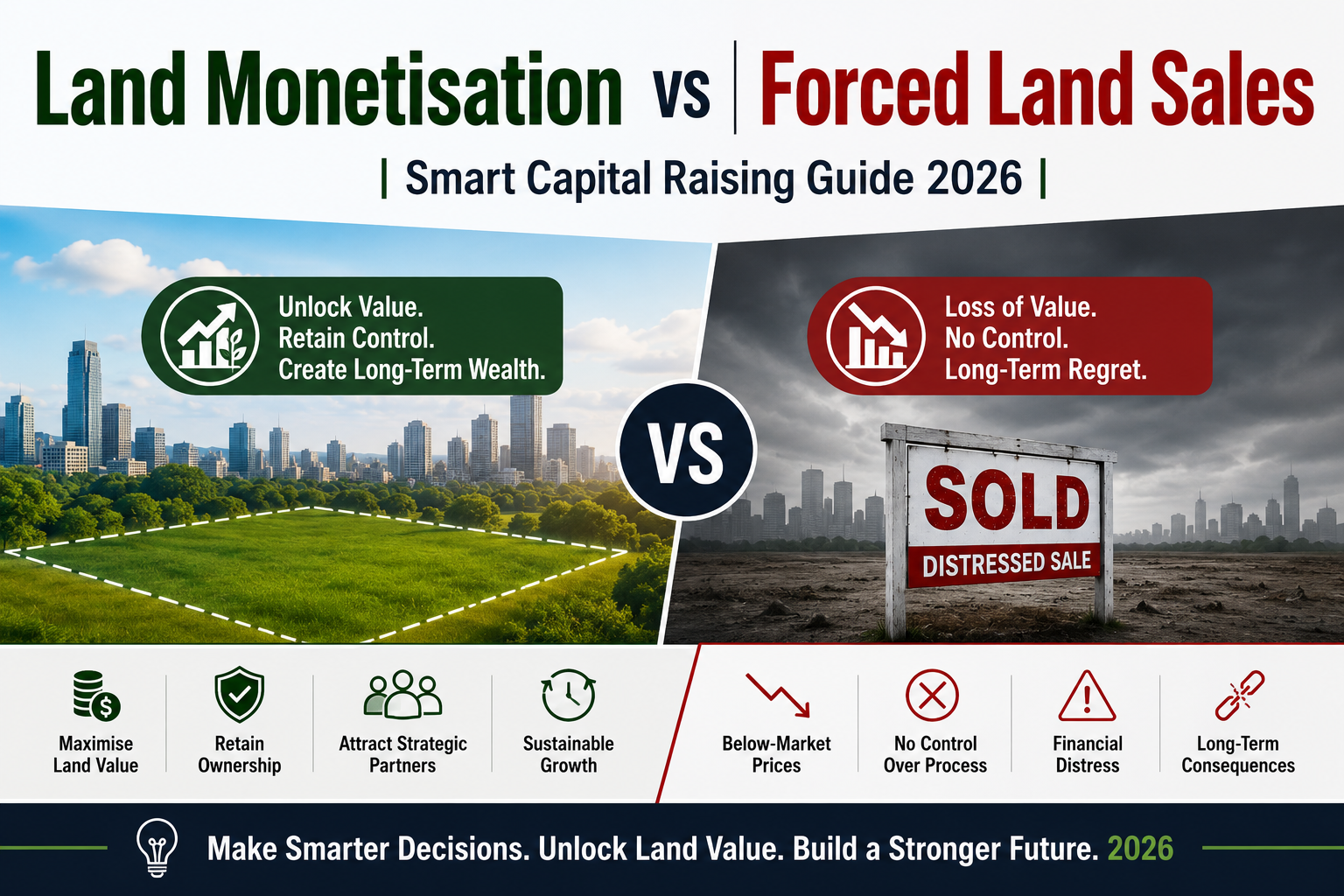
Land Monetisation vs Forced Land Sales: Which Is Better for Raising Capital?
In India, land is one of the most valuable long-term assets owned by individuals, families, businesses, and institutions. However, many landowners face liquidity challenges when they need immediate funds for business expansion, debt restructuring, infrastructure projects, or operational requirements.
Traditionally, distressed owners often resorted to forced land sales to raise quick capital. While selling land may provide instant cash flow, it frequently results in undervaluation, legal complications, emotional loss, and long-term financial disadvantages.
Today, a more strategic alternative is emerging rapidly — Land Monetisation.
Land Monetisation allows landowners to unlock the financial value of their land without completely losing ownership. Instead of selling assets in distress, owners can leverage structured partnerships, leasing arrangements, joint developments, revenue-sharing models, or asset-backed financing to generate capital efficiently.
Across India, governments, infrastructure agencies, businesses, and private landowners are increasingly using land monetisation as a structured funding strategy. Recent infrastructure funding models in Maharashtra and other regions show how land assets are becoming a central financial resource rather than just idle property.
This article explains the difference between forced land sales and Land Monetisation, their advantages and disadvantages, and why monetisation is becoming the smarter capital-raising solution in 2026.
What Is Land Monetisation?
Land Monetisation refers to the process of converting the value of land into liquid capital or recurring revenue without permanently selling the property.
Instead of transferring complete ownership, landowners use strategies such as:
- Long-term leasing
- Joint development agreements
- Revenue-sharing partnerships
- Build-to-suit projects
- Asset-backed funding
- Commercial development partnerships
- Infrastructure collaboration
- Industrial or warehousing leasing
The objective is simple: generate funding while retaining long-term asset ownership and future appreciation potential.
According to recent infrastructure financing trends in India, land monetisation is increasingly being used to support large-scale development without additional borrowing.
What Are Forced Land Sales?
Forced land sales occur when landowners sell property quickly under financial pressure. These sales are usually driven by:
- Debt repayment obligations
- Business losses
- Legal disputes
- Cash flow shortages
- Loan defaults
- Emergency financial requirements
In most cases, distressed sellers accept lower-than-market prices because they need urgent liquidity.
Forced sales often happen without proper valuation, negotiation leverage, or future planning.
While immediate funding may solve short-term problems, it can create major long-term losses.
Key Difference Between Land Monetisation and Forced Land Sales
| Factor | Land Monetisation | Forced Land Sales |
|---|---|---|
| Ownership | Retained partially or fully | Completely transferred |
| Long-Term Wealth | Preserved | Lost permanently |
| Funding Model | Structured capital generation | Distress liquidation |
| Asset Appreciation | Owner benefits from future growth | Buyer gains future value |
| Revenue Opportunity | Recurring income possible | One-time payment only |
| Negotiation Power | Higher | Usually weak |
| Risk Level | Structured and strategic | Often financially damaging |
| Business Continuity | Supports growth | May reduce future stability |
Why Forced Land Sales Can Be Risky
1. Undervaluation of Land
Distressed sales rarely achieve fair market value. Buyers often take advantage of urgency and negotiate aggressive discounts.
In high-growth regions, land prices may rise significantly over time. Selling during financial stress can eliminate future wealth creation opportunities.
2. Permanent Loss of Ownership
Land is a finite asset. Once sold, regaining ownership becomes difficult and expensive.
Families and businesses may later regret selling strategically located land assets.
3. Tax and Legal Issues
Forced sales can create:
- Capital gains tax liabilities
- Title disputes
- Compliance complications
- Delayed payments
- Litigation risks
Improperly structured sales may create additional financial pressure.
4. Loss of Future Income Potential
Land can generate recurring revenue through:
- Leasing
- Commercial projects
- Warehousing
- Renewable energy projects
- Hospitality developments
- Industrial partnerships
Forced sales eliminate these future earning possibilities.
Why Land Monetisation Is Becoming Popular in India
India’s growing infrastructure demand, urban expansion, and rising land values are transforming how land is viewed financially.
Instead of treating land as a passive asset, owners are increasingly using it as a capital-generation tool.
Recent reports show that governments and infrastructure authorities are integrating land monetisation into core financing strategies to reduce dependence on debt.
Several factors are driving this trend:
- Rapid urbanisation
- Increasing commercial demand
- Industrial corridor development
- Logistics and warehousing expansion
- Infrastructure growth
- Rising institutional investment
- Structured funding demand
Common Land Monetisation Models
1. Long-Term Lease Agreements
Owners lease land to businesses, developers, or industrial operators for fixed periods.
Benefits include:
- Regular rental income
- Ownership retention
- Predictable cash flow
- Lower operational risk
This model is commonly used for:
- Warehouses
- Factories
- Logistics parks
- Commercial spaces
- Solar projects
2. Joint Development Agreements (JDAs)
Under a JDA, landowners partner with developers who construct residential, commercial, or mixed-use projects.
Instead of selling land outright, owners receive:
- Revenue share
- Developed units
- Profit participation
- Equity stake
This approach is highly popular in metropolitan and high-growth urban areas.
3. Revenue Sharing Models
Landowners allow developers or operators to use land while earning a percentage of project revenue.
This creates recurring long-term income rather than a single sale payment.
4. Asset-Backed Funding
Land can be used as collateral to secure structured financing solutions for businesses and expansion projects.
This allows owners to raise capital without immediate liquidation.
5. Infrastructure Partnerships
Government agencies and private entities increasingly collaborate using land monetisation to finance infrastructure development.
This model aligns land value appreciation with urban growth and public investment.
Industries Benefiting from Land Monetisation
Land Monetisation is no longer limited to real estate developers.
Several industries are actively using land-backed funding strategies:
Real Estate
Developers use land partnerships to reduce acquisition costs and improve project scalability.
Warehousing & Logistics
The rapid expansion of e-commerce and industrial corridors has increased demand for logistics parks and storage facilities.
Renewable Energy
Solar and wind energy companies lease large land parcels for energy infrastructure projects.
Hospitality & Tourism
Hotels, resorts, eco-tourism projects, and entertainment destinations often operate through lease and revenue-sharing models.
Manufacturing & Industrial Development
Industrial land partnerships support factory setup and long-term production expansion.
Benefits of Land Monetisation
1. Ownership Retention
One of the biggest advantages is maintaining long-term ownership rights.
Landowners continue benefiting from future appreciation.
2. Better Capital Efficiency
Instead of idle land sitting unused, monetisation converts assets into productive financial resources.
3. Recurring Revenue Generation
Unlike forced sales, monetisation can create sustainable recurring income streams.
4. Lower Financial Stress
Structured capital raising reduces the pressure associated with distress liquidation.
5. Higher Long-Term Wealth Creation
Retaining ownership while generating revenue creates better long-term financial outcomes.
6. Strategic Business Expansion
Businesses can unlock land value to fund:
- Expansion projects
- Debt restructuring
- Working capital
- Infrastructure development
- Operational scaling
Risks Associated with Land Monetisation
Although monetisation offers major advantages, proper planning is essential.
Potential risks include:
- Legal disputes
- Title verification issues
- Regulatory delays
- Market slowdowns
- Poor partnership structuring
- Revenue-sharing conflicts
Experts recommend detailed due diligence before entering monetisation agreements.
Recent industry analysis also highlights that overdependence on land-based funding can expose projects to real estate market volatility.
How to Choose the Right Monetisation Strategy
The ideal strategy depends on:
- Land location
- Land size
- Market demand
- Zoning regulations
- Financial goals
- Risk appetite
- Project potential
For example:
| Land Type | Suitable Monetisation Strategy |
|---|---|
| Urban Commercial Land | Joint development |
| Industrial Land | Long-term lease |
| Agricultural Edge Land | Renewable energy partnerships |
| Highway Land | Warehousing & logistics |
| Tourism Land | Hospitality partnerships |
Professional legal, financial, and valuation advice is strongly recommended before structuring transactions.
The Future of Land Monetisation in India
Land Monetisation is expected to become a major financial strategy across India over the next decade.
As infrastructure spending rises and debt costs increase, both public and private sectors are searching for asset-backed funding alternatives.
Industry experts believe monetisation will continue growing because it provides:
- Reduced borrowing dependency
- Better asset utilisation
- Long-term capital efficiency
- Infrastructure financing support
- Sustainable wealth preservation
Recent government infrastructure strategies already demonstrate this shift toward structured land value utilisation.
Final Thoughts
Forced land sales may provide short-term liquidity, but they often destroy long-term financial potential.
In contrast, Land Monetisation offers a smarter and more sustainable way to raise capital while preserving ownership and future value.
Whether through leasing, joint ventures, revenue sharing, or structured partnerships, monetisation allows landowners to transform idle land into a productive financial asset.
As India’s infrastructure, industrial, and commercial sectors continue expanding, strategic land monetisation is becoming one of the most powerful tools for capital generation in 2026.
For landowners, businesses, and institutions seeking growth without losing valuable assets, Land Monetisation represents a modern financial solution built for long-term wealth creation.