
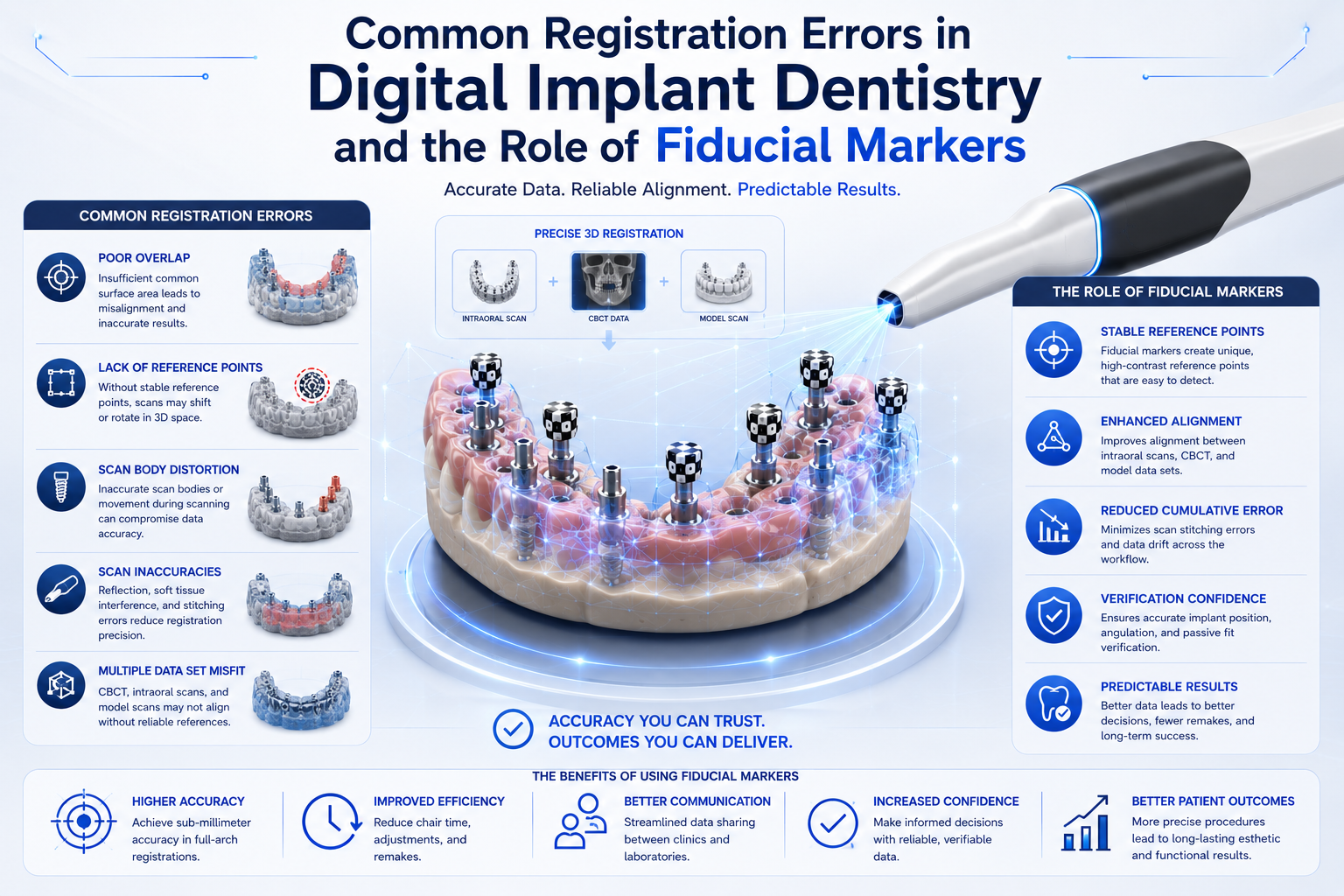
Digital implant dentistry has significantly improved the accuracy and efficiency of full-arch restorations, but the success of a digital workflow depends on more than advanced scanners or CAD software. One of the most common causes of restorative inaccuracies is poor digital dataset registration. When CBCT scans, intraoral scans, photogrammetry records, and implant positions are not aligned correctly, even small discrepancies can affect prosthetic design and final restoration fit. Dental fiducial markers help minimize these registration errors by providing stable reference points that improve digital accuracy throughout the workflow.
What Is Digital Registration in Implant Dentistry?
Digital registration is the process of aligning multiple digital records into a single, accurate treatment model. Modern implant workflows often combine information from several sources before prosthetic planning begins.
These datasets commonly include:
- CBCT imaging
- Intraoral scans
- Photogrammetry records
- Implant position data
- Soft tissue scans
- Facial scans (when applicable)
If these digital files are not registered accurately, the final prosthetic design may not reflect the patient’s true clinical situation.
According to the National Center for Biotechnology Information (NCBI), accurate digital data integration is essential for predictable implant treatment planning and prosthetic success.
Why Registration Accuracy Is Critical in Full-Arch Cases
Full-arch implant restorations require several implants to support one prosthetic framework. Unlike single-unit restorations, inaccuracies become cumulative because every implant must align precisely within the final prosthesis.
Poor registration may contribute to:
- Passive fit issues
- Prosthetic misfit
- Occlusal discrepancies
- Additional chairside adjustments
- Increased laboratory revisions
For this reason, registration accuracy is considered one of the most important stages of a digital AOX workflow.
Common Registration Errors in Digital Implant Dentistry
Although digital technologies continue to evolve, registration errors can still occur if reliable reference data is unavailable.
1. Misalignment Between Digital Datasets
Different digital records may not align correctly when imported into planning software.
Possible causes include:
- Inconsistent reference points
- Incomplete scan data
- Software registration errors
- Poor scan overlap
These discrepancies can affect implant positioning throughout the restorative workflow.
2. Inaccurate Implant Position Capture
If implant positions are recorded incorrectly, every stage that follows—including prosthetic planning and laboratory fabrication—may be affected.
Potential consequences include:
- Framework misfit
- Passive fit complications
- Occlusal corrections
- Prosthetic redesign
Accurate implant position recording remains fundamental to successful full-arch treatment.
3. Inconsistent Reference Geometry
Digital software depends on recognizable landmarks when merging datasets. If these landmarks vary between scans, registration becomes less predictable.
This may result in:
- Dataset distortion
- Alignment inconsistencies
- Reduced planning accuracy
- Laboratory uncertainty
Stable reference points improve consistency throughout digital treatment planning.
4. Communication Gaps Between Clinics and Dental Labs
Registration errors are not always technical. Miscommunication between clinicians and laboratory teams can also contribute to restorative inaccuracies.
Examples include:
- Incorrect dataset versions
- Missing digital files
- Incomplete planning instructions
- Misinterpreted restorative objectives
A standardized digital workflow helps reduce these risks.
How Dental Fiducial Markers Help Prevent Registration Errors
A fiducial marker dental system provides fixed geometric reference points that allow digital software to align multiple datasets with greater precision. Instead of relying only on anatomical landmarks, fiducial markers create consistent reference geometry throughout the workflow.
This supports:
- More accurate dataset registration
- Improved implant position consistency
- Better digital treatment planning
- Reliable communication between clinicians and laboratories
- Greater confidence before prosthesis fabrication
Research published in the Journal of Prosthetic Dentistry continues to emphasize the importance of accurate digital records and workflow precision for successful implant-supported restorations.
Why Fiducial Markers Are Valuable in Photogrammetry
Photogrammetry accurately captures the spatial relationship between implants, but those records must still integrate correctly with CBCT scans, intraoral scans, and prosthetic planning software.
Reliable fiducial markers help strengthen this integration by providing consistent reference points across digital datasets.
Benefits include:
- Improved digital alignment
- Better implant registration
- Reduced cumulative workflow errors
- Enhanced restorative predictability
- More efficient laboratory workflows
Rather than replacing photogrammetry, fiducial markers improve the reliability of the overall digital ecosystem.
The Role of ArchTracer™ in Modern Digital Implant Workflows
As digital implant workflows become increasingly sophisticated, dedicated fiducial marker systems are helping improve registration accuracy. Solutions such as the ArchTracer™ dental fiducial marker for precise digital registration in full-arch implant workflows are designed to provide stable reference geometry for photogrammetry, intraoral scanning, and prosthetic planning.
As part of the Digital Arches digital workflow ecosystem, ArchTracer™ supports clinicians and dental laboratories by improving digital consistency from treatment planning through prosthesis fabrication.
Clinicians interested in digital workflow optimization can also explore educational resources available through the Digital Arches Blog, which covers photogrammetry, implant verification, AOX workflows, and digital prosthetic planning.
Best Practices for Improving Registration Accuracy
Although technology continues to improve, following standardized protocols remains essential.
Recommended practices include:
- Capture complete digital datasets
- Verify scan quality before planning
- Use consistent digital workflows
- Improve communication between clinics and laboratories
- Utilize reliable fiducial marker systems when appropriate
- Review dataset alignment before prosthetic design
Following these steps can reduce workflow variability and improve restorative predictability.
The American Academy of Implant Dentistry (AAID) also highlights the growing role of digital technologies in improving implant diagnosis, treatment planning, and restorative outcomes.
Frequently Asked Questions
What is digital registration in implant dentistry?
Digital registration is the process of accurately aligning CBCT scans, intraoral scans, photogrammetry records, and implant data into one coordinated digital treatment model.
Why are registration errors a concern in full-arch implant cases?
Small alignment errors can affect passive fit, prosthetic design, occlusion, and laboratory fabrication, increasing the likelihood of restorative adjustments.
What is a dental fiducial marker?
A dental fiducial marker is a precision reference device that helps digital software accurately register multiple datasets during implant treatment planning.
How does ArchTracer™ improve digital workflows?
ArchTracer™ provides stable reference points that improve digital dataset registration, helping clinicians and dental laboratories achieve more accurate planning and predictable restorative outcomes.
Final Insight
Registration accuracy is one of the most overlooked yet essential components of successful digital implant dentistry. Even the most advanced scanners and planning software depend on correctly aligned digital information to produce predictable prosthetic outcomes. As full-arch workflows continue to integrate photogrammetry, CBCT imaging, and CAD/CAM technologies, accurate dataset registration becomes increasingly important.
Dedicated fiducial marker systems such as ArchTracer™ demonstrate how stable digital reference points can reduce registration errors, improve collaboration between clinicians and laboratories, and strengthen the overall reliability of modern full-arch implant workflows. By building accuracy into the digital foundation of treatment, clinicians can improve both workflow efficiency and long-term restorative success.