Building Smarter Social Apps:
The AI Playbook Every Founder Needs
in 2026
Everyone talks about AI in social apps like it’s one big feature. It isn’t. It’s a dozen small
decisions — what to personalize, what to automate, what to leave alone — and getting them
right matters more than chasing the newest trend.
Introduction
Ask ten founders what “AI-powered social app” means and you’ll get ten different answers.
For some it’s a recommendation engine. For others it’s a chatbot bolted onto support. A few
will mention moderation almost as an afterthought, even though it’s often where AI earns its
keep the fastest. The truth is there’s no single feature that makes a social app “AI-powered”
— it’s a set of smaller decisions about where machine intelligence actually helps and where
it just adds noise.
That distinction matters more now than it did even a year or two ago. Users have gotten
used to feeds that adjust to them, search that understands what they mean rather than what
they typed, and support that doesn’t route them into a queue. A social app that doesn’t do at
least some of this reads as dated within weeks of launch, no matter how clean the design is.
This piece isn’t a hype list. It’s a working breakdown of what AI actually needs to handle in a
social app, what it costs to get wrong, and a sensible order to build it in — whether you’re
sketching an MVP or planning the next phase of an app that’s already live.
Why Social Apps Can’t Skip AI Anymore
There’s a simple reason AI stopped being optional for social platforms: the competition
already has it. A new entrant isn’t just competing against other apps in its niche — it’s
competing against the muscle memory users have built up from every other app on their
phone. If your feed feels random after theirs feels personal, you’ve already lost a chunk of
the session before the user even scrolls twice.
There’s also a scale problem AI solves that nothing else really does. A community of a few
thousand people can be moderated by a small team reading reports by hand. A community
in the millions can’t — not without AI catching the bulk of it first and leaving humans to
handle the judgment calls. Growth without that layer doesn’t just get harder; past a certain
point it stops being possible at all.
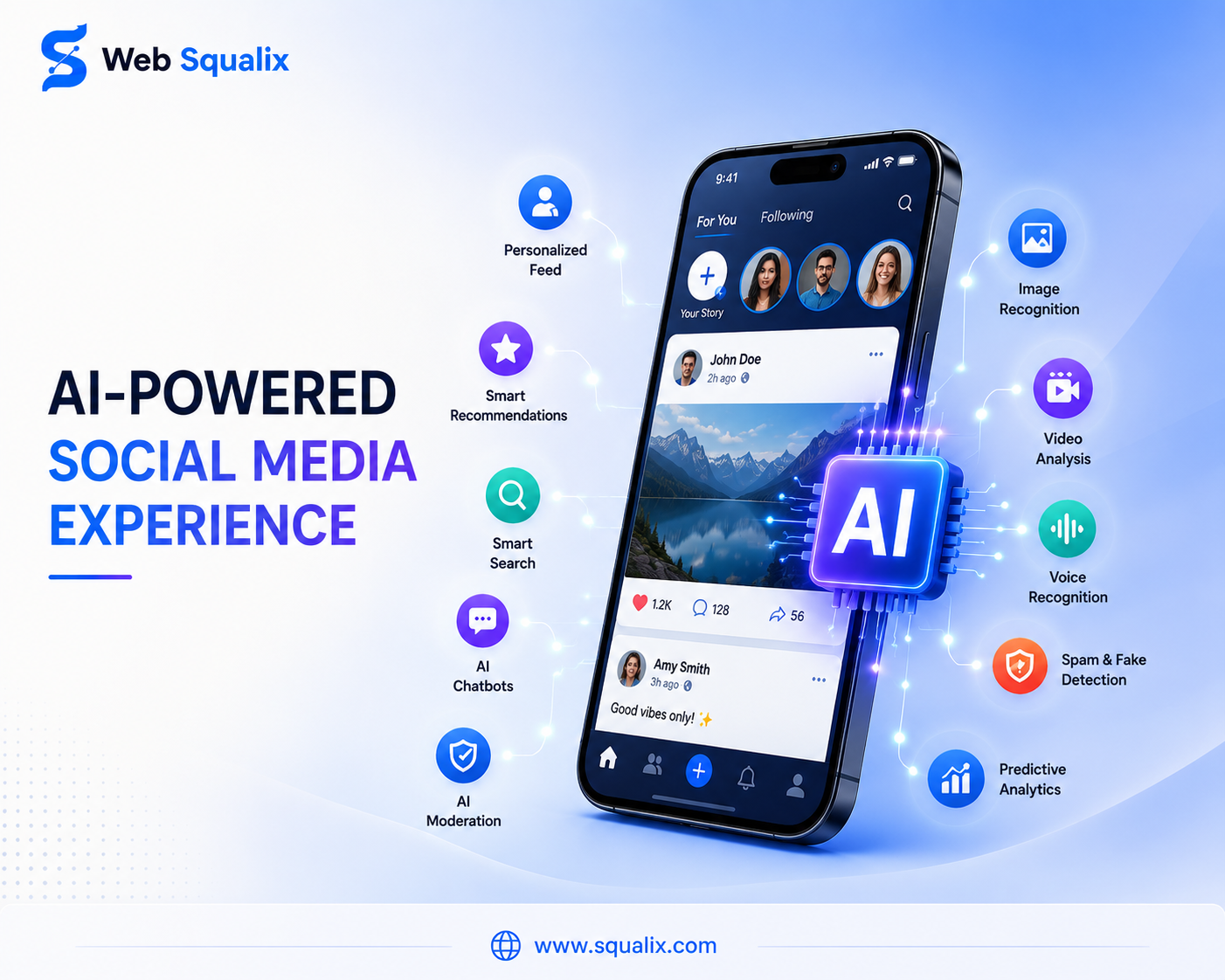
The Core AI Toolkit Behind Every Modern Feed
Strip away the marketing language and most “AI-powered” social apps are really running
three separate systems that happen to share data: one for discovery, one for safety, and one
for communication. It helps to think about them separately, because they get built, tested,
and improved in different ways.
Discovery and Personalization
● Personalized feed ranking — surfaces content based on what someone actually
engages with, not just posting time.
● Content recommendation — suggests creators and posts a user hasn’t found yet but
is likely to engage with.
● Smart search — matches intent, not just keywords, so a vague query still returns
something useful.
● Predictive analytics — flags churn risk or emerging trends before they show up in a
monthly report
Trust and Safety
● Automated moderation — screens text, images, and video against community
guidelines at a volume no team could review manually.
● Spam and bot detection — catches repetitive junk and fake engagement before it
reaches real users.
● Fake account detection — flags signup and activity patterns that look automated
rather than human.
Communication
● AI chatbots — handle onboarding and common support questions without a wait.
● Voice recognition — powers voice search and hands-free content creation.
● Smart notifications — send fewer alerts, but one’s people are actually likely to open.
How to Build an AI-Powered Social Media App
Getting from concept to working product starts on paper, not in code. The first real decision
is figuring out which AI features your audience actually cares about — a niche creator
platform and a general-purpose social network aren’t chasing the same users, so they
shouldn’t be building the same feature list. This is also where a lot of projects go sideways:
teams try to ship everything at once instead of picking a starting point, and the whole thing
stalls before it gets anywhere.
● Planning — prioritize the one or two AI features that matter most for your
audience.
● Choosing AI technologies — use established models where possible,
custom-train only where it counts.
● UI/UX — design flexible layouts that account for AI-driven, per-user variability.
● Backend — Node.js and MongoDB handle the real-time data flows and
flexible schema AI features demand.
● Security — design privacy and data protection from the start, not after launch.
● Testing — evaluate models against real-world edge cases, not just standard
QA checklists.
● Deployment — roll out AI features gradually to catch unexpected behavior
early.
● Continuous AI improvement — retrain and refine models on fresh
engagement data after launch.
Build an Ai powered social media app.
Deployment deserves its own attention. AI features often need to be rolled out gradually —
to a small percentage of users first — so teams can catch unexpected behavior before it
affects everyone. This staged approach also makes it easier to measure whether a new
recommendation model or moderation update is actually improving outcomes.
How AI Improves User Experience
Better recommendations are the most visible AI win, but the experience improvements run
deeper than the feed. Real-time personalization means the app adjusts within a single
session, not just from day to day — if someone starts engaging heavily with short videos
instead of photos, the app notices and shifts immediately.
● Intelligent notifications — fewer, more relevant alerts instead of blasting every
user equally.
● Accessibility — automatic captioning, image descriptions, and voice-based
navigation.
● Faster interactions — AI models process search and chatbot requests almost
instantly.
Intelligent notifications are a quiet but meaningful upgrade. Instead of sending every user the
same alert, AI models predict which notifications someone is actually likely to open and send
fewer, more relevant pings — cutting notification fatigue while keeping the app top of mind.
Future Trends in AI Social Media Development
The next wave of AI in social apps is already here, honestly — you can see it happening.
Generative AI has gone from a party trick to something apps actually rely on, whether that’s
writing captions on the fly or putting together entire short-form video edits. Then there’s the
stranger part: AI influencers. Fully synthetic personalities are picking up real followings now,
and the line between creator and code is getting blurrier by the month.
● AI Video Editing — automatic trimming, highlight detection, and style transfer
for creators.
● AI-powered Advertising — dynamic ad creative generated and tested per
audience segment.
● AI Shopping and Social Commerce — product discovery built directly into the
feed.
● AR + AI — filters that adapt to context using real-time scene understanding.
● Creator Economy tools — AI analytics that help creators see what content
actually converts.
● Emotion Recognition — early-stage tools that adjust content tone based on
inferred mood.
● Hyper-personalization — feeds and layouts that differ meaningfully user to
user, not just in ranking order.
AR and generative AI are converging to make social platforms feel more immersive and
personal.
Not every trend on this list will mature at the same pace, and some — like emotion
recognition — will face real scrutiny over privacy before wide adoption. But the direction is
clear: platforms are moving toward experiences that feel individually built for each user.
Conclusion
AI has stopped being a differentiator in social media app development and become a
baseline expectation. From personalized feeds to automated moderation, the platforms that
win user attention are the ones that understand their users best — and AI is what makes that
understanding possible at scale. The challenges around privacy, bias, and cost are real, but
they’re solvable with the right planning and the right team.
If you’re planning to build or upgrade a social media app, the smartest move is to bring AI
into the conversation early, not as an afterthought. Get in touch with our team to talk through
what an AI-powered social platform could look like for your business.
Learn more: https://www.squalix.com/