Education is changing faster than ever.
The traditional idea of education has usually been built around classrooms, textbooks, teachers and examinations. While these remain important, technology is creating new ways for students to learn, teachers to teach and institutions to deliver education.
In 2026, artificial intelligence, personalized learning, digital platforms, flexible education and future-focused skills are becoming increasingly important parts of the education conversation.
Students are no longer limited to learning from a single textbook or classroom. They can access online courses, educational videos, interactive platforms, digital libraries, AI-powered learning tools and global educational resources from almost anywhere.
At the same time, educators are adapting to these changes and exploring how technology can support—not replace—the human side of education.
The biggest education trend of 2026 is therefore not simply the introduction of new technology.
It is the movement toward more personalized, flexible and skills-focused learning.
AI Is Becoming a Major Part of Education
One of the biggest developments in education is the growing use of artificial intelligence.
AI tools can help students with activities such as:
- Explaining difficult concepts
- Generating practice questions
- Providing study assistance
- Summarizing educational material
- Supporting language learning
- Creating personalized exercises
- Offering feedback
- Helping organize study schedules
For students, this can create a more interactive learning experience.
Instead of reading the same explanation repeatedly, a learner can potentially ask for another explanation, a practical example or a simpler version of a concept.
However, AI also creates important challenges.
Students need to understand the difference between using AI as a learning assistant and using AI simply to complete assignments.
Education systems are increasingly focusing on responsible AI use, critical thinking and academic integrity.
Personalized Learning Is Growing
Not every student learns in exactly the same way.
Some students understand a concept quickly.
Others need additional examples or more practice.
Personalized learning aims to recognize these differences.
Digital learning platforms can potentially adapt content based on a student’s progress, strengths and areas that need improvement.
For example, a mathematics platform might identify that a student understands basic equations but struggles with advanced problem-solving.
Instead of giving the same material to every learner, the platform can provide additional practice around that specific area.
This can make education more targeted and efficient.
AI Can Support Teachers Too
The impact of AI is not limited to students.
Teachers can potentially use AI-assisted tools for:
- Lesson planning
- Creating practice material
- Generating quizzes
- Organizing educational content
- Providing initial feedback
- Adapting learning resources
- Administrative tasks
This could reduce time spent on repetitive work and allow educators to focus more on teaching, mentoring and interacting with students.
However, teachers remain essential.
Technology can provide information and assistance, but human educators understand classroom context, motivation, emotions and individual student needs in ways automated systems cannot fully reproduce.
Digital Skills Are Becoming Essential
Education is increasingly connected to the digital economy.
Students are preparing for careers that may require knowledge of:
- Artificial intelligence
- Data analysis
- Cybersecurity
- Programming
- Cloud computing
- Digital communication
- Content creation
- Automation
- Digital collaboration
This means education cannot focus only on memorizing information.
Students also need to learn how to use information and technology effectively.
Digital literacy is becoming a basic skill rather than a specialized advantage.
The Importance of Critical Thinking
As AI makes information easier to generate, critical thinking becomes even more important.
Students may be able to receive an answer within seconds, but they still need to determine:
Is the information accurate?
Where did it come from?
Does the evidence support the claim?
Could the answer contain errors or bias?
This is one of the most important skills for the AI era.
Future education will likely place greater emphasis on questioning information, evaluating sources, solving problems and forming independent conclusions.
Online Learning Continues to Expand
Online education has become an established part of modern learning.
Students can access:
- Online courses
- Video lessons
- Digital textbooks
- Virtual classrooms
- Online tutoring
- Educational communities
- Certification programmes
The advantage is flexibility.
Students can learn according to their schedules and often access educational resources from institutions and experts outside their local area.
Online learning is particularly useful for people who want to continue education while working or managing other responsibilities.
Hybrid Learning Is Becoming More Practical
The future of education is unlikely to be completely online or completely classroom-based.
Instead, hybrid learning can combine both.
Students may attend physical classes while using digital platforms for:
- Homework
- Additional practice
- Recorded lessons
- Online discussions
- Assessments
- Learning resources
This approach can provide the social benefits of classroom education while also offering digital flexibility.
Learning Is Becoming More Accessible
Technology can also help expand access to education.
Digital platforms can connect students with:
- Teachers
- Courses
- Universities
- Experts
- Educational content
This is particularly important for learners who may not have access to specialized education locally.
However, digital access itself remains a challenge.
Students need reliable internet connections, suitable devices and digital skills to benefit from online education.
Therefore, improving digital access remains an important part of making technology-driven education more inclusive.
Short-Form Learning Is Changing Study Habits
Students increasingly consume information through short videos and visual content.
This is influencing educational content as well.
Short educational videos can explain:
- Mathematical concepts
- Scientific ideas
- Historical events
- Language skills
- Technology concepts
- Exam preparation topics
Short-form learning can be useful for introducing a concept or revising information.
However, complex subjects still require deeper learning.
The best educational strategy may therefore combine short explanations with detailed study and practical application.
Microlearning Is Becoming Popular
Microlearning breaks larger subjects into smaller learning units.
Instead of studying a large topic in one session, students can learn through short modules.
For example:
10 minutes: Learn a concept
10 minutes: Practice
5 minutes: Review
This approach can make learning easier to fit into busy schedules.
Microlearning is especially useful for professional development and digital skills.
Skills-Based Education Is Growing
Another major shift is the movement from qualification-focused education toward skills-focused learning.
Degrees and certificates remain important, but employers increasingly care about what people can actually do.
Students may therefore benefit from developing practical skills such as:
- Problem-solving
- Communication
- Teamwork
- Data literacy
- Programming
- Digital marketing
- Project management
- Creativity
- Research
This is creating stronger connections between education and employment.
Education and Industry Are Becoming More Connected
Technology is changing jobs rapidly.
As industries adopt AI, automation and digital systems, education institutions need to understand which skills employers will need.
This can encourage stronger collaboration between:
Universities + Companies + Technology Providers
Students may gain opportunities through:
- Internships
- Industry projects
- Professional certifications
- Apprenticeships
- Practical assignments
- Real-world case studies
This can make education more relevant to the workplace.
The Rise of Lifelong Learning
Education is increasingly becoming something people continue throughout their careers.
A person may complete a degree and later need to learn:
- AI
- Data analysis
- New software
- Management skills
- Cybersecurity
- Digital communication
As technology changes quickly, professional skills can become outdated faster than before.
This is making lifelong learning increasingly important.
The future student may not be someone who studies for a few years and stops.
Instead, learning may become a continuous part of professional life.
Gamification Can Make Learning More Engaging
Gaming concepts are also influencing education.
Educational platforms can use:
- Points
- Levels
- Challenges
- Rewards
- Progress tracking
- Interactive activities
These features can make learning more engaging.
Gamification does not automatically make education better, but when used carefully, it can encourage students to practise and return to learning activities.
Virtual and Immersive Learning
Virtual reality and other immersive technologies are also creating new possibilities.
Imagine students learning about history by exploring a virtual historical environment.
Or studying science through a simulated laboratory.
Or learning geography by exploring a virtual representation of a different part of the world.
Immersive learning can make abstract concepts more visual and interactive.
However, cost, hardware access and content availability remain challenges.
The Role of Teachers Is Changing
Technology does not eliminate the need for teachers.
Instead, the teacher’s role may become broader.
Teachers can increasingly act as:
Educators + Mentors + Coaches + Guides
Rather than simply delivering information, teachers can help students:
- Ask better questions
- Understand difficult concepts
- Work collaboratively
- Develop confidence
- Evaluate information
- Apply knowledge
Human interaction remains one of the most valuable parts of education.
Parents Are Becoming Part of Digital Learning
Technology is also changing how parents monitor education.
Digital platforms can provide information about:
- Assignments
- Attendance
- Academic progress
- Upcoming activities
- Learning performance
This can improve communication between schools and families.
However, students also need independence.
Too much monitoring can create unnecessary pressure, so digital tools need to be used thoughtfully.
Education Needs More Focus on Wellbeing
Academic performance is important, but education is also connected to student wellbeing.
Students face pressures related to:
- Exams
- Competition
- Career decisions
- Social expectations
- Digital environments
Schools and institutions are increasingly recognizing the importance of creating environments where students can develop academically while also building confidence, resilience and healthy learning habits.
Technology should support this goal rather than create additional pressure.
The Future of Education Will Be More Personalized
The traditional classroom often provides the same lesson to a large group of students.
Future education could become more individualized.
A student could potentially have a digital learning environment that understands:
- Current skill level
- Learning speed
- Preferred learning format
- Areas of difficulty
- Progress
- Career interests
This could allow education to become more responsive to individual needs.
What Will Education Look Like in the Future?
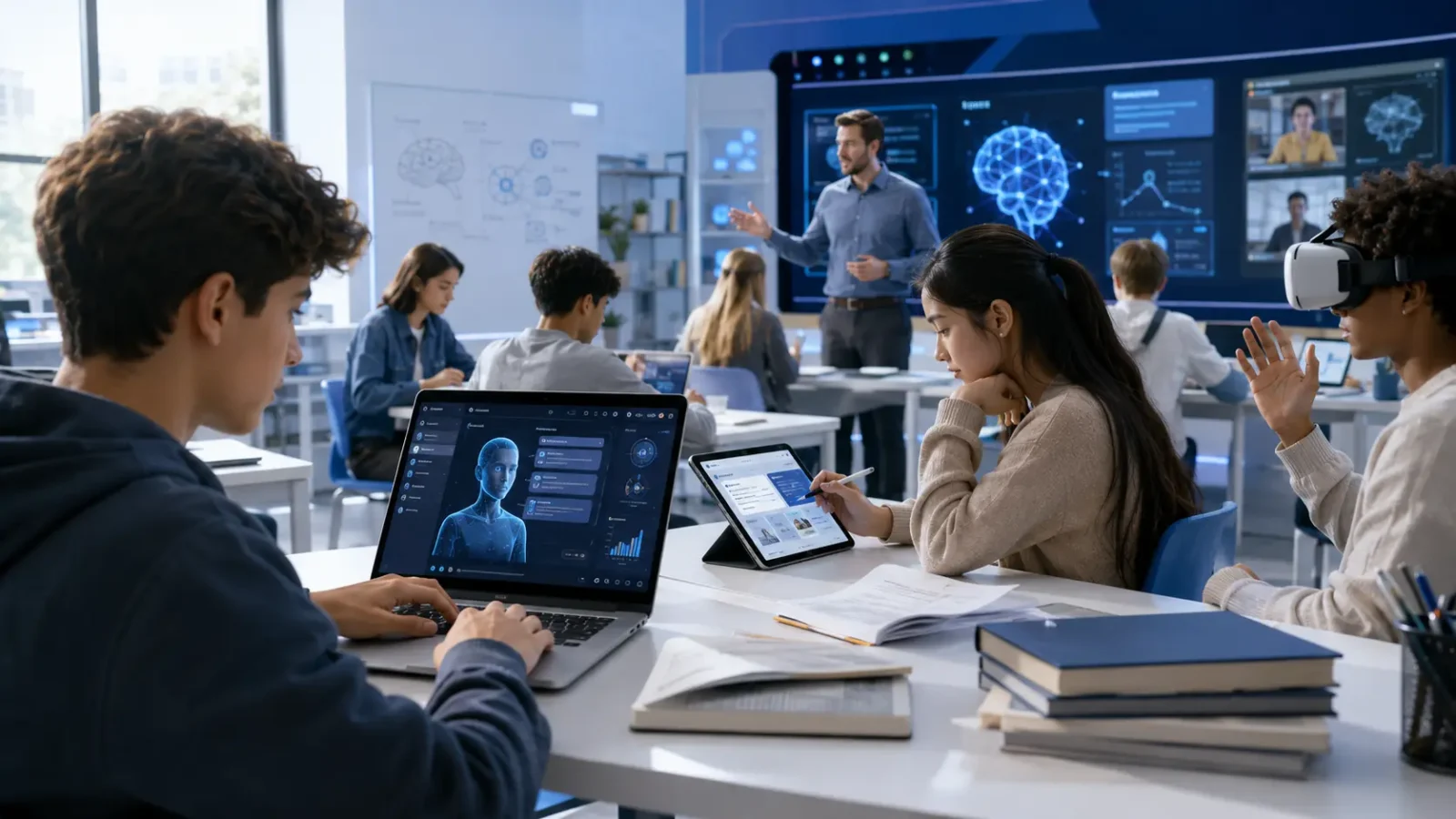
The future classroom may look very different from today’s classroom.
Students could combine:
Physical classrooms
- AI learning assistants
- Online courses
- Virtual experiences
- Personalized learning platforms
- Industry projects
- Digital certifications
This does not mean traditional education will disappear.
Instead, technology will increasingly become part of a larger learning ecosystem.
The Biggest Education Trend of 2026
The biggest education trend may not be AI alone.
It is the shift from one-size-fits-all education toward personalized and lifelong learning.
AI can support personalization.
Online platforms can provide flexibility.
Digital tools can provide access.
Teachers can provide guidance.
Industry partnerships can provide practical experience.
Together, these elements can create a more flexible education system.
Final Thoughts
Education in 2026 is becoming more digital, personalized and skills-focused.
Artificial intelligence is changing how students study and how educators prepare learning material. Online and hybrid education are providing greater flexibility. Digital skills are becoming increasingly important for future careers. Personalized learning is helping students focus on their individual needs, while critical thinking is becoming more important in a world where information can be generated instantly.
But technology is only one part of the future.
The most successful education systems will likely combine technology with human teaching, creativity, critical thinking, collaboration and emotional support.
Students will need to know not only how to find answers, but also how to question them.
They will need to learn not only specific subjects, but also how to continue learning as technology and careers change.
The future of education is therefore not simply about replacing textbooks with screens or teachers with AI.
It is about creating a learning environment where technology helps people learn better, think smarter and prepare for a rapidly changing world.
In 2026 and beyond, the most valuable education may be the kind that teaches students not just what to know, but how to learn, how to adapt and how to solve problems in the real world.