Modern businesses face a growing challenge: generating predictable revenue in an increasingly complex and data-driven environment. Sales teams work from one set of metrics, marketing teams track another, and customer success departments often operate with entirely different objectives. While each function contributes to growth, disconnected systems and siloed data frequently create inefficiencies that limit performance.
As organizations expand, these challenges become even more pronounced. Inconsistent reporting, fragmented customer information, and limited visibility into the revenue lifecycle can negatively impact decision-making and forecasting accuracy. Business leaders are increasingly recognizing that sustainable growth requires more than isolated departmental optimization—it requires alignment across the entire revenue engine.
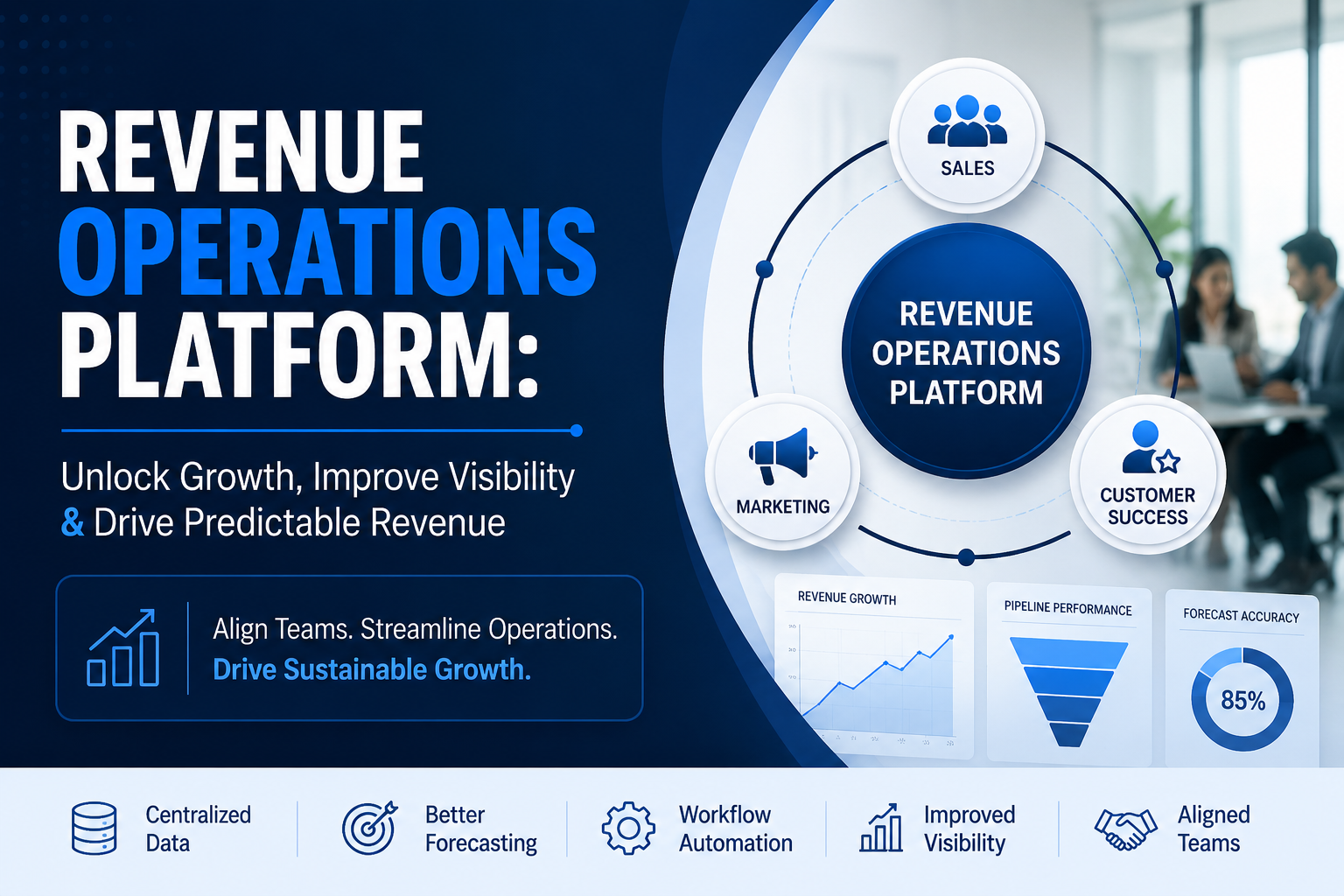
This is where a revenue operations platform becomes strategically important. By centralizing data, standardizing processes, and improving collaboration among revenue-generating teams, organizations can create a unified approach to growth. Rather than focusing on individual departments, revenue operations connects sales, marketing, and customer success around shared goals, enabling greater efficiency, improved forecasting, and stronger business outcomes.
The Evolution of Revenue Operations
Revenue operations, often referred to as RevOps, emerged as a response to growing organizational complexity. Historically, sales, marketing, and customer success operated independently, each with its own tools, processes, and performance metrics.
As digital transformation accelerated, companies began accumulating large volumes of customer and operational data. However, without a structured framework to connect these insights, organizations struggled to convert information into actionable business intelligence.
The modern Revenue Operations Platform evolved to address this challenge by creating a centralized operational foundation that supports the entire customer lifecycle.
Breaking Down Revenue Silos
One of the most significant barriers to growth is organizational silos. When departments work independently, customer information becomes fragmented and communication gaps emerge.
For example, marketing may generate qualified leads, but sales teams may lack visibility into campaign engagement data. Similarly, customer success teams may not have access to critical information gathered during the sales process.
A unified platform helps eliminate these barriers by creating a shared source of truth. Teams gain access to consistent data, standardized processes, and aligned objectives, improving collaboration across the organization.
This level of integration supports a stronger revenue operations strategy by ensuring all revenue-related functions work toward common business goals.
Improving Revenue Visibility
Revenue visibility is essential for strategic decision-making. Without a clear understanding of performance across the revenue lifecycle, leaders may struggle to identify opportunities, risks, and operational bottlenecks.
A centralized revenue operations framework provides visibility into:
- Pipeline performance
- Customer acquisition trends
- Revenue growth metrics
- Customer retention performance
- Sales cycle efficiency
- Forecasting indicators
By consolidating information from multiple departments, businesses can gain a more complete picture of overall performance and make decisions based on accurate, real-time insights.
Improved revenue visibility also enables organizations to respond more quickly to changing market conditions and customer behaviors.
Enhancing Forecast Accuracy
Forecasting remains one of the most challenging aspects of business management. Inaccurate forecasts can result in poor resource allocation, missed growth opportunities, and unrealistic business expectations.
Many forecasting challenges stem from inconsistent data sources and disconnected reporting systems.
A revenue operations platform improves forecasting accuracy by centralizing information across sales, marketing, and customer success. This creates a more reliable foundation for predictive analysis and performance planning.
When organizations have access to standardized data and consistent performance metrics, forecasts become more accurate, actionable, and trustworthy.
Better forecasting enables leaders to make informed decisions about hiring, budgeting, expansion initiatives, and long-term growth strategies.
Workflow Automation Benefits
Manual processes often consume valuable time and resources. Teams may spend hours updating records, generating reports, routing leads, or managing approvals.
Workflow automation helps eliminate these inefficiencies.
Automated processes can support:
- Lead routing
- Data synchronization
- Reporting and dashboards
- Customer onboarding workflows
- Pipeline management updates
- Task assignments
By reducing repetitive administrative work, organizations improve operational efficiency while allowing employees to focus on higher-value activities.
Automation also reduces human error, increases consistency, and accelerates business processes across revenue-generating functions.
Aligning Sales, Marketing, and Customer Success
Alignment among revenue teams is one of the strongest predictors of business performance.
When sales, marketing, and customer success operate independently, customer experiences often become inconsistent. Prospects may receive conflicting messages, and valuable customer insights may never be shared across departments.
A modern revenue operations approach promotes alignment by creating shared performance goals, standardized workflows, and unified reporting structures.
Improved sales and marketing alignment ensures that teams work together to attract, convert, and retain customers more effectively.
At the same time, stronger collaboration with customer success teams helps organizations focus on long-term customer value rather than short-term transactions.
Data-Driven Decision Making
Successful organizations increasingly rely on data to guide strategic decisions. However, access to data alone is not enough. Businesses need accurate, integrated, and actionable insights.
A revenue operations platform supports data-driven decision-making by combining information from multiple systems into a centralized environment.
Leaders can evaluate:
- Revenue trends
- Customer behavior
- Conversion rates
- Retention metrics
- Sales performance
- Marketing effectiveness
These insights help organizations identify opportunities, optimize investments, and improve overall business performance.
As business intelligence capabilities continue to evolve, organizations that leverage integrated data effectively gain a significant competitive advantage.
Supporting Scalable Growth
Scalability requires operational consistency. As businesses grow, manual processes and disconnected systems often become obstacles to expansion.
A strong revenue operations strategy provides the structure necessary to support growth while maintaining efficiency.
Standardized workflows, integrated systems, and centralized reporting enable organizations to scale without introducing unnecessary complexity.
This is particularly important for companies expanding into new markets, launching additional products, or managing larger customer bases.
Scalable operational frameworks help ensure that growth remains sustainable and manageable over time.
AI and Analytics in Revenue Operations
Artificial intelligence is rapidly transforming revenue operations.
Organizations are increasingly using AI-powered tools to improve forecasting, identify trends, optimize customer engagement, and support strategic planning.
Advanced analytics can help businesses:
- Predict customer behavior
- Identify revenue opportunities
- Detect pipeline risks
- Improve lead qualification
- Optimize resource allocation
AI-driven insights allow organizations to move beyond reactive decision-making and adopt more proactive growth strategies.
As AI capabilities continue to mature, businesses will gain access to deeper levels of analysis and predictive intelligence that support more informed decisions.
Why a Revenue Operations Platform Matters
A revenue operations platform serves as the operational foundation for modern revenue teams. Rather than treating sales, marketing, and customer success as separate functions, it creates a connected framework that aligns people, processes, and data.
This approach improves collaboration, increases revenue visibility, supports forecasting accuracy, and enables more efficient operations.
Organizations that embrace integrated revenue operations are often better equipped to respond to changing market conditions, improve customer experiences, and achieve sustainable revenue growth.
In an increasingly competitive business environment, operational alignment has become a strategic advantage rather than simply an operational improvement.
Future Trends in Revenue Operations
The future of revenue operations will be shaped by increasing automation, deeper data integration, and more advanced analytics capabilities.
Organizations are expected to place greater emphasis on predictive intelligence, real-time decision-making, and cross-functional collaboration. AI-powered forecasting, automated workflow orchestration, and enhanced performance monitoring will continue to evolve.
Additionally, businesses will likely focus on creating more connected customer experiences across the entire lifecycle, from initial engagement through long-term retention.
As digital transformation continues, revenue operations will play an increasingly central role in helping organizations manage complexity while supporting growth and innovation.
Building a Stronger Foundation for Sustainable Revenue Growth
The strategic value of a revenue operations platform extends far beyond process optimization. It provides organizations with the alignment, visibility, and operational discipline needed to navigate increasingly complex revenue environments.
By breaking down silos, improving forecasting accuracy, enhancing revenue visibility, and enabling workflow automation, businesses can create a more connected and efficient revenue engine. These capabilities support better decision-making, stronger collaboration, and improved customer experiences across the entire lifecycle.
Organizations that invest in modern revenue operations practices are better positioned to adapt to market changes, scale efficiently, and achieve long-term success. As technology, analytics, and AI continue to advance, the role of revenue operations will become even more critical.
Looking ahead, businesses that prioritize integrated operations, data-driven insights, and cross-functional alignment will be best equipped to drive sustainable growth in an increasingly competitive marketplace.
Frequently Asked Questions
What is a revenue operations platform?
A revenue operations platform is a centralized framework that aligns sales, marketing, and customer success teams by integrating processes, data, reporting, and operational workflows to support revenue growth.
How does it improve forecasting?
It improves forecasting by consolidating data from multiple revenue-generating functions, creating a more accurate and consistent foundation for predictive analysis and planning.
Why is revenue visibility important?
Revenue visibility helps organizations understand performance across the customer lifecycle, identify growth opportunities, detect risks, and make informed strategic decisions.
How does RevOps improve team alignment?
RevOps improves alignment by creating shared goals, standardized processes, centralized reporting, and consistent access to customer and performance data.
What role does AI play in revenue operations?
AI helps automate analysis, improve forecasting accuracy, identify revenue opportunities, optimize customer engagement, and provide predictive insights that support better decision-making.