Immigration paperwork can be one of the most important parts of moving to another country. A small mistake in a name, date, place, or translated statement can create confusion and may cause unnecessary delays. When official documents are written in a language different from the one required by an immigration authority, an accurate translation becomes an essential part of the process.
Translation Services help individuals, families, businesses, and organizations prepare documents for use with government agencies, educational institutions, employers, and other official organizations. For people applying for visas, permanent residency, citizenship, or other immigration benefits, professional document translation can make the paperwork easier to understand and submit correctly.
What Is Immigration Document Translation?
Immigration Document Translation is the process of converting an official document from one language into another while preserving its original meaning, details, and format as closely as practical.
Immigration-related documents can contain sensitive and important information, including legal names, dates of birth, addresses, identification numbers, marriage details, educational history, and employment information. Because these details can affect an application, accuracy is extremely important.
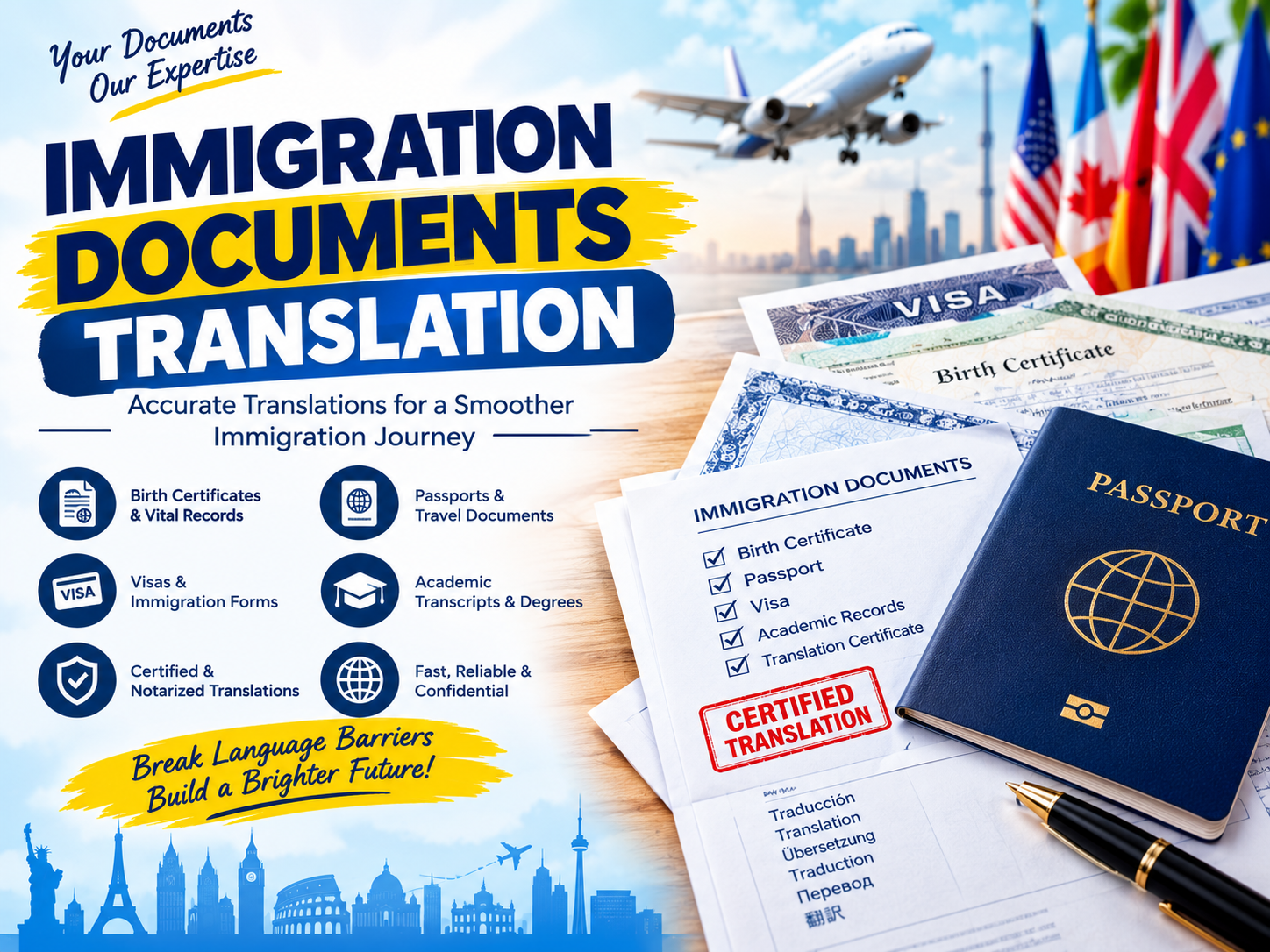
Common documents that may require translation include:
- Birth certificates
- Marriage certificates
- Divorce decrees
- Death certificates
- Passports and identification documents
- Police records
- Court documents
- Academic transcripts
- Diplomas and certificates
- Employment records
- Financial documents
- Adoption records
- Medical records
- Immigration forms and supporting documents
The exact documents required depend on the applicant’s situation and the immigration authority handling the application.
Why Accurate Translation Matters for Immigration
Immigration applications are often reviewed carefully. Government officials need to understand the information contained in supporting documents, even when those documents were originally issued in another language.
An inaccurate translation can create inconsistencies between documents. For example, a person’s name may be spelled differently on a translated birth certificate than on a passport. A date may also be converted incorrectly or a legal term may be translated without considering its actual meaning.
Professional translators understand the importance of maintaining consistency throughout the document.
Accuracy is especially important for:
- Personal names
- Dates
- Addresses
- Legal terminology
- Government titles
- Educational qualifications
- Marriage and family information
- Employment details
- Official stamps and certifications
A quality translation should communicate the original document’s information clearly without changing its meaning.
Documents Commonly Needed for Immigration Translation
Different immigration situations require different types of supporting documents. Some applicants may only need one translated document, while others may have an entire collection of records.
Birth Certificates
Birth certificates are frequently requested during immigration processes. They may be used to establish identity, age, parentage, or family relationships.
If the original birth certificate is not in the required language, a certified translation may be necessary.
Marriage Certificates
Marriage certificates can be important for family-based immigration applications. The translated version should accurately reflect the names, dates, locations, and other information shown on the original document.
Divorce Documents
Divorce decrees may be required when an applicant needs to establish previous marital status or demonstrate eligibility for a new marriage or family-based application.
Academic Records
Students and professionals may need translated diplomas, transcripts, certificates, or other academic records when applying for educational programs, professional opportunities, or immigration benefits.
Police and Court Records
Some immigration applications require criminal background information or court documentation. Because these records contain legal terminology, careful translation is particularly important.
Financial and Employment Documents
Certain applications may require evidence related to employment, income, or financial support. Depending on the circumstances, these records may also need to be translated.
What Is a Certified Translation?
A certified translation generally includes a statement from the translator or translation provider confirming that the translation is complete and accurate to the best of their knowledge and ability.
The exact certification requirements can depend on the organization receiving the translation.
For immigration purposes, applicants should carefully review the current instructions provided by the relevant government authority. A translation provider can prepare the translation and certification according to the requested format, but the receiving authority ultimately determines whether the submitted document meets its requirements.
Certification is different from notarization. A certified translation does not automatically mean that the translation has been notarized.
Certified Translation vs. Regular Translation
A regular translation may be suitable for personal understanding, websites, general communication, or informal use. Immigration documents are different because they are often submitted as part of an official application.
A certified translation typically includes additional documentation or a certification statement confirming the translator’s accuracy.
When selecting a provider, ask what is included with the completed translation and whether the format is appropriate for your intended use.
How the Immigration Translation Process Works
The process can be straightforward when the required information is available.
Step 1: Provide a Clear Copy
Start with a clear, readable copy of the document. Important information should not be cut off or hidden.
Step 2: Identify the Target Language
Tell the translator which language the document needs to be translated into.
Step 3: Explain the Intended Use
Let the provider know that the translation will be used for an immigration application. This helps them understand the importance of accuracy and certification.
Step 4: Translation and Review
The document is translated while preserving important details from the original. A review should be performed to identify spelling, formatting, terminology, and consistency issues.
Step 5: Certification
If certification is required, the appropriate certification statement can be prepared with the completed translation.
Step 6: Final Review
Before submitting your paperwork, compare the translated information with the original document. Pay particular attention to names, dates, addresses, and identification details.
How Long Does Immigration Translation Take?
Turnaround time depends on several factors, including the number of pages, language combination, document complexity, formatting requirements, and whether expedited service is available.
A simple one-page certificate may be completed much faster than a lengthy legal or academic record.
If you have an immigration deadline, it is better to start early rather than waiting until the final days before submission. This gives you time to correct any issue that may be discovered during your final review.
How Much Does Document Translation Cost?
Translation pricing can vary based on the language pair, number of words or pages, document type, formatting, certification, and turnaround time.
Some providers charge per page, while others calculate pricing based on word count or project complexity.
Before ordering, ask for a clear quote that explains what is included. If certification, formatting, notarization, or expedited delivery involves an additional fee, it should be explained beforehand.
The cheapest option is not always the best choice for an immigration document. Accuracy, experience, consistency, and proper preparation are more important than simply finding the lowest price.
How to Choose a Reliable Translation Provider
Choosing the right provider is an important step when preparing immigration paperwork.
Look for a company that:
- Works with your required language pair
- Has experience with official documents
- Understands immigration-related translation requirements
- Provides clear pricing
- Offers certification when appropriate
- Protects customer information
- Reviews translations for accuracy
- Communicates clearly about turnaround times
You should also avoid providers that make unrealistic promises about immigration approval. A translation company can prepare documents accurately, but it cannot guarantee that an immigration application will be approved.
Common Mistakes to Avoid
Several avoidable mistakes can create problems during the document preparation process.
Using an Unclear Document
A blurry or incomplete source document makes accurate translation difficult. Always provide the clearest available copy.
Inconsistent Names
Make sure names are translated or transliterated consistently across supporting documents whenever applicable.
Incorrect Dates
Different countries use different date formats. Translators should preserve the intended date information accurately.
Translating Only Part of a Document
If an authority requires a complete translation, leaving out stamps, seals, handwritten information, or other relevant content can cause problems.
Waiting Until the Deadline
Rush requests may cost more and leave little time for corrections. Start as early as possible.
Assuming Every Authority Has the Same Rules
Requirements can differ between immigration programs and government agencies. Always check the instructions associated with your specific application.
Benefits of Professional Translation
Using professional Translation Services can provide several advantages when preparing important documents.
First, it can save time. Instead of trying to interpret complicated legal or administrative terminology yourself, you can have the document prepared by someone experienced with multilingual paperwork.
Second, professional translation can improve consistency. Names, dates, terminology, and other details can be carefully checked against the original.
Third, professional assistance can help you understand what is included in the finished translation, particularly when certification is required.
Most importantly, professional preparation gives you an opportunity to catch potential document issues before submitting your application.
Final Thoughts
Immigration paperwork requires attention to detail, especially when documents are written in a language different from the one required by the receiving authority. A carefully prepared translation can help make important information clear and accessible while preserving the meaning of the original document.
Whether you are preparing a birth certificate, marriage record, academic transcript, court document, or another official record, Translation Services can help you prepare documents for their intended purpose.
For the best results, begin by checking the current requirements of the immigration authority receiving your application. Make sure you understand whether certification, notarization, or any additional documentation is required.
Most importantly, review every translated document before submission. Verify names, dates, addresses, and other personal details against the original. Taking these simple steps can help reduce avoidable errors and make your immigration document preparation more organized and straightforward.
Frequently Asked Questions
1. What is Immigration Document Translation?
Immigration Document Translation is the professional translation of documents that may be submitted as part of an immigration, visa, residency, citizenship, or related application.
2. Which documents commonly require translation for immigration?
Common examples include birth certificates, marriage certificates, divorce records, academic documents, police records, court documents, and other official records. Requirements depend on the specific application.
3. Does an immigration translation need to be certified?
It depends on the requirements of the authority receiving your application. If certification is required, the translation should include the appropriate certification documentation.
4. Can I translate my own immigration documents?
Whether a self-translated document is acceptable depends on the receiving authority’s rules. Applicants should follow the specific instructions for their application rather than assuming a personal translation will be accepted.
5. Is certification the same as notarization?
No. Certification and notarization are different processes. A certified translation generally includes a translator’s certification statement, while notarization involves a notary witnessing or verifying a signature or statement.