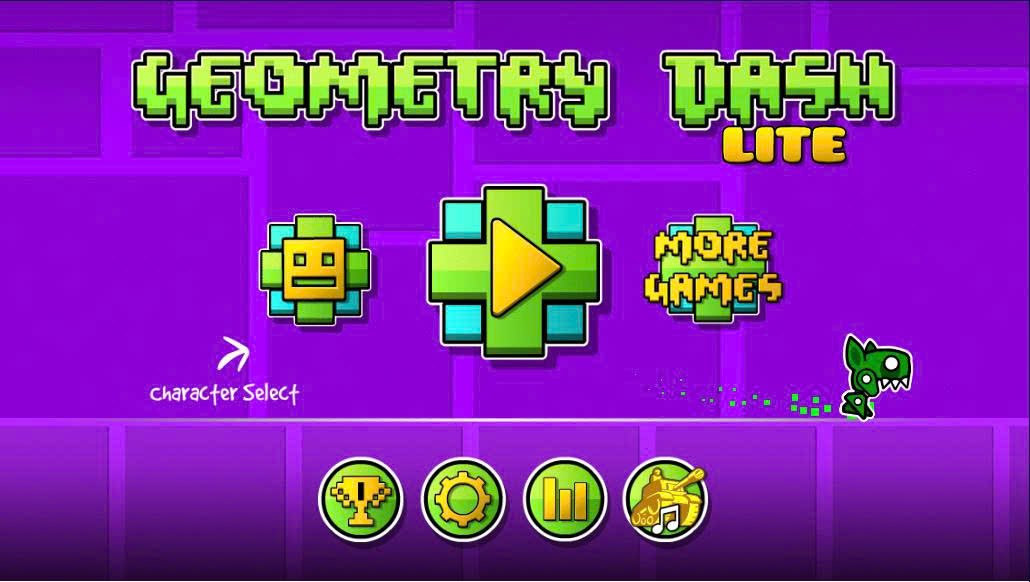
There’s a particular kind of joy in a game that asks almost nothing of you at first glance. You tap. You jump. You die. Then you tap again. Geometry Dash looks like a stripped-down mobile distraction, yet it has quietly become one of the most demanding and rewarding rhythm-action games ever made. If you’ve ever wondered why people spend hundreds of hours dying to the same thirty-second song, or if you’re considering picking it up yourself, this guide walks through how the game actually works, how to survive your first real levels, and how to make the experience fun rather than frustrating.
What You’re Actually Doing
At its core, Geometry Dash is a one-button rhythm platformer. Your square icon moves forward automatically at a fixed speed. Your only input is a tap, click, or press of the spacebar, which makes the icon jump. Hit an obstacle and you restart instantly from the beginning of the level. That’s the entire premise—and it’s deceptively brutal.
What makes it work is the marriage of music and level design. Every spike, platform, and portal is placed to sync with the beat of the soundtrack. Once you internalize that relationship, the game stops feeling like reaction-testing and starts feeling like a piece of choreography you’re learning to perform. The soundtrack isn’t background noise; it’s your timing sheet.
The main levels—Stereo Madness, Back on Track, Polargeist, and so on—escalate gradually in difficulty and introduce new mechanics: gravity portals that flip you upside down, ship sections where you fly instead of jump, ball modes where you click to switch surfaces, and speed changes that force you to re-learn rhythms you thought you had memorized. Each mode has its own feel, and each one will humble you at least once.
The Progression Loop
Here’s how a typical session flows. You pick a level, you die somewhere in the first few seconds, you learn that pattern, and you push a little further. Progress is measured in percentages displayed at the top of the screen. Seeing that number tick from 34% to 47% after twenty minutes of attempts is oddly satisfying—it’s a visible receipt for invisible effort.
Along the way you collect practice mode stars, earn orbs and diamonds in the broader game, and unlock new icons, colors, and trails. These cosmetic rewards aren’t the point, but they’re a nice excuse to keep playing when a level is grinding you down. The real currency is muscle memory.
Then there’s the community layer. Thousands of player-made levels, ranked by difficulty from Easy to Extreme Demon, are available through the online browser. Some are artistic showcases; others are sadistic gauntlets designed to be beaten by a handful of people worldwide. This is where the game’s long tail lives—and where you’ll find your next obsession.
Tips That Actually Help
Play with sound on, always. This is not negotiable. Visual cues matter, but the audio carries the rhythm that everything is built around. If you’re playing on PC, use headphones.
Use practice mode properly. Place a checkpoint, run the segment until it’s automatic, then place the next one a bit further. Don’t just spam attempts at the full level and hope. Isolating the hard parts is faster than brute-forcing the whole thing.
Learn in chunks, not wholes. A three-minute level is too much to hold in your head at once. Break it into sections of five to ten seconds and treat each as a mini-level. String them together only when each piece is solid.
Don’t chase progress when you’re tilted. Frustration makes your timing worse, and worse timing makes you more frustrated. If you’ve died twenty times in a row at the same spot, take a break—genuinely, walk away for a bit. Your hands often remember better after a rest than they do mid-tilt.
Watch a completion video when you’re stuck. There’s no shame here. Seeing the intended path through a tricky corridor can save you an hour of blind guessing, and it helps you understand where the beat falls.
Consider keyboard over touch if you have the option. A physical key gives crisper, more consistent input than a touchscreen, which matters enormously at higher speeds. Many players find the PC or desktop version much easier for this reason.
Adjust your icon and practice on easier levels. Comfort sounds silly, but a clear, high-contrast icon that you like looking at reduces visual noise during intense sections. And going back to beat an Easy level perfectly is a great warm-up before you attack something harder.
Making It Fun, Not Just Hard
The most common mistake new players make is treating Geometry Dash as a test of talent. It isn’t. It’s a test of patience and pattern recognition, and everyone—literally everyone—starts by dying constantly on Stereo Madness. The players who get good aren’t more gifted; they’re just more willing to fail the same nine seconds thirty times in a row without taking it personally.
So set realistic goals. Beat the first level. Then beat it without dying. Then move to the next one. Try a community level rated Easy. Join a Discord or forum, share a clip of your best run, and let someone tell you where your timing slipped. The social side of the game is warmer than its reputation suggests.
And if you hit a wall—if a level feels genuinely impossible—put it down and come back in a week. Distance does something to your reflexes that grinding never will.
Wrapping Up
Geometry Dash is a rare thing: a game simple enough to explain in one sentence and deep enough to swallow entire evenings. It rewards attention, punishes carelessness, and then hands you a percentage counter that makes every scrap of progress feel earned. You don’t need to be a rhythm prodigy to enjoy it. You just need to be willing to tap, die, and tap again.
Start with the main levels, keep your headphones on, and let the music teach you the timing. Before long, that impossible spike pattern will look less like chaos and more like a dance you happen to know by heart.