The demand for high-performance optical technologies is growing rapidly across industries such as telecommunications, aerospace, defense, healthcare, semiconductor manufacturing, laser technology, and scientific research. As optical systems become more powerful and precise, the performance of individual Optical Components becomes increasingly important.
Optical components are designed to control, transmit, reflect, focus, or manipulate light with a high degree of accuracy. While traditional materials continue to serve many applications, advanced materials such as synthetic diamond are gaining attention for specialized optical systems where thermal stability, mechanical strength, durability, and optical performance are critical.
What Are Optical Components?
Optical Components are precision-engineered elements used to manage the behavior of light within an optical system. Depending on their design and purpose, they can transmit, focus, redirect, filter, or modify light.
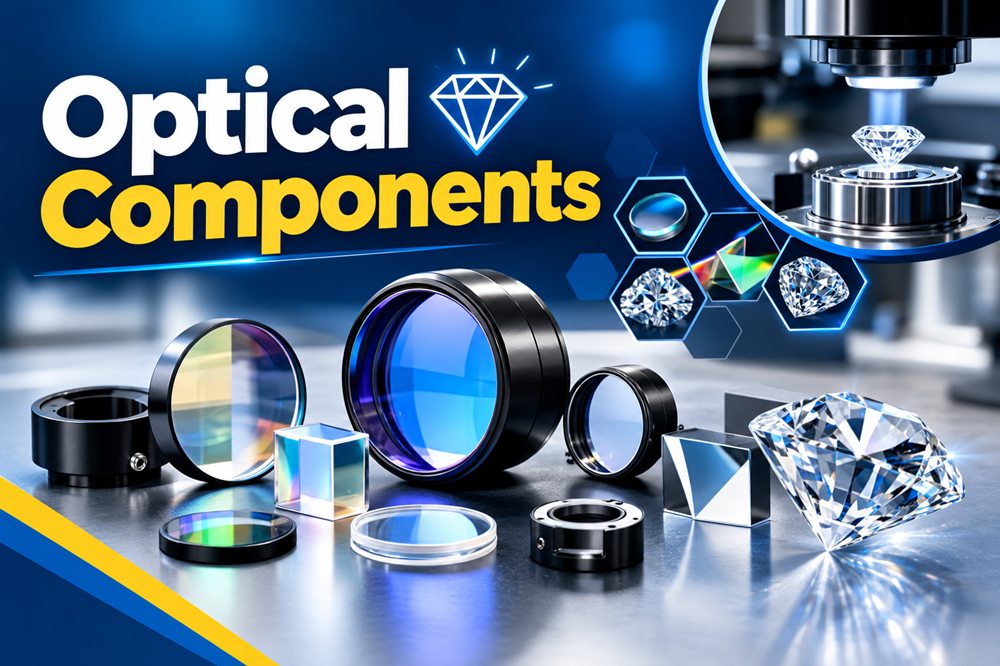
Common optical components include:
- Optical windows
- Lenses
- Prisms
- Mirrors
- Beam splitters
- Optical substrates
- Laser components
- Protective windows
- Infrared optical elements
The quality of these components directly affects factors such as light transmission, image clarity, system efficiency, alignment, and overall optical performance.
Why Material Selection Matters in Optical Components
The material used to manufacture an optical component plays a major role in determining its performance and reliability. Optical systems may operate under high temperatures, intense laser exposure, mechanical stress, vacuum conditions, or chemically demanding environments.
For these applications, the material must provide an appropriate combination of optical, thermal, mechanical, and chemical properties.
Diamond is particularly interesting for specialized optical applications because it combines high hardness, excellent thermal conductivity, chemical stability, and broad optical transmission characteristics across relevant wavelength ranges.
Diamond in Advanced Optical Components
Synthetic diamond has become an important material for specialized optical applications where conventional materials may face limitations. High-quality diamond can be manufactured and processed into components designed for demanding environments.
High Thermal Conductivity
High-power lasers and other optical systems can generate significant heat. Excessive thermal loading can affect optical alignment, component stability, and system performance.
Diamond’s high thermal conductivity allows heat to move efficiently through the material, making diamond-based optical elements valuable for applications where thermal management is a major consideration.
Exceptional Mechanical Strength
Optical components can be exposed to mechanical stress, vibration, pressure, and harsh operating environments. Diamond’s exceptional hardness provides strong resistance to scratching and wear, which can be beneficial for protective windows and other specialized components.
Optical Performance
Diamond offers useful optical transmission characteristics, including transmission across significant infrared regions. This makes it relevant to certain infrared optical systems, high-power laser applications, and sensing technologies where material transmission properties are carefully considered.
Applications of Optical Components
Advanced optical components are used in numerous industries, with performance requirements varying significantly between applications.
Laser Technology
High-power laser systems require optical components capable of managing intense energy while maintaining dimensional and thermal stability. Diamond can be considered for specialized laser windows, optical substrates, and other components where heat dissipation is important.
Aerospace and Defense
Aerospace and defense systems often operate in demanding environments involving temperature variations, vibration, pressure changes, and exposure to harsh conditions. Durable optical windows and infrared components can support imaging, sensing, targeting, and communication technologies.
Semiconductor Manufacturing
Modern semiconductor manufacturing depends heavily on precision optics for inspection, lithography-related processes, metrology, and other advanced manufacturing operations. Optical components must meet stringent requirements for accuracy, surface quality, and stability.
Telecommunications
Optical communication systems rely on components that efficiently manage and transmit light signals. Precision optical elements are essential for maintaining signal quality and supporting reliable high-speed communication infrastructure.
Medical and Scientific Equipment
Optical components are also widely used in medical imaging, diagnostic equipment, microscopy, spectroscopy, and scientific instruments. In these systems, precise control of light is essential for obtaining accurate measurements and high-quality results.
Manufacturing Precision and Surface Quality
Producing high-performance optical components requires more than selecting the right material. Manufacturing processes must provide precise dimensions, controlled geometry, high-quality surfaces, and minimal optical defects.
For diamond optical components, processes such as diamond growth, cutting, polishing, shaping, and surface finishing must be carefully controlled. Even minor imperfections can influence optical performance in precision applications.
Technologies such as Microwave Plasma Chemical Vapor Deposition (MPCVD) are used to produce synthetic diamond under controlled conditions. The ability to manage growth parameters helps manufacturers develop diamond material suited to specific engineering requirements.
Benefits of Diamond-Based Optical Components
Diamond can offer several advantages for specialized optical applications:
- Excellent thermal management for high-energy optical systems
- High hardness for improved resistance to scratching and wear
- Strong chemical stability in demanding environments
- High mechanical durability for protective applications
- Useful optical transmission across selected wavelength ranges
- Thermal stability for precision optical systems
- Potential for demanding infrared and laser applications
The exact performance depends on diamond quality, crystal structure, surface finish, component geometry, wavelength, and application-specific operating conditions.
The Future of Optical Components
The development of advanced photonics, high-power lasers, infrared sensing, quantum technologies, autonomous systems, and next-generation communication networks is increasing the need for sophisticated optical components.
As optical systems become smaller, more powerful, and more integrated, material performance will become even more important. Synthetic diamond offers an interesting combination of optical, thermal, and mechanical properties that can support the development of specialized components for demanding applications.
Continued improvements in diamond growth technologies, precision machining, polishing, and optical surface treatment are expected to expand the practical use of diamond in advanced optical engineering.
Conclusion
Optical Components are fundamental to modern technologies that depend on the controlled transmission and manipulation of light. From laser systems and telecommunications to aerospace, semiconductor manufacturing, healthcare, and scientific research, precision optical elements contribute directly to system performance.
Diamond provides a distinctive material platform for specialized optical components where thermal management, durability, mechanical strength, and optical characteristics are important. With advances in synthetic diamond manufacturing and precision processing technologies such as MPCVD, diamond-based optical solutions are becoming an increasingly relevant part of advanced photonics and optical engineering.