Education Is Entering a New Era
Education has always evolved alongside society. The classroom of 2026, however, is changing at a much faster pace.
Artificial intelligence is becoming part of everyday learning, universities are experimenting with new approaches to assessment, students are developing skills through shorter learning pathways, and educators are increasingly expected to understand technologies that did not exist in traditional teacher training.
The World Economic Forum’s 2026 report on education readiness argues that AI is transforming how people learn and access knowledge, while education systems need to make sure innovation strengthens learning, equity and trust rather than weakening them.
UNESCO has also placed AI and education at the center of its 2026 Digital Learning Week discussions, with education ministers and experts focusing on how AI should be governed while preserving human agency, learner rights and the public purpose of education.
So what does education look like in 2026?
Here are the major trends shaping the future.
1. AI Is Becoming a Learning Partner
Artificial intelligence is moving beyond experimentation.
Students can already use AI tools to explain difficult concepts, generate practice questions, summarize information, brainstorm ideas and receive personalized feedback.
The World Economic Forum reported that the share of students using AI for homework increased from 48% in May 2025 to 62% in December 2025, while many students also expressed concerns about its effect on critical thinking.
This creates an important distinction.
AI should not simply become a shortcut for completing assignments. The bigger opportunity is to use AI as a learning partner that helps students understand why an answer works.
The future classroom may therefore focus less on banning AI and more on teaching students how to question, verify and improve AI-generated information.
2. Personalized Learning Is Becoming More Practical
Traditional classrooms often require one teacher to support many students following roughly the same curriculum.
AI and learning analytics can help move toward more personalized education.
Students can receive different explanations, practice exercises and learning recommendations based on their progress.
A student struggling with mathematics, for example, could receive additional foundational exercises, while another student who understands the topic quickly could move toward more advanced problems.
This does not mean every learner needs a completely different curriculum.
Instead, technology can help educators identify where individual support is most useful.
3. Skills Are Becoming as Important as Degrees
The relationship between education and employment is changing.
Employers increasingly need people who can demonstrate practical skills, particularly in areas affected by rapid technological change.
Micro-credentials, certifications and shorter skill-based programs are therefore becoming more important.
A 2026 Coursera report found strong employer interest in micro-credentials, with 94% of surveyed employers saying they were willing to offer higher starting salaries to graduates with them.
The broader shift is toward education that can be built progressively.
A learner may complete a degree, add a data analytics credential, develop AI skills and later earn another specialized certification without starting their education journey from zero.
4. Micro-Credentials and Flexible Learning Pathways
Education is becoming less linear.
Instead of following only a traditional degree → graduation → career model, learners can increasingly combine formal education with online courses, professional certifications, workshops and micro-credentials.
Research published in 2026 describes micro-credentials as modular and stackable pathways that can support lifelong learning and workforce alignment.
This model can be especially valuable for working professionals who cannot return to full-time education every few years.
Learning can happen in smaller stages while careers continue.
5. Assessment Is Being Reimagined
Generative AI has created a major challenge for traditional assignments.
If an AI system can produce an essay, presentation or basic coding solution within seconds, simply evaluating the final output becomes less useful as a measure of what a student actually understands.
The 2026 EDUCAUSE Horizon Report notes that AI is complicating traditional assessment and that institutions are increasingly exploring authentic, process-based demonstrations of learning.
This could mean more:
- Oral presentations
- Project-based assignments
- Live problem solving
- Practical demonstrations
- Portfolio-based assessment
- Classroom discussions
- Iterative project work
- Reflection on how an answer was developed
The question is shifting from “What did the student submit?” to “What can the student actually explain and do?”
6. Critical Thinking Is Becoming More Valuable
Ironically, as AI becomes better at generating answers, human thinking becomes even more important.
Students need to know how to:
- Check information
- Identify weak arguments
- Compare sources
- Ask better questions
- Recognize uncertainty
- Challenge assumptions
- Make independent decisions
- Explain their reasoning
The OECD’s 2026 Digital Education Outlook highlights the importance of hybrid human-AI skills, including strategic AI use, critical thinking, metacognition and ethical judgment.
The goal is not simply to teach students how to use AI.
It is to teach them when they should use AI—and when they should think without it.
7. Teachers Are Becoming Even More Important
AI may automate some educational tasks, but that does not eliminate the role of teachers.
Teachers still provide context, encouragement, mentorship, classroom management, human feedback and social learning.
AI can explain a concept.
A teacher can recognize that a student has lost confidence.
AI can generate practice questions.
A teacher can understand why a student is struggling to participate.
That distinction matters.
Microsoft’s September 2026 education position similarly emphasizes that teaching and inspiring students remains a deeply human endeavor even as AI supports personalization, administration and research.
8. AI Governance Is Becoming a Core Education Issue
The conversation around AI in education is no longer only about technology.
It is also about governance.
Schools and universities need to consider questions around:
- Student privacy
- Data protection
- AI transparency
- Academic integrity
- Bias
- Safety
- Appropriate age-based use
- Teacher training
- Responsible procurement
- Human oversight
UNESCO’s September 2026 consultation specifically focuses on how education systems can maintain agency while governing rapidly spreading AI technologies.
This means AI policies are likely to become a normal part of institutional education strategy.
9. Digital Literacy Is Expanding
Digital literacy used to mean knowing how to use a computer, search the internet and work with basic software.
In 2026, the definition is much broader.
Students increasingly need AI literacy, media literacy, cybersecurity awareness, information verification skills and an understanding of how algorithms influence what they see.
Being digitally educated now means understanding not just how technology works, but also how technology affects decisions and behavior.
10. Higher Education Is Becoming More Technology-Driven
Universities are using AI across teaching, research, student support and administration.
But adoption is not happening at the same pace everywhere.
UNESCO’s 2026 higher education research found that AI adoption is spreading rapidly while institutional governance and strategies are struggling to keep up.
This creates an important challenge.
Universities cannot simply add AI tools to existing systems.
They need policies, infrastructure, staff training and clear academic expectations.
11. Learning Is Becoming More Immersive
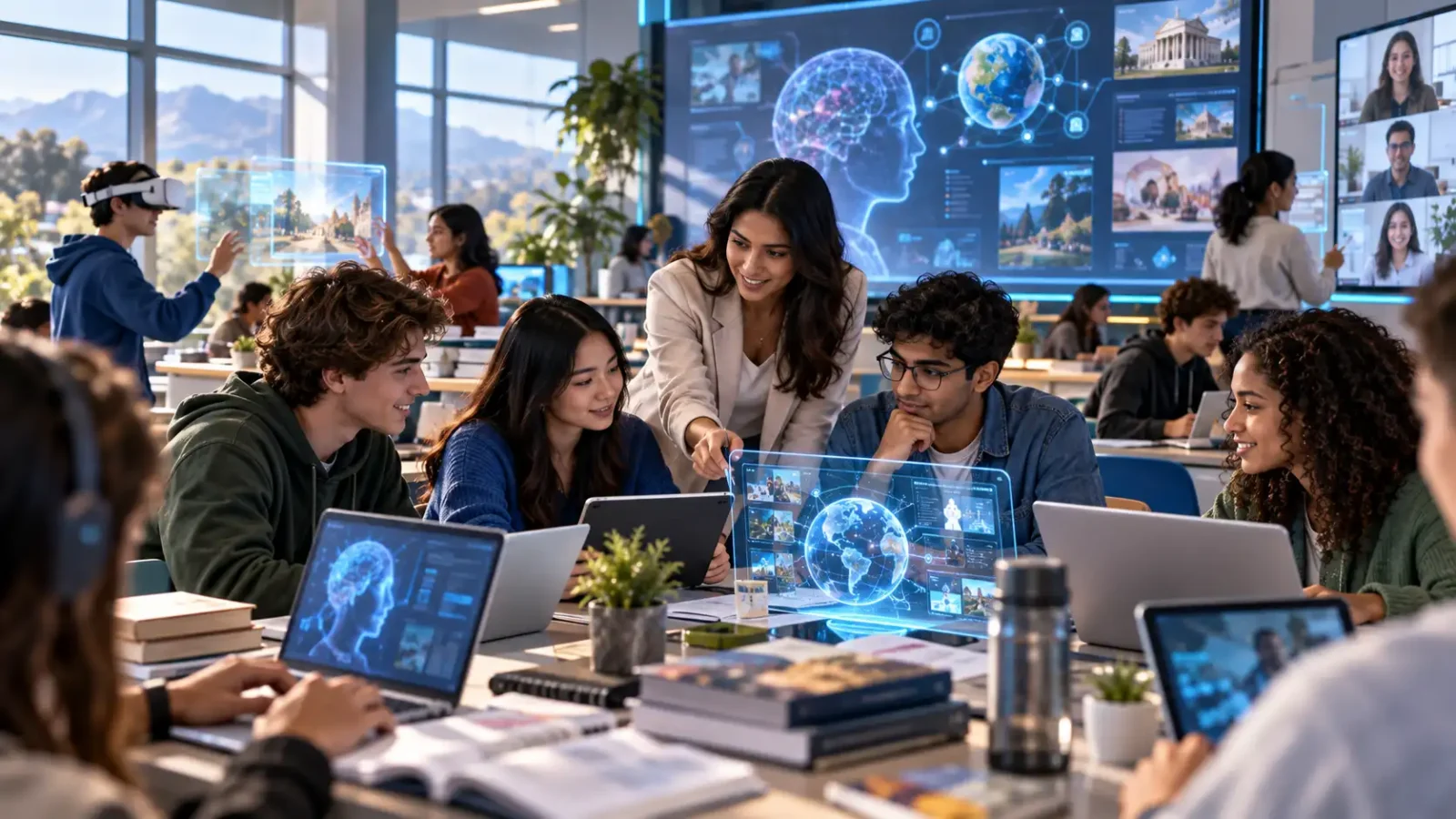
Extended reality, simulations and interactive digital environments are creating new possibilities for experiential education.
Instead of reading about a complex environment, students may eventually explore it virtually.
Medical students can practice procedures in simulated environments.
Engineering students can interact with digital models.
History students can explore reconstructed environments.
Science students can visualize processes that are difficult to observe physically.
Technology is therefore making some forms of learning more experiential rather than purely theoretical.
12. Education Is Becoming More Connected to Careers
The distance between education and employment is shrinking.
Students increasingly want to understand how what they are learning connects to real-world opportunities.
That is driving greater interest in:
- Industry projects
- Internships
- Skill certifications
- Career-focused courses
- Portfolio development
- Employer partnerships
- Practical assignments
- Professional communities
Higher education research in 2026 also points toward stronger links between institutions, industry and EdTech providers to keep curricula aligned with changing skill requirements.
13. Education Must Focus on Learning, Not Just Engagement
More technology does not automatically mean better education.
This is becoming an important lesson in 2026.
The American Psychological Association reported in September 2026 that engagement with educational technology should not be confused with actual learning. Its expert report emphasizes durable knowledge and transferable skills rather than simply measuring screen activity or immediate performance.
A visually impressive learning app can attract attention.
But the real question is:
Does the student remember, understand and apply what they learned?
That distinction will become increasingly important as AI-powered education products expand.
14. Human Connection Remains Central
One of the biggest paradoxes of AI-powered education is that technology may make human connection more valuable.
Students need teachers.
They need classmates.
They need mentors.
They need collaboration, debate and social experiences.
UNESCO’s 2026 discussions emphasize human agency and the importance of ensuring that AI serves educational purposes rather than replacing the broader social purpose of education.
The future of education is therefore unlikely to be purely digital.
It is more likely to be human-centered education supported by intelligent technology.
What Will Education Look Like in the Future?
The classroom of the future may not have one fixed format.
A student could learn through a combination of:
Teacher + AI Tutor + Digital Resources + Real-World Projects + Peer Collaboration + Skill Credentials
This creates a more flexible learning ecosystem.
Technology can personalize the experience.
Teachers can provide human guidance.
Industry can provide practical context.
Students can build portfolios that demonstrate what they can actually do.
That combination may define the next phase of education.
The Biggest Challenge: Using AI Without Losing the Learning
The biggest education question in 2026 is not whether students will use AI.
They already are.
The more important question is whether AI will help students become better thinkers or simply help them produce better-looking answers.
That distinction will shape the future of education.
Schools and universities that successfully integrate AI will need to balance innovation with critical thinking, technology with human connection, personalization with privacy, and efficiency with genuine learning.
Final Thoughts
Education Trends 2026 show a clear direction: learning is becoming more personalized, flexible, skills-focused and technology-enabled.
AI is changing how students research, practice and access knowledge. Micro-credentials are creating new pathways for professional development. Assessment is evolving toward practical demonstrations of understanding. And digital literacy is expanding into AI literacy, critical thinking and responsible technology use.
But the future of education will not be defined by AI alone.
The strongest education systems will likely be those that use technology to strengthen human learning rather than replace it.
Because even in an AI-powered classroom, the most important outcome remains the same:
Helping people learn how to think, create, solve problems and continue learning throughout their lives.
FAQs
What are the biggest education trends in 2026?
The major trends include AI-assisted learning, personalized education, micro-credentials, skills-based learning, new assessment models, digital literacy, immersive learning and stronger connections between education and employment.
How is AI changing education?
AI can support personalized learning, research, feedback, tutoring, content creation and administrative tasks. However, educators and institutions are also focusing on academic integrity, privacy, critical thinking and responsible AI use.
Will AI replace teachers?
AI can automate some educational tasks, but teachers continue to provide mentorship, context, emotional support, classroom interaction and human judgment. Current education discussions emphasize AI as a support tool rather than a complete replacement for educators.
What are micro-credentials?
Micro-credentials are shorter, skill-focused qualifications that demonstrate specific competencies. They can complement degrees and provide flexible pathways for professional development.
Why is critical thinking important in AI-powered education?
AI can generate convincing answers that may contain errors or lack context. Students therefore need the ability to evaluate information, verify sources, question assumptions and make independent judgments.
Is online learning replacing traditional classrooms?
Not necessarily. The direction of education is increasingly toward blended models that combine digital tools, online resources, classroom interaction, practical work and human guidance.
What skills will students need in the future?
Future-ready learners will need a combination of technical and human skills, including AI literacy, critical thinking, communication, creativity, problem-solving, collaboration, adaptability and ethical decision-making.