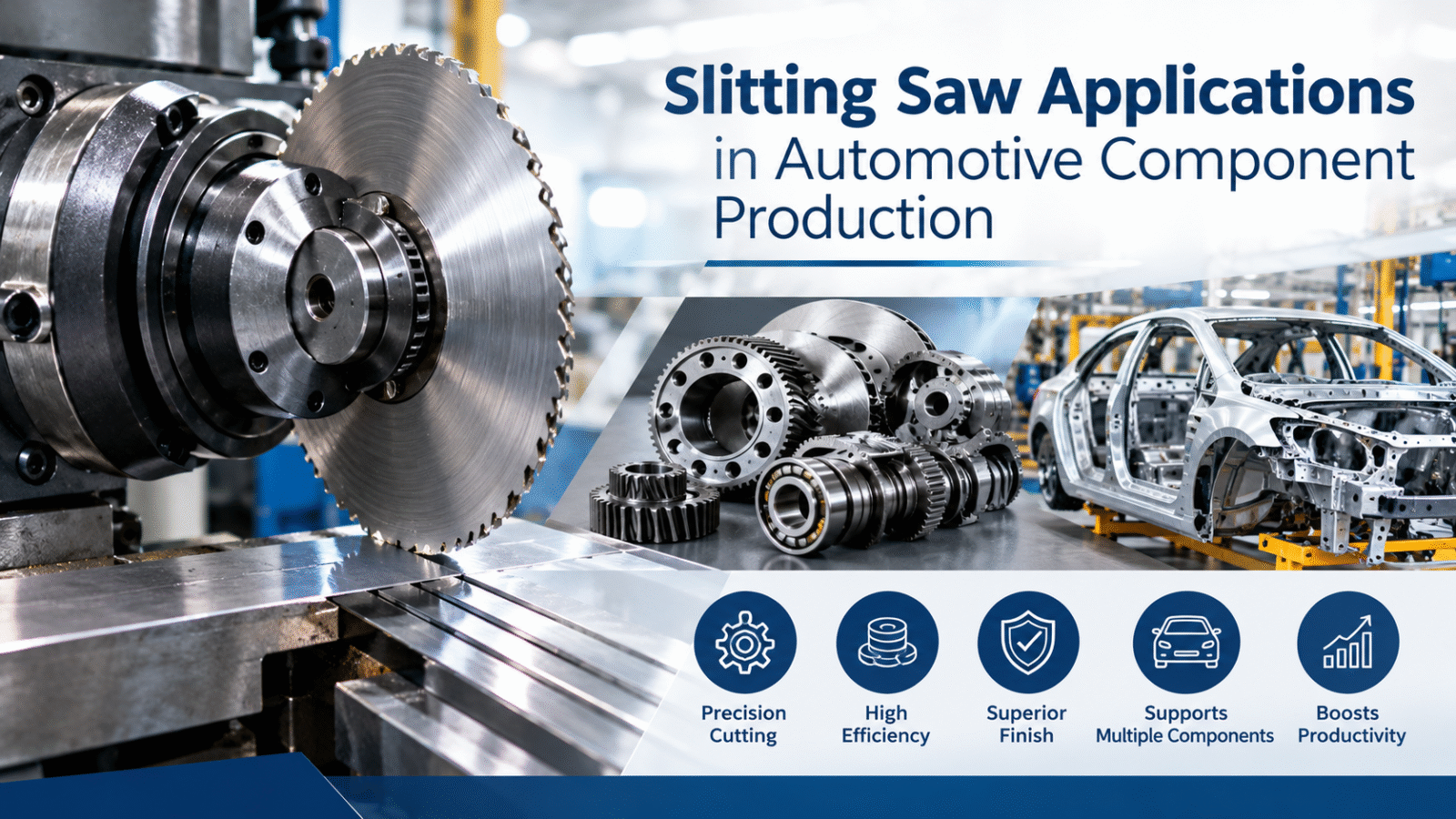
Automotive manufacturing requires precision, consistency, and efficient machining processes to produce reliable vehicle components. From engine parts to transmission assemblies, many components require narrow slots, precise cuts, and controlled material removal. A slitting saw is a useful machining tool for these applications because it can create narrow cuts and slots in metal workpieces while supporting accurate manufacturing operations. Understanding its applications, selection criteria, and operating requirements helps manufacturers improve production quality and maintain consistent results.
Understanding the Role of Slitting Saws in Automotive Manufacturing
A slitting saw is a circular cutting tool designed primarily for producing narrow slots, separating material sections, and performing specific cutting operations. Depending on its design, material, and tooth configuration, it can be used with different metals and machining setups.
Automotive components often have complex geometries and precise dimensional requirements. Manufacturers must select suitable cutting tools to achieve the required dimensions without causing excessive burr formation, deformation, or unnecessary material waste.
In suitable applications, slitting saws provide a practical solution for machining narrow features that may be difficult to produce efficiently using other tools. Their performance depends on factors such as workpiece material, blade thickness, cutting diameter, tooth geometry, machine rigidity, and operating parameters.
1. Producing Precision Slots in Automotive Components
Many automotive components require narrow slots for assembly, positioning, fastening, or functional purposes. These features can appear in brackets, mounting components, shafts, and other machined metal parts.
A slitting saw can produce these slots when the required width and depth fall within the tool’s capabilities. Its thin cutting profile helps remove material along a defined path, making it suitable for operations where controlling slot width is important.
Manufacturers should consider the workpiece material and the required dimensional tolerances before selecting a tool. Correct alignment, secure workholding, and appropriate cutting parameters also contribute to consistent results.
When these factors are properly controlled, slitting operations can become a reliable part of an automotive component production process.
2. Machining Engine and Transmission Components
Engine and transmission systems contain components that must meet specific dimensional and functional requirements. Certain parts may require narrow grooves, relief cuts, or slots to accommodate assembly features and mechanical connections.
Slitting saws can support these operations when the component geometry and machining conditions are appropriate. For example, a manufacturer may use a suitable saw to create a narrow groove in a metal component before completing additional finishing or inspection steps.
Material selection is particularly important in these applications. Aluminum alloys, carbon steels, and stainless steels can behave differently during cutting because of variations in hardness, thermal conductivity, and chip formation.
Choosing the correct tool specification and adjusting cutting conditions to the material helps reduce unnecessary wear and supports predictable machining outcomes.
3. Supporting Bracket and Mounting-Part Production
Automotive vehicles contain numerous brackets and mounting components that secure mechanical, electrical, and structural assemblies. These parts may require slots that allow positioning adjustments or provide clearance during installation.
A slitting saw can help produce such features in suitable metal workpieces. When manufacturers process repeated component designs, a consistent machining setup can support repeatability across production batches.
However, slot quality depends on more than the cutting tool alone. Workpiece clamping, machine condition, tool runout, and feed rate can all influence the finished result.
Regularly checking these variables helps manufacturers maintain dimensional consistency and reduce the need for rework. This is particularly valuable when multiple components must fit together accurately during vehicle assembly.
4. Cutting Aluminum and Steel Automotive Parts
Automotive manufacturers use a variety of materials to balance strength, weight, durability, and cost. Aluminum alloys are common in weight-sensitive components, while different grades of steel are used where strength, wear resistance, or structural performance is required.
The cutting characteristics of these materials vary significantly. Aluminum may produce long or sticky chips under certain conditions, while harder steels can increase cutting forces and tool wear.
Selecting a suitable slitting saw requires consideration of the material grade, workpiece thickness, slot dimensions, and machine capabilities. Tooth geometry and tool material should also match the intended operation.
Manufacturers should follow the tool supplier’s recommendations for cutting speed, feed rate, and coolant use. Appropriate settings help manage heat, support chip evacuation, and reduce the risk of premature tool damage.
5. Improving Production Efficiency and Material Utilization
Efficient automotive production depends on balancing machining speed with quality requirements. Tool-related delays, inconsistent cuts, and excessive scrap can affect production schedules and operating costs.
Using an appropriately selected slitting saw can help streamline specific cutting operations by producing narrow features in a controlled machining pass. However, the benefits depend on the component design, production volume, equipment, and alternative machining methods.
Manufacturers can improve efficiency by evaluating tool life, cycle time, surface quality, and the amount of material removed during each operation.
It is also important to avoid choosing a tool based on cutting speed alone. A faster process may create additional costs if it leads to frequent tool changes, poor surface quality, or dimensional inconsistencies.
A balanced approach supports reliable production while making better use of tooling resources.
6. Maintaining Cutting Accuracy and Tool Life
Maintaining tool condition is essential when machining automotive components. Repeated cutting can gradually wear the teeth, increase cutting forces, and affect the quality of the finished slot.
Operators should inspect tools for visible damage, chipped teeth, uneven wear, and other signs of deterioration. They should also monitor changes in machine sound, vibration, cutting force, and surface finish.
Correct mounting and alignment are equally important. Excessive spindle runout or an unsuitable setup can cause uneven tooth loading and reduce cutting accuracy.
Depending on the application, suitable coolant or lubrication may help control heat and improve chip removal. The correct approach should follow the tool manufacturer’s and machine manufacturer’s guidance.
A preventive maintenance schedule helps identify developing problems before they cause significant production interruptions.
7. Selecting the Right Slitting Saw for Automotive Applications
Choosing a suitable tool begins with understanding the requirements of the component being manufactured. Important factors include material composition, workpiece thickness, required slot width, cutting depth, and dimensional tolerances.
Manufacturers should also evaluate the following considerations:
-
Tool diameter: Select a diameter compatible with the machine setup and required cutting depth.
-
Blade thickness: Match the thickness to the required slot width while accounting for the cutting process and tolerances.
-
Tooth configuration: Choose suitable tooth geometry and spacing for the material and chip formation requirements.
-
Tool material: Consider the balance between wear resistance, toughness, and the characteristics of the workpiece.
-
Machine stability: Ensure the spindle, workholding, and setup provide adequate rigidity.
-
Operating parameters: Use appropriate cutting speeds, feed rates, and coolant practices.
Testing the selected tool under controlled conditions can help verify performance before introducing it into regular production.
The Importance of Reliable Industrial Cutting Tools
Automotive component production depends on a combination of appropriate tooling, stable machining equipment, skilled operators, and consistent quality control. Even a well-designed cutting tool cannot compensate for poor alignment, incorrect operating parameters, or unsuitable workholding.
Maxwell Slitter Industries works within the industrial cutting-tool sector, where tool selection and manufacturing considerations are important to achieving dependable cutting performance. Manufacturers evaluating slitting saws should consider their specific machining requirements and seek appropriate technical guidance when choosing tooling for demanding applications.
By matching the tool to the job and maintaining a consistent inspection process, production teams can improve the reliability of their machining operations.
Conclusion
Slitting saws can play a valuable role in automotive component production, particularly when manufacturing narrow slots, grooves, and other precisely defined features. Their applications may include suitable engine components, transmission parts, brackets, and mounting assemblies.
Achieving dependable results requires careful tool selection, appropriate cutting parameters, secure workholding, and regular maintenance. Manufacturers should evaluate material properties, dimensional requirements, and production conditions before choosing a cutting solution.
With a well-planned machining process and suitable tooling, automotive manufacturers can support consistent component quality, reduce avoidable rework, and maintain efficient production operations.