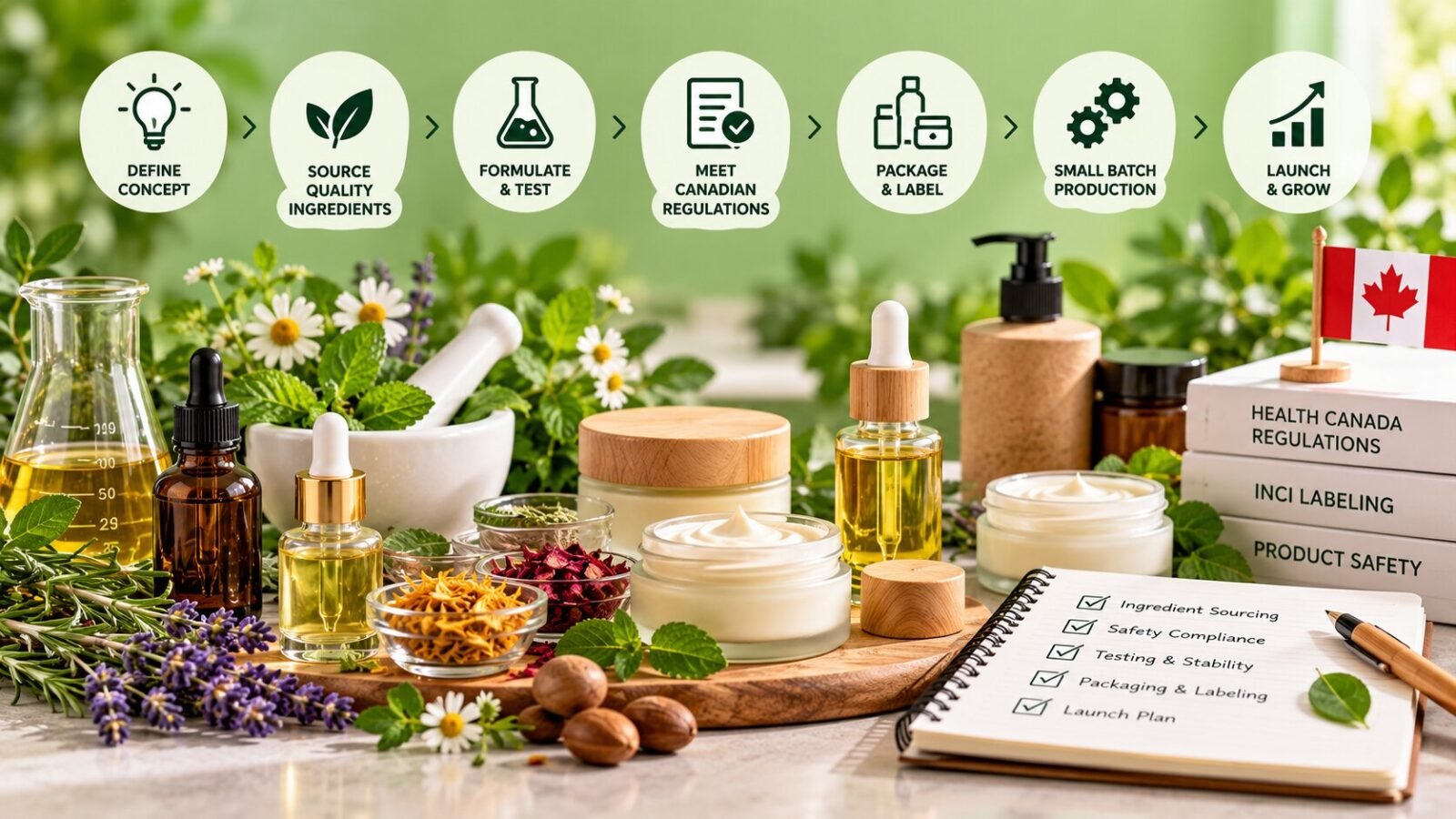
Most founders I speak with start with the same excitement: a formula that works, a name they love and a vision of the finished bottle. The harder part comes afterward. Between the kitchen-table batch and a shelf in a store sits a stretch of sourcing, safety and regulatory decisions that decide whether a brand lasts. In my experience, the founders who treat that stretch as part of the creative process, not an obstacle, are the ones who scale without costly resets.
Start With the Customer Promise, Not the Formula
Before buying a single ingredient, I ask founders to describe the product in one sentence without using the word “natural.” If the sentence falls apart, the positioning is not ready. A line such as “a fragrance-light night balm for dry winter skin” gives you a clear brief for ingredients, packaging and pricing. “A natural skincare brand” gives you none of those.
This matters for compliance as well, because what you say about a product affects how it is regulated. Health Canada generally treats cosmetics as products that cleanse, improve or alter appearance. Claims about treating a condition, such as acne or eczema, can move a product toward drug or natural health product rules, which carry a very different approval path. I recommend keeping early claims about how skin looks and feels.
Sourcing Raw Ingredients With Intent
Sourcing is where a small brand’s quality is either built or quietly compromised. I judge every supplier on three questions. Can they tell me the plant’s botanical name and country of origin? Do they provide a certificate of analysis (a lab report showing the batch’s purity and composition)? And will the next batch match the first?
Consistency is the one that surprises founders. Plant materials vary by harvest, so an essential oil that smells perfect in your sample may differ slightly in a larger order. Ask for the same lot number you sampled, and keep your own records of every batch you receive.
Local availability also saves time and risk. Buying from a domestic supplier of essential oils in Canada shortens shipping, simplifies documentation and makes it easier to resolve problems when something arrives off-spec. When your volumes grow, sourcing pure essential oils in bulk in Canada can lower your cost per unit, but I advise testing a small lot first. Cheap bulk oil that varies from order to order costs far more than it saves.
Some ingredients need extra handling. Benzoin resinoid essential oil, for instance, is a thick, sticky extract from tree resin (a resinoid is a concentrated aromatic material made from resin). It is prized for its warm, vanilla-like scent and as an aroma that lingers, but it often needs gentle warming or dilution before it blends smoothly. A newcomer who skips this step usually finds it clumped at the bottom of the batch. Niche choices such as catnip essential oil deserve similar research on safe use rates and suitability, particularly if pets share the home of your customer.
Safety Compliance: What Every Founder Must Know
Canadian law holds the manufacturer or importer responsible for safety. Three obligations come up most often.
First, check every ingredient against the Hotlist. Health Canada maintains the Cosmetic Ingredient Hotlist, which identifies substances that are prohibited or restricted in cosmetics sold in Canada. Review your full formula against it before you finalize anything, including fragrance components.
Second, notify Health Canada. Manufacturers and importers must submit a Cosmetic Notification Form within 10 days of a product’s first sale in Canada. The same source clarifies that a notification is neither an evaluation nor an approval of the product, so filing does not replace your own safety assessment. If a formula later changes, an amendment is also due within 10 days.
Third, label correctly. In practice, this means listing ingredients by their INCI names and meeting bilingual requirements. INCI refers to the standard international ingredient names, such as Butyrospermum parkii for shea butter. Plan for English and French from the start, because redesigning a label after printing is an expensive lesson.
A practical rule: treat the 10-day filing deadline as the last possible date, not the target. File before your first sale, because many retailers and distributors will ask for proof.
Preservation deserves a separate note. Products that contain water, such as lotions and toners, invite bacteria and mould, and need a properly tested preservative system. Oil-based products such as balms and body butters carry a lower risk, which is why many founders begin there. Either way, run stability testing so you know how the product behaves over its shelf life.
Testing, Batches and the Small-Business Mindset
A cosmetic business thrives on boring discipline. Assign a lot number to every batch, record every ingredient lot used, and keep samples. If a customer ever reports a reaction, those records let you act in hours instead of days. Following good manufacturing practices (basic standards for cleanliness, record-keeping and quality control) from the first batch also makes it far easier to move to a contract manufacturer later.
Scaling Without Losing Control
A founder I advised recently (I will keep details private) launched with six products and found that two of them made up almost all her revenue. Her cash was tied up in ingredients and packaging for four items nobody was buying. We narrowed the range to the two best sellers, negotiated larger orders on those inputs and reinvested the savings into marketing. Her margins improved within a single quarter.
The lesson is that scale comes from depth before breadth. In my experience, a sensible path looks like this:
- Launch one or two hero products and learn their real demand.
- Standardize your supplier list and secure backup sources for key ingredients.
- Raise batch sizes gradually, and re-test stability when you do.
- Consider contract manufacturing only when demand is steady enough to meet minimum order quantities.
- Add products only when existing ones fund the move.
Build the Business Behind the Bottle
A skincare brand is, at its core, a promise kept repeatedly. Sourcing with documentation, formulating within the rules and growing at a pace your cash flow can support protect that promise. The founders who last are rarely the fastest. They are the ones who document everything, check twice and add products only when the business can carry them.