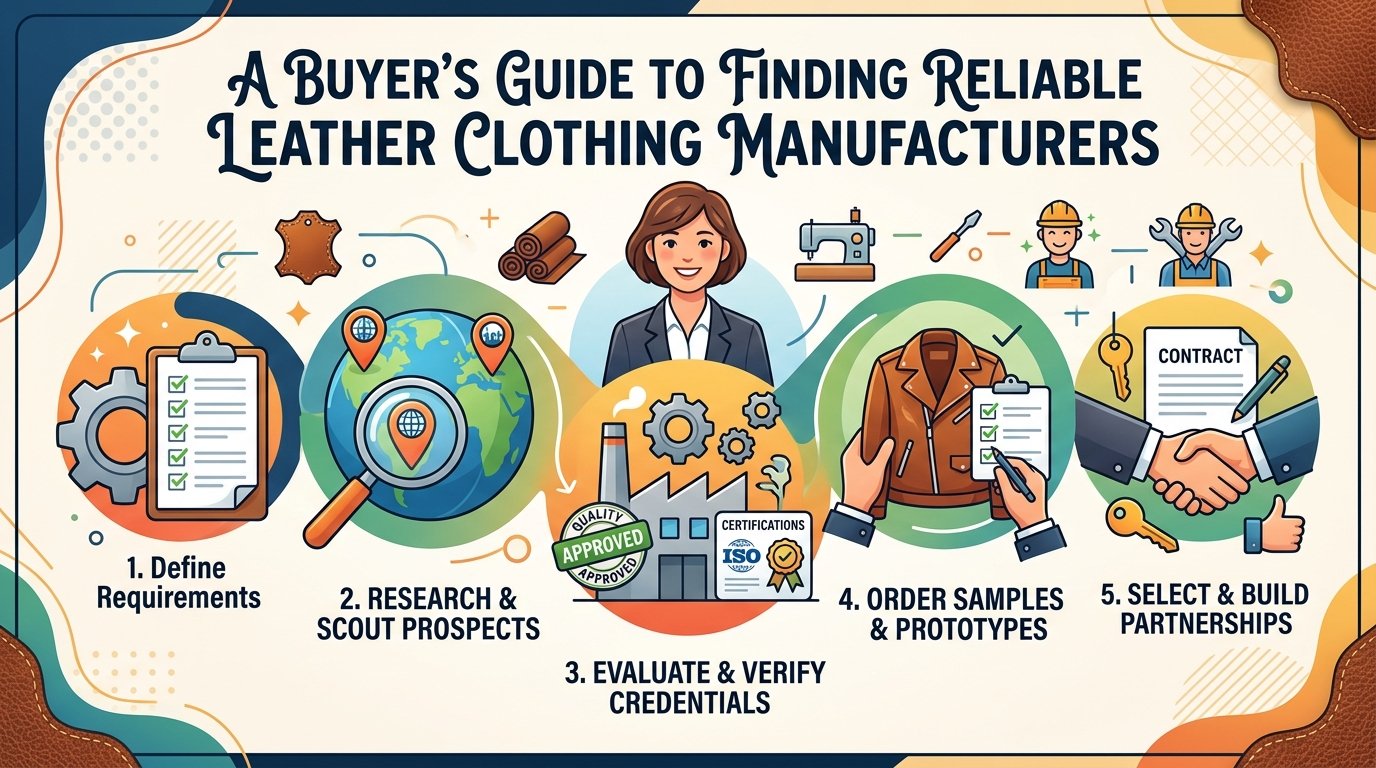
Finding the right leather clothing manufacturer can have a major impact on a fashion brand’s quality, profitability, and long-term growth. Leather garments require specialized skills that go beyond conventional cut-and-sew production. Material selection, pattern cutting, stitching, hardware installation, finishing, and quality control all need careful attention.
For brands developing a new leather collection or expanding an established apparel business, the ideal manufacturing partner should be more than a supplier. A reliable manufacturer can help translate designs into production-ready garments, maintain consistent quality, meet agreed deadlines, and scale production as demand grows.
This buyer’s guide explains the key factors to consider when evaluating leather clothing manufacturers, from material quality and sampling to production capacity, pricing, customization, and quality assurance.
Why Choosing the Right Manufacturer Matters
Leather is a natural material, so every hide can contain differences in grain, thickness, texture, color, and natural markings. Experienced manufacturers understand these characteristics and know how to position and cut leather panels to achieve an attractive and consistent finished garment.
Leather apparel also requires specialized production techniques. Jackets, coats, trousers, skirts, and vests may involve multiple layers, linings, zippers, snaps, pockets, reinforced seams, and other components. Poor construction can lead to uncomfortable garments, weak seams, damaged surfaces, or premature wear.
A dependable manufacturer should therefore demonstrate expertise throughout the product lifecycle, including:
- Leather sourcing and material evaluation
- Pattern development and technical interpretation
- Prototype and pre-production sampling
- Specialized cutting and stitching
- Hardware and lining installation
- Finishing and quality inspection
- Bulk production and repeat orders
Evaluate Leather Expertise and Product Experience
Do not assume that every garment factory has the same level of leather expertise. Ask prospective suppliers what types of leather they regularly process and whether they have experience producing products similar to your designs.
Review their previous work carefully. Examine seam alignment, stitching, panel construction, edges, zippers, lining, and overall finishing. A strong portfolio should demonstrate that the manufacturer can consistently produce the quality level your customers expect.
It is also useful to determine whether product development is handled internally. A manufacturer with pattern-making and sampling expertise can often identify construction issues before they become expensive production problems.
Check Leather Quality and Material Sourcing
The quality of the raw material directly affects the appearance, durability, and perceived value of a leather garment. Before approving production, establish detailed material specifications covering leather type, thickness, finish, color, texture, and acceptable natural variation.
Ask suppliers where their leather comes from and whether they can maintain consistent material availability for repeat orders. This is particularly important for brands that expect to replenish successful products or produce multiple seasonal collections.
Buyers should also understand that natural leather variation is not necessarily a defect. Instead of demanding completely identical hides, define which characteristics are acceptable and which represent unacceptable quality issues.
Consider Broader Leather Product Capabilities
A manufacturer capable of producing multiple leather categories can offer useful opportunities for fashion brands seeking to expand their product range. Apparel can be complemented by travel products, handbags, wallets, and other accessories that reinforce a consistent brand identity.
For example, brands developing a broader lifestyle collection can explore wholesale Leather duffle bags as complementary products alongside jackets and other leather garments.
Working with a supplier that understands several product categories can simplify vendor management and make it easier to coordinate materials, colors, hardware, and finishing details. However, buyers should confirm which processes are actually performed by the manufacturer and which are outsourced.
Pay Close Attention to Sampling
The sampling process is one of the clearest indicators of manufacturing professionalism. A reliable supplier should have a structured method for turning your design concept and technical specifications into a production-ready sample.
Your technical package should communicate measurements, construction details, leather specifications, lining, hardware, labels, stitching, and packaging requirements as clearly as possible. Once the first sample is produced, inspect it carefully rather than approving it based only on appearance.
- Submit complete technical specifications and reference materials.
- Review the manufacturer’s interpretation before production begins.
- Inspect the prototype for measurements, construction, materials, and finishing.
- Wear-test the garment for comfort, movement, and fit.
- Document required corrections and review the revised sample.
- Approve a final sample before authorizing bulk production.
Testing a garment through movement is especially important. Sitting, bending, walking, reaching, and layering can expose fit or construction problems that may not be visible during a basic visual inspection.
Review Customization Options
Customization allows brands to create products that are clearly differentiated from generic catalog merchandise. Depending on the supplier, customization may include leather colors, linings, hardware, labels, stitching, pockets, silhouettes, embossing, and proprietary patterns.
Accessory customization can also help create a complete brand ecosystem. A clothing label adding handbags to its collection, for instance, may investigate custom Leather purses wholesale solutions that complement its apparel designs.
Always ask about minimum order quantities for customized products. Some manufacturers offer extensive customization but require large production volumes. Others provide more flexible quantities that allow emerging brands to test new concepts before making a substantial investment.
Examine Quality Control Procedures
Quality control should take place throughout production, not only when finished goods are packed. Problems discovered during cutting or assembly can often be corrected before they affect an entire production run.
| Quality Area | What to Check | Why It Matters |
|---|---|---|
| Leather | Thickness, finish, color, texture, and acceptable markings | Controls appearance and durability |
| Cutting | Panel accuracy and material utilization | Supports consistent fit and reduces waste |
| Stitching | Seam alignment, thread tension, and stitch consistency | Protects structural strength |
| Hardware | Zippers, snaps, buckles, and buttons | Ensures reliable function and presentation |
| Finishing | Edges, lining, loose threads, and surface marks | Creates the final customer impression |
Before production starts, agree on inspection standards and defect tolerances. The approved sample should serve as a practical reference for evaluating bulk inventory.
Compare Capacity, Lead Times, and Pricing
A manufacturer may produce excellent samples but still lack the capacity required for commercial orders. Ask about production capacity, current commitments, peak-season constraints, minimum order quantities, and typical lead times.
Make sure quoted lead times are clearly defined. Determine whether they include material sourcing, sampling, production, inspection, and preparation for shipment. A realistic timeline is much more valuable than an attractive promise that cannot be maintained.
Price should also be evaluated carefully. The lowest unit quotation does not necessarily represent the lowest overall cost. Poor quality, delayed deliveries, defects, rework, and customer returns can quickly eliminate apparent savings.
When comparing quotations, confirm what is included in the price. For brands expanding into small leather goods, volume purchasing can also support broader product strategies. Options such as bulk leather wallets may provide complementary products that increase average order value without introducing garment sizing requirements.
Assess Communication and Compliance
Good communication is essential because leather manufacturing involves numerous decisions. Specifications may need clarification, samples may require revisions, and materials or production schedules can change.
Pay attention to how a supplier communicates during the evaluation process. Reliable manufacturers should answer technical questions clearly, identify potential production challenges, and provide documentation for approvals.
Brands should also consider applicable workplace, product, labeling, material, and environmental requirements in their target markets. Ask suppliers what relevant documentation or compliance procedures they can provide and make sure requirements are agreed upon before production begins.
Watch for Manufacturing Red Flags
Certain warning signs should encourage additional due diligence before placing an order:
- Unclear material specifications or sourcing information
- Samples containing obvious unresolved defects
- Unrealistic production promises
- Large unexplained price changes
- Poor communication during technical discussions
- No clearly defined quality-control process
- Unclear sample-approval procedures
- Limited evidence of relevant leather production experience
One issue may not automatically disqualify a supplier, but several warning signs together can indicate significant supply-chain risk.
A Practical Process for Selecting Your Supplier
Once you have identified potential leather clothing manufacturers, use a structured selection process rather than choosing based on price or a single attractive sample.
- Create a shortlist: Remove suppliers that cannot meet your product, quality, volume, or compliance requirements.
- Request comparable quotations: Give each manufacturer the same specifications so prices can be evaluated fairly.
- Develop samples: Test materials, fit, construction, hardware, and finishing.
- Perform due diligence: Review capacity, communication, quality procedures, and relevant documentation.
- Start with a controlled order: Use an initial production run to verify commercial-scale consistency.
- Track performance: Measure defects, delivery accuracy, responsiveness, and repeat-order quality.
Frequently Asked Questions (FAQs)
What should I look for in a leather clothing manufacturer?
Look for proven leather expertise, strong sampling capabilities, consistent quality, reliable communication, realistic lead times, suitable production capacity, customization options, and transparent pricing.
Why is sampling important before bulk production?
Sampling allows buyers to verify fit, leather quality, construction, hardware, lining, and finishing before committing to a large production run.
Can leather manufacturers produce accessories as well as clothing?
Some manufacturers have capabilities across both apparel and leather accessories, while others specialize in specific categories. Always verify the supplier’s actual production capabilities.
Should I choose the manufacturer with the lowest price?
Not necessarily. Consider total value, including quality, consistency, delivery reliability, defect rates, communication, and the manufacturer’s ability to support future orders.
Build a Reliable Leather Supply Chain
Choosing a leather manufacturer is ultimately about creating a dependable production foundation for your brand. The right partner should combine material knowledge, craftsmanship, quality control, communication, and scalable production capabilities.
By carefully evaluating suppliers before placing a major order, brands can reduce manufacturing risk while building a stronger foundation for future collections. A thoughtful sourcing process can turn a manufacturing relationship into a genuine competitive advantage, supporting consistent product quality and sustainable brand growth.