Heavy-duty construction projects require fastening solutions that can handle substantial loads, vibration, weather exposure, and long-term structural demands. Anchor Bolts are among the most important components used to connect structural elements securely to concrete foundations. From steel columns and industrial equipment to bridges and infrastructure systems, these fasteners help create stable and dependable connections.
Unlike ordinary bolts that typically connect two or more components, anchor bolts are designed to secure structures or equipment to concrete. Their performance depends on factors such as material strength, bolt size, embedment depth, installation method, foundation condition, and environmental exposure.
Choosing the right type is therefore an important part of construction planning. The following guide explains the major types of anchor bolts and their applications in heavy-duty construction.
What Are Anchor Bolts?
Anchor bolts are threaded fasteners used to connect structural components to concrete foundations or other supporting materials. They generally contain a threaded portion for attaching a nut and washer, while the anchored end provides resistance against forces acting on the connection.
These fasteners can be installed during concrete construction or added after the concrete has cured, depending on the anchoring system being used.
A properly designed connection helps transfer loads from the supported structure into the foundation. This can include:
- Tensile loads
- Shear loads
- Compression-related forces
- Wind loads
- Equipment vibration
- Dynamic loads
- Structural movement
The specific design must be selected according to engineering requirements rather than simply choosing the largest available bolt.
Why Anchor Bolts Matter in Heavy-Duty Construction
Heavy-duty structures are often exposed to forces that ordinary construction components may not encounter. A large steel column, for example, may need to withstand building loads, wind forces, vibration, and other stresses throughout its service life.
Anchor bolts help secure the base of such structures and maintain the connection between steel components and concrete foundations.
They can also make installation more practical. Structural steel members can be positioned over accurately placed anchor bolts and secured with nuts and washers, creating a strong connection between the structure and foundation.
The quality of the complete connection matters. Even a high-strength bolt may not perform properly if the concrete, embedment, alignment, or installation procedure is inadequate.
Major Types of Anchor Bolts
Different construction requirements call for different anchoring designs. Understanding the available types makes it easier for engineers and contractors to select a suitable solution.
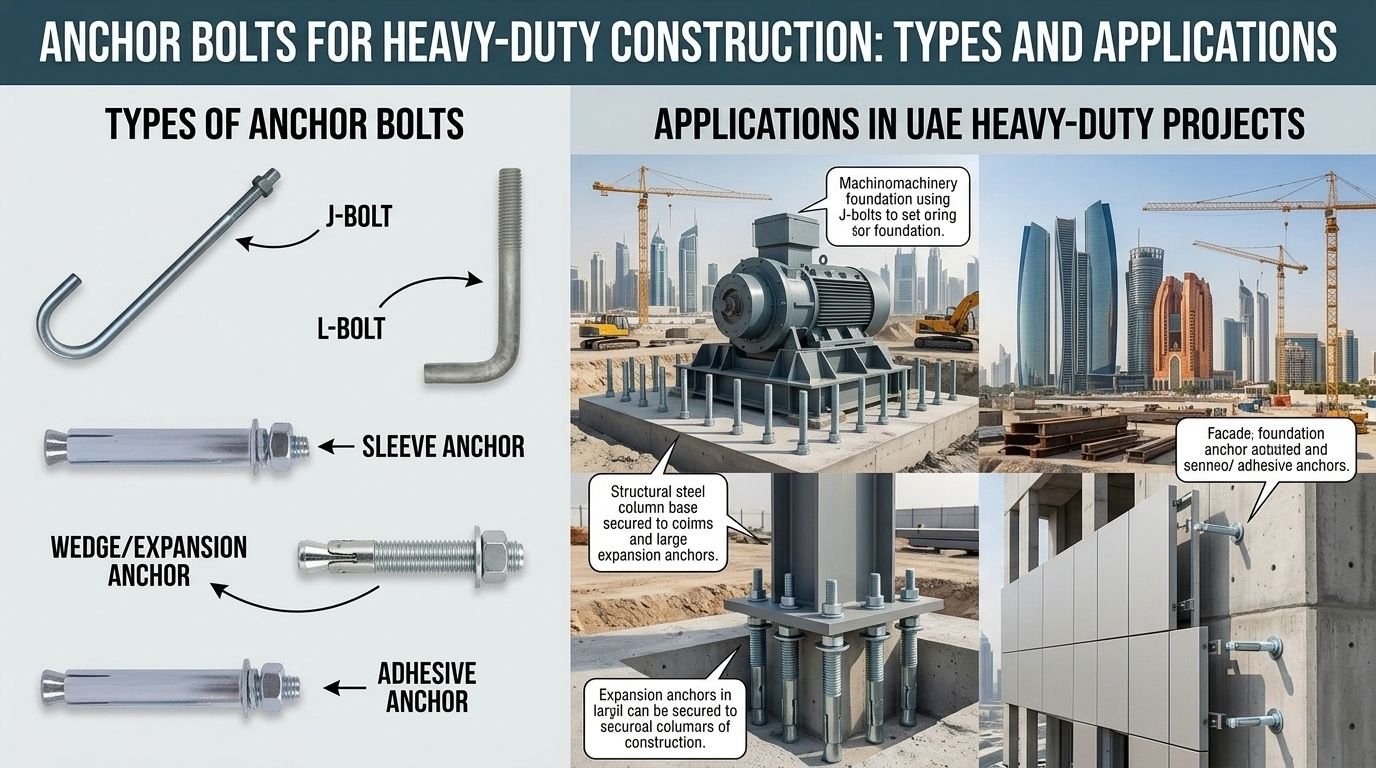
L-shaped Anchor Bolts
L-shaped anchor bolts are among the traditional designs used for securing structural components to concrete.
The bent section provides mechanical anchorage inside the concrete while the threaded section remains exposed for connection to a base plate or structural member.
These bolts are commonly used for:
- Steel columns
- Structural frames
- Equipment foundations
- Base plates
- Industrial structures
Their simple design makes them practical for many construction applications.
J-shaped Anchor Bolts
J-shaped anchor bolts use a curved lower section to provide anchorage within concrete.
Like L-shaped designs, they are often installed before concrete is poured. The exposed threaded portion allows structural components to be secured after the concrete has reached the required strength.
They can be useful for foundation connections where the shape and embedment arrangement suit the project design.
Straight Anchor Bolts
Straight anchor bolts have a relatively simple cylindrical form with threading on the exposed end. Anchorage can be achieved through a plate, nut, sleeve, or other specified arrangement depending on the design.
They are used in various industrial and structural applications where a straight configuration is suitable.
The main advantage is their straightforward geometry, which can simplify manufacturing and installation.
Headed Anchor Bolts
Headed anchor bolts feature an enlarged head at one end. The head becomes embedded in concrete and provides mechanical resistance against pullout.
These fasteners are widely used for structural connections where dependable anchorage is required.
Headed designs can be found in:
- Structural steel foundations
- Heavy equipment bases
- Industrial buildings
- Infrastructure projects
- Concrete-to-steel connections
Expansion Anchors
Expansion anchors are generally installed into hardened concrete. When the anchor is tightened or activated, an expansion mechanism engages with the surrounding concrete.
These systems can be useful when anchoring must take place after concrete construction has been completed.
They are often used for attaching:
- Steel supports
- Machinery
- Handrails
- Equipment
- Brackets
- Secondary structural components
The suitability of an expansion anchor depends on concrete strength, edge distance, hole dimensions, load requirements, and installation conditions.
Chemical Anchors
Chemical anchoring systems use a bonding compound to secure a threaded rod or anchor element inside a drilled hole.
They can be particularly useful for retrofit work or situations where cast-in-place anchoring wasn’t completed during the original concrete installation.
Chemical anchoring can provide strong connections when the correct adhesive system, hole preparation, embedment depth, curing time, and installation procedure are followed.
Applications of Anchor Bolts in Heavy Construction
Anchor bolts are used across many industries because structural connections are essential to modern construction.
Steel Building Construction
Steel buildings rely heavily on connections between columns and concrete foundations. Anchor bolts are installed in foundation systems to secure column base plates.
Accurate positioning is particularly important because incorrectly positioned bolts can make steel column installation difficult.
They can be used in:
- Warehouses
- Manufacturing plants
- Commercial buildings
- Industrial facilities
- Large storage structures
Industrial Equipment Foundations
Heavy machinery needs stable foundations. Equipment movement and vibration can create repeated forces that affect connections.
Anchor bolts can secure equipment bases to concrete foundations and help limit unwanted movement.
Applications include:
- Pumps
- Compressors
- Generators
- Motors
- Processing equipment
- Industrial skids
For these applications, engineers need to consider both the static weight of the equipment and dynamic forces generated during operation.
Oil and Gas Facilities
Oil and gas facilities contain extensive steel structures, processing equipment, pipe racks, storage systems, and support platforms.
Anchor bolts may be used to connect these components to concrete foundations.
Petrofast Middle East FZC supplies industrial fastening solutions for applications where dependable connections and suitable material specifications are important across demanding industrial environments.
Bridges and Infrastructure
Infrastructure projects can involve substantial structural loads and environmental exposure. Anchor bolts may be used in various support and connection systems depending on the engineering design.
Applications can include:
- Bridge components
- Road infrastructure
- Sign structures
- Utility structures
- Industrial platforms
- Transportation facilities
For infrastructure projects, long-term durability and corrosion resistance can be especially important.
Choosing the Right Anchor Bolts
Selecting the correct anchor bolt requires careful consideration of the complete application.
Consider the Load Requirements
Engineers should determine the expected loads before selecting a fastener. Tensile, shear, bending, and combined forces may all influence the design.
The anchor should have adequate capacity for the intended application, while the concrete and surrounding foundation must also be capable of supporting the connection.
Select the Correct Material
Material selection affects strength, durability, and corrosion resistance.
Common choices may include:
- Carbon steel
- Alloy steel
- Stainless steel
- Galvanized steel
High-strength alloy steel can be appropriate for demanding structural applications, while corrosion-resistant materials or protective coatings may be necessary in aggressive environments.
Check Bolt Dimensions
Diameter and length are critical considerations. The bolt needs to provide sufficient anchorage while also allowing appropriate thread engagement.
Important dimensional factors include:
- Bolt diameter
- Overall length
- Thread length
- Embedment depth
- Thread pitch
- Washer dimensions
- Nut compatibility
Incorrect dimensions can compromise installation and connection performance.
Importance of Corrosion Protection
Construction structures may operate outdoors or in environments where moisture, chemicals, salt, and temperature changes are present.
Corrosion can gradually reduce the effective strength and service life of steel fasteners. Appropriate protection is therefore an important consideration.
Depending on project requirements, options may include galvanizing, protective coatings, stainless steel, or other corrosion-resistant materials.
The correct solution depends on the environment and applicable project specifications.
Proper Installation of Anchor Bolts
Installation has a direct impact on the performance of an anchoring system.
For cast-in-place bolts, positioning must be accurate before concrete placement. Templates can help maintain the required spacing and alignment.
For post-installed anchors, drilling must follow the manufacturer’s specified hole diameter and depth. Dust and debris should be removed according to the approved installation procedure.
The connection should then be tightened according to the specified requirements.
Proper installation generally involves:
- Checking the foundation condition.
- Confirming anchor locations.
- Verifying bolt dimensions.
- Maintaining proper alignment.
- Following the specified embedment depth.
- Using compatible nuts and washers.
- Applying the required tightening procedure.
- Inspecting the completed connection.
A good installation process can prevent avoidable problems later.
Common Problems to Avoid
Even quality anchor bolts can experience performance issues when they’re incorrectly specified or installed.
Some common problems include:
- Incorrect bolt positioning
- Insufficient embedment
- Inadequate concrete strength
- Improper hole preparation
- Incorrect tightening
- Poor corrosion protection
- Damaged threads
- Using incompatible nuts
- Ignoring environmental conditions
These issues can affect structural stability and may result in expensive corrective work.
Quality and Standards
Heavy-duty construction projects often require fasteners to meet specific technical standards and project specifications.
Depending on the application, specifications may reference ASTM, ISO, ASME, EN, or other recognized standards.
Quality control may include:
- Dimensional inspection
- Material verification
- Mechanical testing
- Hardness testing
- Thread inspection
- Coating inspection
- Material certificates
- Batch traceability
Purchasing teams should ensure that the supplied fasteners match the project’s approved specifications.
Anchor Bolts vs. Ordinary Bolts
Although both are threaded fasteners, anchor bolts and ordinary structural bolts perform different functions.
| Feature | Anchor Bolts | Ordinary Bolts |
|---|---|---|
| Main purpose | Connect structures to foundations | Connect components together |
| Typical installation | Concrete foundation or substrate | Pre-drilled holes in components |
| Anchorage | Embedded or mechanically/chemically anchored | Nut and bolt connection |
| Common applications | Columns, foundations, equipment | Steel assemblies and mechanical connections |
| Load transfer | Structure to foundation | Component to component |
Understanding this distinction helps prevent the wrong fastening solution from being selected for a project.
Benefits of Using High-Quality Anchor Bolts
High-quality anchor bolts can provide several advantages when correctly designed and installed.
Improved Structural Stability
A reliable foundation connection helps keep structural components securely positioned and supports proper load transfer.
Greater Durability
Appropriate materials and protective coatings can help the fastening system withstand environmental exposure.
Reduced Maintenance
Durable connections can reduce the frequency of repairs and replacements, particularly in demanding industrial environments.
Better Project Reliability
Correctly specified fastening components contribute to predictable construction performance and long-term structural service.
Maintenance and Inspection
Anchor bolts should be inspected throughout the service life of critical structures.
Inspection teams can look for:
- Visible corrosion
- Loose nuts
- Damaged threads
- Cracked concrete
- Coating deterioration
- Unexpected movement
- Signs of excessive vibration
The frequency of inspection depends on the structure, environment, and project requirements.
For heavy-duty facilities, a documented inspection program can help identify potential problems before they become major failures.
Frequently Asked Questions
What are Anchor Bolts used for?
Anchor bolts secure structural components and equipment to concrete foundations. They’re widely used for steel columns, machinery foundations, industrial structures, and infrastructure applications.
Which type of Anchor Bolt is best for heavy construction?
There isn’t one universal type. L-shaped, J-shaped, headed, straight, expansion, and chemical anchors can all be appropriate depending on the load, foundation, installation method, and project specifications.
Are Anchor Bolts stronger than regular bolts?
Anchor bolts are designed for a different purpose rather than simply being stronger than regular bolts. Their design allows them to transfer forces between a supported structure and its foundation.
Can Anchor Bolts be installed in existing concrete?
Yes. Post-installed systems such as expansion anchors and chemical anchors can be installed in existing concrete when the application and foundation conditions are suitable.
How do I prevent Anchor Bolts from corroding?
Selecting suitable materials and protective coatings can help reduce corrosion. Galvanizing, stainless steel, and specialized coatings may be considered depending on environmental conditions.
Why is accurate Anchor Bolt placement important?
Accurate placement ensures that structural components, such as steel column base plates, can be positioned correctly. Poor alignment may cause installation difficulties and affect the intended connection.
Are Anchor Bolts used in oil and gas construction?
Yes. They’re commonly used in foundations and support systems for equipment, structural steel, pipe racks, platforms, and other industrial components.
Conclusion
Anchor bolts are essential fastening components in heavy-duty construction because they establish reliable connections between structural systems and concrete foundations. Their applications range from steel buildings and industrial equipment to oil and gas facilities, power projects, and infrastructure.
Choosing the correct type requires careful consideration of load requirements, material grade, dimensions, embedment, corrosion exposure, installation method, and applicable standards. Just as importantly, proper installation and regular inspection help ensure that the connection continues to perform throughout its service life.
With the right engineering approach and quality fastening components, anchor bolts can provide the strength, stability, and durability required for demanding construction environments.