


Marketing has become more complex, and autonomous marketing intelligence is helping businesses make better decisions by connecting data, customer insights, creative performance, and AI-powered analysis. Instead of depending entirely on manual research and disconnected reports, modern marketing teams can use intelligent systems to identify opportunities, understand audience behaviour, and decide what actions deserve attention.
For growing brands and agencies, the goal is not simply to use more marketing tools. It is to build a smarter process where technology supports research, planning, creative testing, and performance improvement. This approach also gives an AI marketing team more time to focus on strategy and meaningful customer engagement.
What Is Autonomous Marketing Intelligence?
Autonomous marketing intelligence refers to the use of AI and connected data systems to analyse marketing information, identify patterns, and recommend or support decisions with less manual effort.
Traditional marketing teams often collect information from different sources. One platform provides advertising metrics, another stores customer feedback, and separate tools help monitor competitors. Bringing these details together can take considerable time.
An intelligent marketing system helps connect these signals and turn them into useful insights. For example, it can help a team understand:
-
Which advertising messages are attracting attention.
-
What customers frequently ask before purchasing.
-
Which competitor campaigns are gaining visibility.
-
Which creative formats deserve further testing.
-
When an existing advertisement may be losing effectiveness.
The purpose is to make marketing decisions more informed, timely, and consistent. Human teams still provide direction, review recommendations, and make important business decisions.
Why Modern Businesses Need a Smarter Marketing Approach
Marketing success depends on understanding what customers want and responding with relevant communication. However, customer preferences, competitor activities, and advertising trends can change quickly.
Relying only on manual observation can make it difficult to identify useful patterns at the right time. Teams may spend hours reviewing advertisements, comparing campaign results, and discussing new creative ideas without reaching a clear decision.
An intelligence-led approach addresses these challenges in several ways:
1. Less time spent on repetitive research
AI-powered systems can organise large amounts of marketing information and highlight patterns that deserve attention. This reduces the need to manually review every data point.
2. Better understanding of customer behaviour
Comments, reviews, direct messages, and customer conversations can reveal common questions, concerns, expectations, and purchase motivations.
3. More informed creative decisions
Instead of selecting advertising ideas only through assumptions, teams can consider historical performance, audience feedback, and competitor activity before planning their next experiments.
4. Improved coordination
When research and performance insights are easier to access, marketing, creative, and growth teams can work with a shared understanding of priorities.
How an AI Marketing Team Can Improve Daily Work
An AI marketing team does not necessarily mean replacing human professionals with automated software. It means combining human expertise with intelligent tools that support research, analysis, communication, and decision-making.
Here is how this approach can improve everyday marketing activities.
Step 1: Collect Marketing Signals
The first step is gathering information from relevant sources. These may include advertising performance, competitor campaigns, customer reviews, social media comments, and direct messages.
When information is collected in an organised way, teams can understand what is happening in their market instead of relying on scattered observations.
Step 2: Understand What the Data Reveals
Collecting information is only useful when it leads to meaningful conclusions. AI can help identify recurring themes, performance changes, customer objections, and creative patterns.
For example, if customers repeatedly ask about product quality, delivery, or pricing, these conversations may reveal topics that deserve attention in future advertisements.
Step 3: Identify the Next Creative Opportunity
Once the available information has been analysed, the team can decide which advertising concepts are worth exploring.
A useful creative opportunity might involve:
-
Testing a new customer problem or buying motivation.
-
Improving an existing advertisement’s opening message.
-
Exploring a different visual format.
-
Addressing a common customer objection.
-
Revisiting a previous creative concept with a new approach.
This makes creative planning more structured and less dependent on random brainstorming.
Step 4: Prioritise Ideas Before Spending
Not every creative idea deserves the same amount of time or advertising budget. Teams need to identify which concepts have a stronger reason to be tested.
A prioritised plan can help marketers decide what to create first, what needs improvement, and what should be postponed. This is an important part of using intelligence effectively because it connects research with practical action.
Step 5: Measure Results and Learn From Experiments
After launching an advertisement, teams should review relevant metrics such as click-through rate (CTR), cost per click (CPC), conversion rate, add-to-cart rate, and return on ad spend (ROAS).
The results should be compared with the original objective. If an advertisement attracts clicks but does not generate meaningful conversions, the team may need to examine the message, audience, or landing-page experience.
Every experiment should contribute to future decisions. Recording what worked, what failed, and why prevents teams from repeatedly testing similar ideas without learning from previous outcomes.
The Role of Creative Intelligence in Autonomous Marketing
Creative performance is not determined by attractive visuals alone. The message, offer, audience, format, and timing can all influence how people respond to an advertisement.
This is where creative intelligence becomes valuable. It connects advertising results with the reasons behind those results, helping teams understand which elements deserve attention.
For example, an advertisement may receive strong engagement but generate fewer purchases. Rather than immediately increasing its budget, marketers can investigate whether the message matches customer expectations and whether the product page supports the promise made in the advertisement.
Platforms offering AI-powered creative intelligence for marketing teams can help bring together competitor observations, customer signals, and historical advertising performance. These insights can support more informed creative planning and help teams identify what to test, improve, or stop.
How Deepsolv Supports Better Creative Decisions
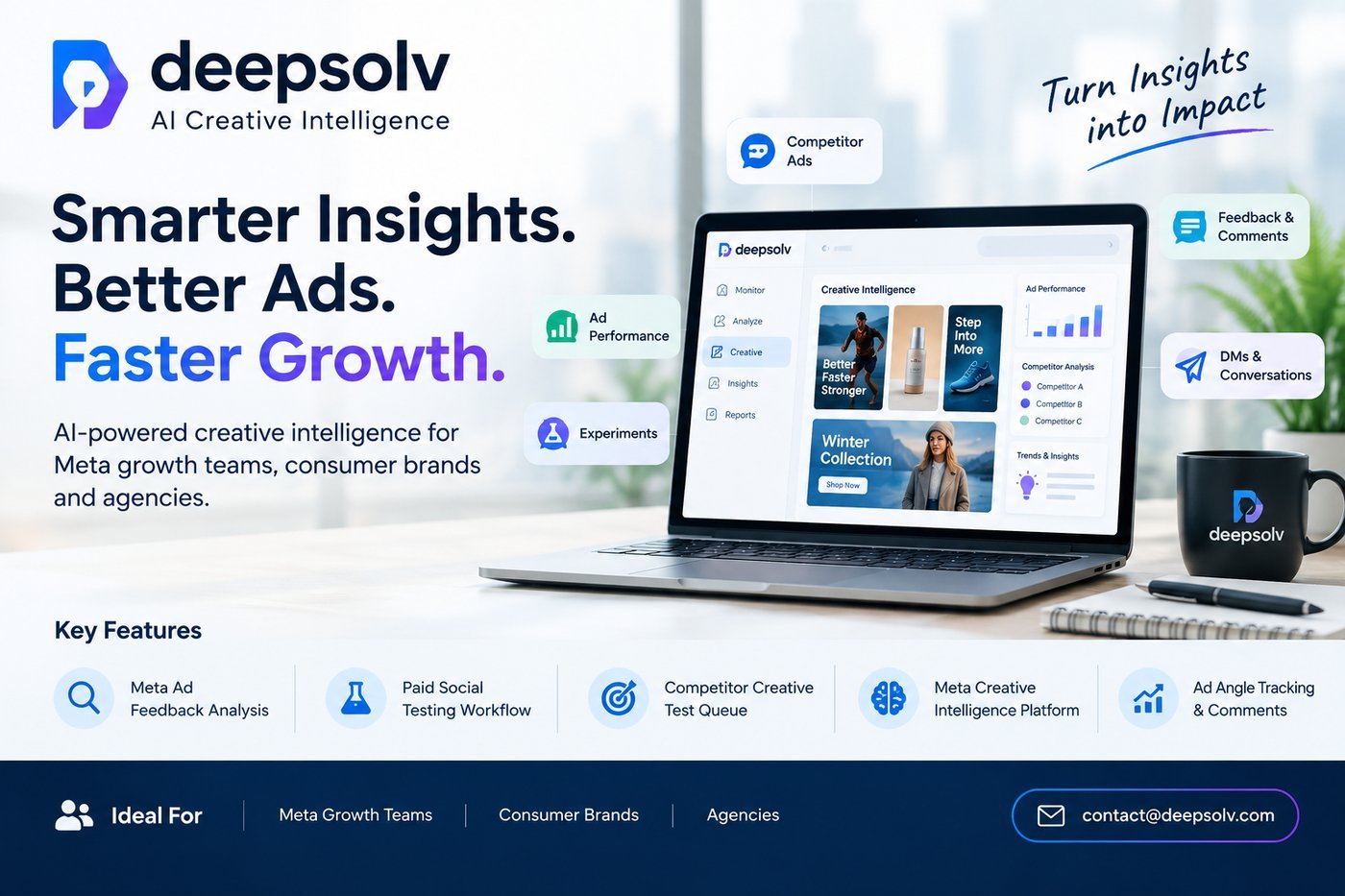
Deepsolv focuses on creative decision intelligence for brands and agencies running Meta advertising campaigns. Its approach brings together competitor activity, customer feedback, advertising performance, and previous experiment learnings to help growth teams decide what to test next.
Its capabilities can support several important activities:
-
Competitor research: Understand visible competitor advertising messages, offers, hooks, and creative formats.
-
Customer insight analysis: Identify recurring questions, objections, desires, and motivations from customer conversations.
-
Creative performance analysis: Review metrics such as CTR, CPC, add-to-cart rate, conversion rate, and ROAS.
-
Test prioritisation: Organise creative opportunities into a ranked plan for what to test, improve, or stop.
-
Learning from past experiments: Maintain a record of previous creative outcomes to inform future decisions.
Deepsolv also supports teams with creative briefs and draft ideas based on available insights. Its Brand Brain helps retain information about previous creative tests, including what worked and what did not.
For brands looking to make their advertising workflow more organised, exploring Deepsolv’s creative intelligence platform can be a useful step towards connecting research with practical creative decisions.
Practical Tips for Building an Intelligence-Led Marketing Workflow
Businesses do not need to transform every marketing activity at once. They can begin with a few focused improvements.
-
Choose a clear objective: Decide whether the immediate priority is improving ad performance, understanding customers, reducing research time, or increasing creative testing efficiency.
-
Organise your data: Identify the information your team already collects and remove unnecessary duplication.
-
Use AI where it adds value: Start with research, customer feedback analysis, creative comparisons, or performance interpretation.
-
Keep people involved: Let marketers review AI-generated insights and check whether recommendations match the brand’s goals.
-
Run measurable experiments: Give each creative test a clear hypothesis, success metric, and review period.
-
Record every important learning: Use previous results to guide future campaigns instead of starting the planning process from zero.
Read Also :Smarter Ad Experiments: How AI Is Changing the Way Brands Grow
Conclusion
Autonomous marketing intelligence represents a shift towards more connected, informed, and efficient marketing decisions. By combining AI-powered analysis with human creativity, businesses can understand customers more clearly, evaluate advertising performance, and prioritise the ideas that deserve further testing.
An effective AI marketing team uses technology as a decision-support partner rather than relying on automation without direction. With the right data, clear objectives, and continuous learning, brands can build a marketing workflow that responds more intelligently to changing customer needs and market conditions.
Frequently Asked Questions
1. What is autonomous marketing intelligence?
Autonomous marketing intelligence uses AI and connected data to analyse marketing activities, identify patterns, and support decisions with less manual effort.
2. How does an AI marketing team help businesses?
An AI marketing team combines human expertise with AI tools to support research, customer analysis, creative planning, and campaign performance evaluation.
3. Can AI help improve advertising performance?
Yes. AI can help analyse campaign metrics, identify creative patterns, understand customer feedback, and suggest areas that may need improvement. Results still depend on proper testing and human review.
4. What information is useful for marketing intelligence?
Useful information includes advertising performance, competitor creatives, customer reviews, social media comments, direct messages, conversion data, and previous experiment results.
5. Does autonomous marketing intelligence replace marketing professionals?
No. It supports professionals by reducing repetitive analysis and providing useful insights. Human marketers remain important for strategy, creative judgement, brand communication, and final decisions.
6. How can Deepsolv support an AI marketing team?
Deepsolv helps Meta growth teams connect competitor activity, customer signals, and historical ad performance to prioritise creative tests and make more informed advertising decisions.