Introduction
High-purity water is essential in industries such as pharmaceuticals, power generation, chemicals, electronics, food processing, and laboratories. To achieve the required water quality, industries use different types of water treatment systems, including DM Water Plant and Mix Bed DM Plant. Although both systems are designed to remove dissolved salts and ionic impurities from water, their working process, water purity levels, and industrial applications are different. Understanding the difference between a DM Water Plant and a Mix Bed DM Plant helps industries select the right system based on operational requirements and desired water quality standards.
What is a DM Water Plant?
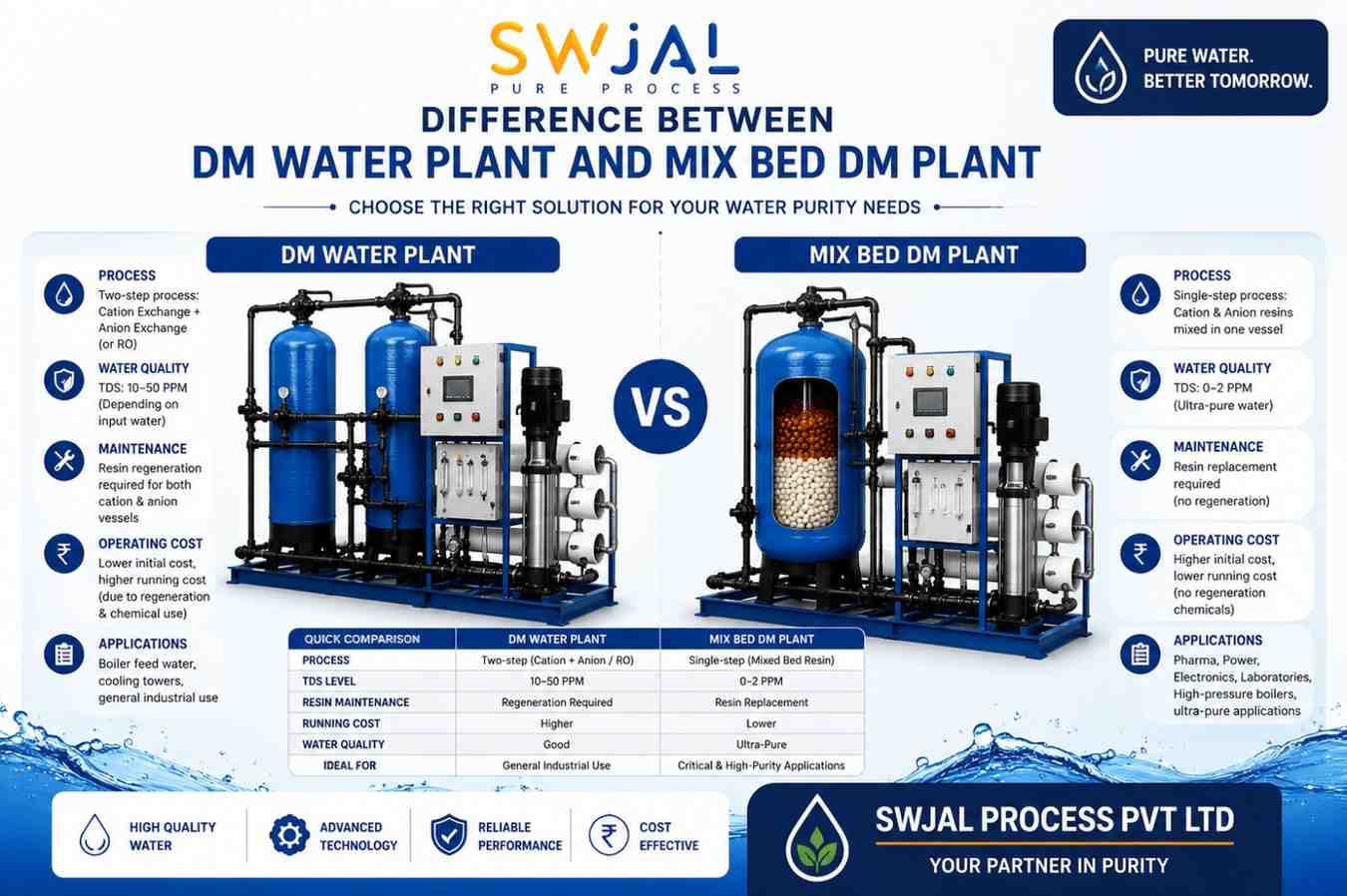
A DM Water Plant, also known as a Demineralized Water Plant, is a water treatment system that removes dissolved minerals and salts from raw water using ion exchange technology. The system typically consists of separate cation and anion exchange vessels.
Working Process of DM Water Plant
- Raw water passes through a cation exchange vessel where positively charged ions like calcium, magnesium, and sodium are removed.
- The water then enters an anion exchange vessel where negatively charged ions such as chloride, sulfate, and nitrate are removed.
- The final output is demineralized water with low conductivity and reduced Total Dissolved Solids (TDS).
DM Water Plants are widely used in industries where standard demineralized water quality is sufficient for operations.
What is a Mix Bed DM Plant?
A Mix Bed DM Plant is an advanced water purification system used to achieve ultra-pure water quality. It contains a mixture of both cation and anion exchange resins in a single vessel.
Working Process of Mix Bed DM Plant
- Water enters the mixed bed vessel containing mixed ion exchange resins.
- Both cation and anion exchange processes occur simultaneously.
- The system removes even trace ionic impurities from water.
- The final output is ultra-pure water with extremely low conductivity.
Mix Bed DM Plants are generally used as polishing units after a standard DM Water Plant to achieve higher water purity levels.
Major Difference Between DM Water Plant and Mix Bed DM Plant
Resin Arrangement
- DM Water Plant uses separate cation and anion exchange vessels.
- Mix Bed DM Plant uses mixed cation and anion resins in a single vessel.
Water Purity Level
- DM Water Plants provide high-purity demineralized water.
- Mix Bed DM Plants produce ultra-pure water with very low conductivity.
Conductivity Output
- DM Water Plant output conductivity is comparatively higher.
- Mix Bed DM Plant delivers extremely low conductivity water suitable for critical applications.
Application Area
- DM Water Plants are suitable for general industrial applications.
- Mix Bed DM Plants are used in pharmaceutical, electronics, and laboratory applications requiring ultra-pure water.
Operational Complexity
- DM Water Plants are simpler to operate and maintain.
- Mix Bed DM Plants require more careful resin handling and regeneration processes.
Cost
- DM Water Plants are generally more economical.
- Mix Bed DM Plants involve higher installation and maintenance costs due to advanced purification requirements.
Advantages of DM Water Plant
Cost-Effective Water Treatment
DM systems provide reliable demineralized water at lower operational costs.
Easy Maintenance
Separate resin vessels simplify regeneration and maintenance processes.
Suitable for Industrial Applications
Widely used in boilers, cooling systems, and process industries.
Advantages of Mix Bed DM Plant
Ultra-Pure Water Production
Provides extremely low conductivity water suitable for critical applications.
High Water Quality Consistency
Ensures stable and superior water purity standards.
Ideal for Sensitive Industries
Used in pharmaceuticals, electronics manufacturing, laboratories, and high-pressure boilers.
Applications of DM Water Plant
- Power plants
- Chemical industries
- Textile industries
- Food & beverage processing
- General industrial applications
Applications of Mix Bed DM Plant
- Pharmaceutical industries
- Semiconductor manufacturing
- Laboratories
- Electronics industries
- Critical boiler feed applications
Which System Should You Choose?
The selection between a DM Water Plant and a Mix Bed DM Plant depends on the required water quality and industrial application.
Choose a DM Water Plant if:
- Standard demineralized water is sufficient
- Lower operational cost is required
- Industrial process applications are less critical
Choose a Mix Bed DM Plant if:
- Ultra-pure water is required
- Extremely low conductivity is necessary
- The application involves pharmaceuticals, electronics, or laboratory processes
Conclusion
Both DM Water Plants and Mix Bed DM Plants play important roles in industrial water purification. While a DM Water Plant provides efficient removal of dissolved salts for general industrial use, a Mix Bed DM Plant offers ultra-pure water suitable for highly sensitive applications. Understanding the difference between these systems helps industries select the right water treatment solution for improved efficiency, equipment protection, and product quality. Choosing the proper system ensures reliable operations and long-term industrial performance.