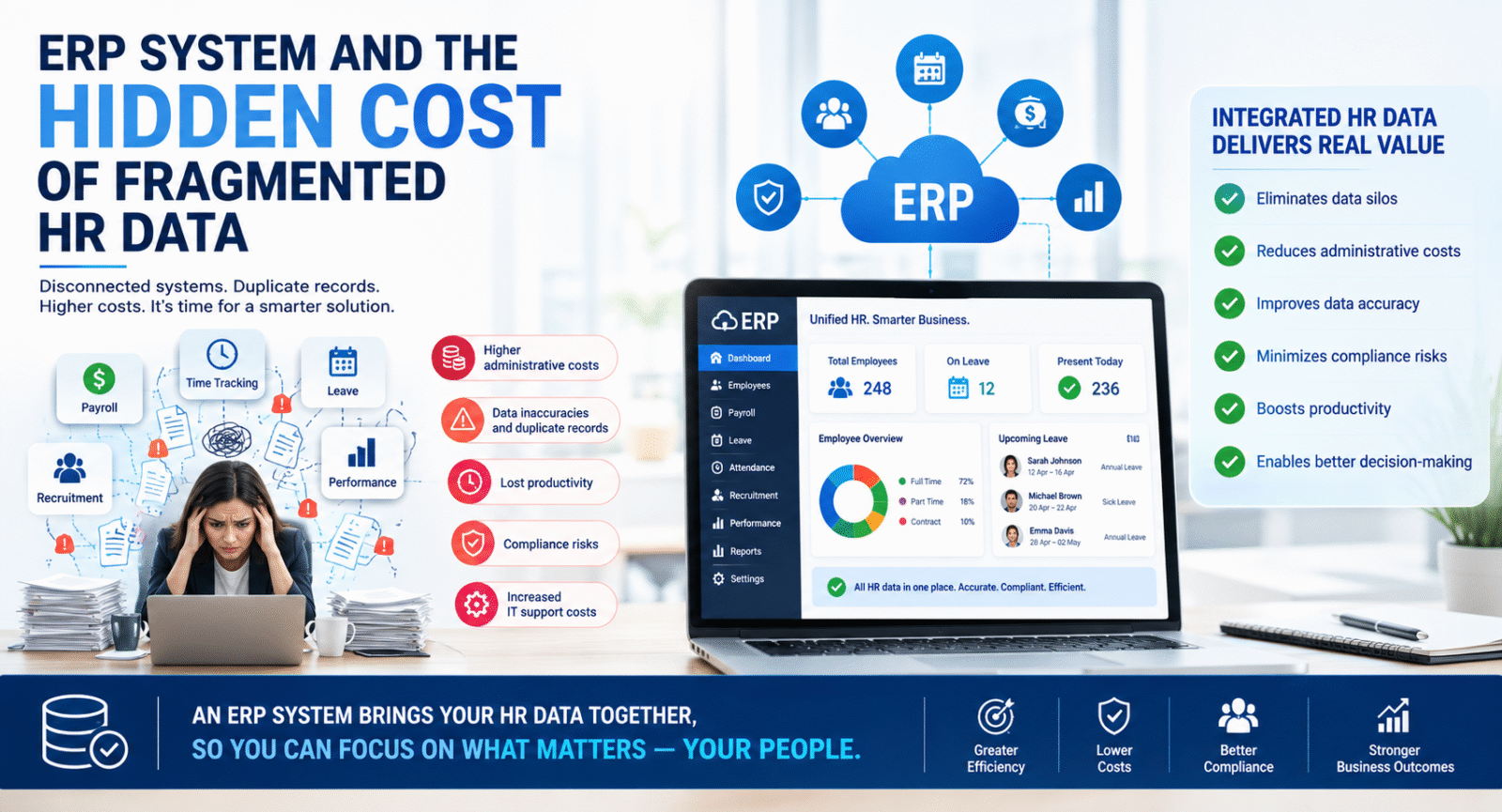
Employee data is costly when it’s stored in spreadsheets, attendance systems, payroll software, and isolated databases. Errors like duplicate records, inconsistent employee profiles, and delayed updates can subtly impact payroll accuracy, workforce planning, and compliance.
An erp system establishes a unified database to facilitate consistent movement of employee data between HR, attendance, payroll, finance and reporting functions.
The challenge isn’t just about HR information management for businesses. It’s stopping siloed data from becoming a burden to the operation and finances.
-
Identify where HR data becomes fragmented
There can be multiple operational sources for employee information. This is because recruitment can store details about candidates, HR can store details regarding employees, attendance systems can store working hours and payroll can store payroll records.
The data fragmentation problem
If these systems are not linked, the same individual might be listed in more than one record as having a different job title, department, salary, or employment status.
Common symptoms include:
- Duplicate employee records
- Outdated contact information
- Inconsistent department assignments
- Keep attendance and payroll records apart from each other.
- Manual spreadsheet reconciliation
Human resources software can help you to centralize employee data but the benefit is enhanced when HR data is integrated into the broader business system.
-
Eliminate duplicate employee records
Duplicate records are more than an administrative inconvenience. These can alter headcount numbers, lead to inaccurate payroll information and can make it hard to monitor employee costs.
Create one employee identity
An erp system may be capable of assigning a distinct employee record that may be referenced throughout the HR, payroll, attendance, leave and financial processes. In the applications, the employee identifier is the same for the connected modules, and is not created as a new profile in the application.
This architecture enables the ability to control changes at their source. If an employee is transferred to a different department, the approved record can automatically change related processes without having to have multiple teams make changes to separate databases.
-
Connect HR data with payroll
Employee master data is a crucial component of payroll. The salary structure, allowances, deductions, leave balance, overtime, and employment should match the employee.
The HRI software integration allows for the transfer of approved employee information directly to the payroll system, without having to manually enter it into the payroll system.
This decreases risks of:
- Salaries master data is wrong.
- Outdated employee status
- Manual payroll adjustments
- Missing allowance information
- Incorrect department costing
It leads to a more controlled payroll process, in which HR changes are now part of a more structured payroll input.
-
Avoid discrepancies in attendance information
Another significant source of fragmented HR information is attendance. HR departments can end up wasting a lot of time comparing records when biometric devices, spreadsheets and payroll applications work independently.
Set up an automated attendance process
A linked ERP can accept attendance transactions and apply shift rules, compute working hours and transfer approved working hours to payroll.
The process can be done in the following sequence:
Attendance Device → Attendance Module → Validation → Approval → Payroll
This way you will not have to export, clean and re-enter attendance data manually for each payroll.
-
Improve leave and workforce records
When employees apply for leave via email, spreadsheet or individual apps, while HR keeps its records, there can also be inconsistencies with leave information.
An integrated HR environment connects the dots between leave transactions, employee profiles, attendance and payroll.
Key advantages include:
- Centralized leave balances
- Automated approval workflows
- Consistent absence records
- Payroll-ready leave information
- Availability visibility of the workforce is enhanced.
The business can tie leave to the overall HR record of the employee instead of just a one-off HR exercise.
-
Reduce the hidden cost of manual reconciliation
Inconsistent HR systems lead to regular reconciliation tasks. Staff have to undertake time-consuming tasks such as record checking, data rectification, spreadsheet corrections and verifying which records are correct.
Take measurements of the effects of operations
This can be masked by payroll corrections, delayed reporting, too much administrative time and wrong workforce choices.
A reduction of this dependency occurs if an erp system stores the common employee information in various modules. While automated synchronization cannot solve all exceptions, it can help HR teams focus on true exceptions instead of duplication of data.
-
Improve the governance of HR data.
Centralization is not sufficient. Businesses also require controls on who can create, modify, approve and have access to employee data.
HR software can handle role-based access, approval processes, audit trails, and controlled master data modifications.
For instance, an HR administrator can update an employee’s department, and salary details will only be accessed by authorized payroll users. All major changes can be traced back to a user and date, thus enhancing accountability.
-
Use HR data for business decisions
When employee information is consistent, it can be more helpful for management reporting. With connected information, business owners can gain insight into workforce costs, turnover, overtime, headcount, departmental costs, and employee utilization.
Sowaan ERP can play a role in this by integrating the HR processes with the wider business operations, instead of storing employee data in silos.
A unified data model also enhances reporting capabilities as the same employee data is used in management dashboards rather than piecing together data from various spreadsheets.
Conclusion
Inconsistent and disjointed HR data leads to costs that can be hard to identify until they surface as payroll mistakes, reporting inaccuracies, compliance concerns, or administrative time. Linking employee master details, attendance, leave, payroll, and reporting enable a more secure operational framework.
Hence, the importance of an erp system for the business owners is not restricted to automation. It establishes a controlled HR data environment that allows accurate data to flow around the organization without needing to manually reconcile HR data multiple times.