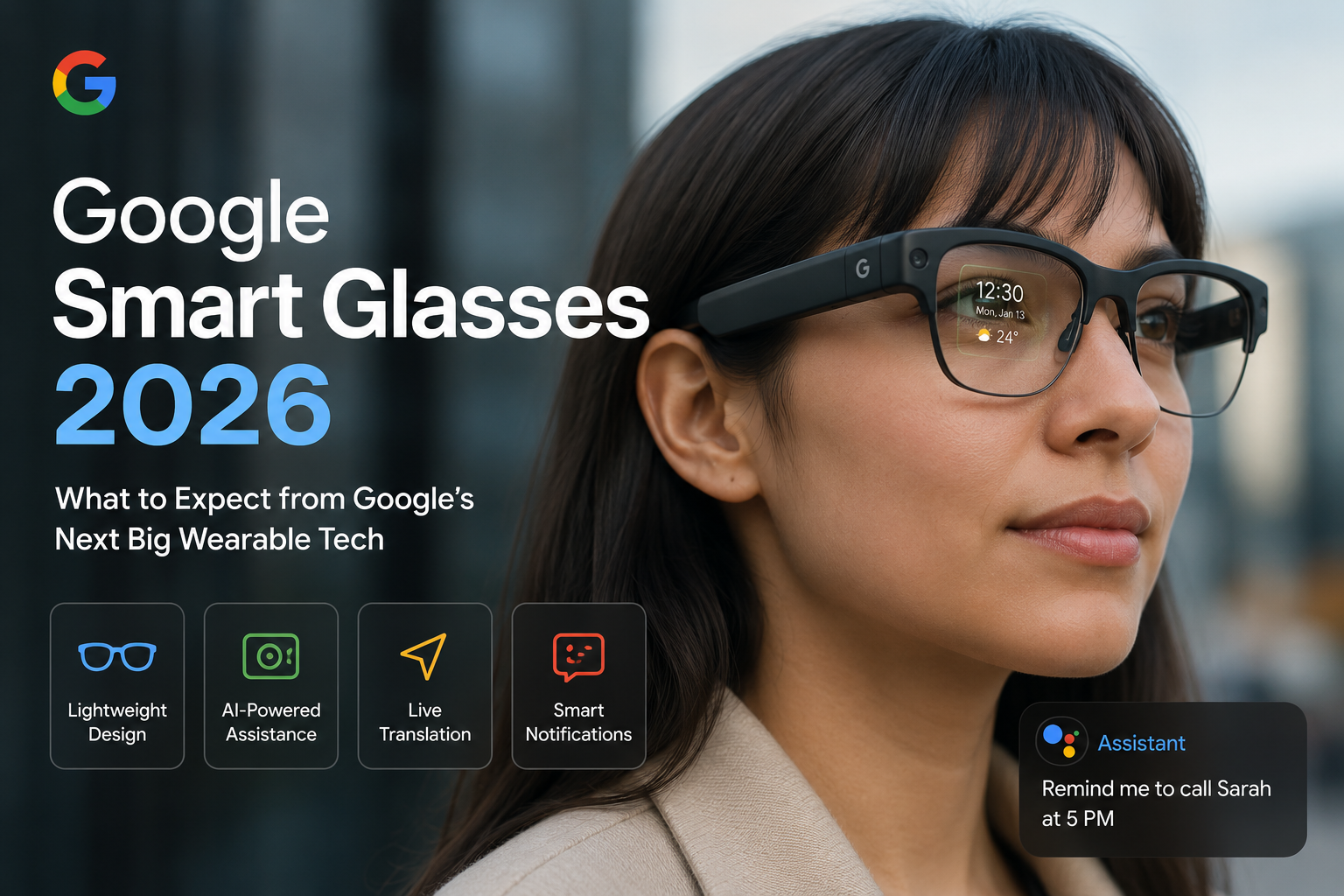
Google is preparing to re-enter the smart glasses market with a powerful new generation of AI-powered wearable devices expected around 2026. Unlike the early Google Glass experiment, this new version is rumored to focus on practical everyday use, advanced augmented reality (AR), and deep integration with Google’s Gemini AI.
With competition rising from Apple, Meta, and Samsung in the XR (extended reality) space, Google’s 2026 smart glasses could become one of the most important tech launches of the decade.
Expected Launch Date
While Google has not officially confirmed a release date, industry leaks and analyst reports suggest:
- First official teaser may appear at Google I/O 2026
- Full product launch expected in late 2026 or early 2027
- Part of Google’s new Android XR ecosystem
This indicates Google is building a long-term AR platform rather than a one-off device.
Design & Build Quality
Google’s upcoming smart glasses are expected to focus heavily on comfort and daily usability.
Key Design Expectations:
- Lightweight and minimal frame design
- Normal eyeglasses-style appearance
- Multiple style options for users
- Prescription lens compatibility
- Touch and gesture-based controls
The goal is to make smart glasses look and feel like regular eyewear instead of a bulky gadget.
Display & AR Experience
The biggest upgrade will likely come in display technology.
Expected Features:
- Micro-OLED transparent display
- Augmented reality overlays in real time
- Navigation arrows and directions in view
- Notifications directly in the lens
- Live captions and translations
This AR layer could transform how users interact with the digital world without looking at a phone.
Gemini AI Integration
One of the most powerful features will be deep integration with Google Gemini AI.
AI Capabilities May Include:
- Real-time voice assistance
- Context-aware suggestions
- Live translation of conversations
- Object and scene recognition
- Instant search based on what you see
- Smart reminders and task help
For example, looking at a menu could instantly show reviews, prices, and recommendations.
Camera & Visual Intelligence
The glasses are expected to include a built-in camera system for AI-powered vision features.
Possible Camera Specs:
- Ultra-wide 12MP camera
- Real-time visual search
- QR and object scanning
- POV video recording support
- Privacy LED indicator for transparency
This will allow the device to “see” and interpret the environment.
Battery Life & Charging
Battery efficiency is a major challenge for AR devices, but Google is expected to optimize it using next-gen chips.
Expected Battery Features:
- Full-day moderate usage
- Fast USB-C charging
- Possible wireless charging support
- AI-powered power optimization
Performance & Hardware
Google may partner with Qualcomm for XR-focused processors.
Rumored Hardware:
- Snapdragon XR-series chipset
- 8GB RAM (expected)
- 128GB internal storage
- Dedicated AI processing unit
- Android XR operating system
This setup will ensure smooth AR and AI performance.
Audio & Connectivity
Expected audio and connectivity features include:
- Open-ear directional speakers
- Multiple noise-canceling microphones
- Bluetooth 5.4 support
- Wi-Fi 7 connectivity
- Seamless Android ecosystem integration
Users will be able to take calls, listen to audio, and interact with AI hands-free.
Key Features of Google Smart Glasses 2026
Here are the standout features expected:
- Real-time language translation
- AI-powered navigation (Google Maps AR)
- Smart notifications on lens
- Visual search with Gemini AI
- Hands-free calling and messaging
- Context-aware assistant support
Expected Price
Pricing is still speculative, but estimates suggest:
- Base model: $499 – $699
- Premium AR version: $800+
Google may position it competitively against Meta Ray-Ban smart glasses and Apple’s XR devices.
Competition in 2026
Google will face strong competition from:
- Apple Vision and AR ecosystem
- Meta Ray-Ban Smart Glasses
- Samsung XR devices
- Other emerging AI wearables
The success of Google’s glasses will depend on how practical and affordable they are.
Final Verdict
Google Smart Glasses 2026 could mark a major comeback in wearable technology. With Gemini AI integration, AR overlays, and Android XR support, the device has the potential to redefine how people interact with information in real time.
If Google delivers on performance, design, and battery life, these smart glasses could become one of the most influential tech products of 2026–2027.