Let’s be incredibly honest for a second: the tech world right now feels like it’s moving at Mach 10. Every morning we wake up to a new headline about a smarter LLM, a more autonomous agent, or a job market that seems to be shifting under our feet. If you’ve been scrolling through LinkedIn or job boards lately, you’ve probably felt that nagging sense of “AI anxiety.”
You’re likely asking yourself: “Is my current skill set enough? Do I need to be a math genius to work in AI? Where do I even start?”
The good news? You don’t need a Ph.D. from Stanford to be part of this revolution. What you do need is a solid handle on the “language of the future.” If you’re looking to move from being a spectator to a creator, an AI with Python course is the single most practical bridge you can cross.
But why Python? And more importantly, how do you pick a path that isn’t just a bunch of boring, outdated slides? Let’s break it down, human to human.
Why Python is the Uncontested King of AI
In the coding world, languages come and go. Remember when everyone said you had to learn Ruby? Or when Perl was the big thing? Python is different. It has become the “Gold Standard” for Artificial Intelligence for one simple reason: It gets out of your way.
When you’re building complex neural networks or training a machine learning model, the last thing you want to do is wrestle with complicated syntax or manual memory management. Python reads almost like English. This simplicity allows you to focus on the logic of AI rather than the mechanics of the code.
The Ecosystem Advantage
When you enroll in a high-quality Python for Artificial Intelligence training course, you aren’t just learning a language; you’re gaining access to a massive library of pre-built tools:
- NumPy & Pandas: For crunching the massive datasets that feed AI.
- Scikit-learn: For the classic machine learning algorithms we use every day.
- PyTorch & TensorFlow: The heavy hitters used to build Deep Learning models.
- LangChain: The 2026 favorite for building “Agentic” AI systems.
What Should a 2026 AI with Python Course Actually Teach You?
The “Intro to Python” courses from five years ago are essentially obsolete today. In 2026, the bar has been raised. If you’re looking for the best AI with Python course online, your curriculum needs to cover the “New Frontier.”
1. The Transition from “Code” to “Intelligence”
It’s one thing to write a script that prints “Hello World.” It’s another thing entirely to write a script that can sentiment-analyze a thousand customer reviews in seconds. A modern course must bridge the gap between basic programming and Machine Learning fundamentals.
2. Generative AI & LLM Integration
We are past the point of just building predictive models. Today, an AI engineering with Python program should teach you how to work with APIs from OpenAI, Anthropic, or Google. You need to know how to build “wrappers” and custom applications that leverage these massive brains.
3. Data Science for AI
AI is only as good as the data you feed it. You need to master Python Data Science—learning how to clean “dirty” data, handle missing values, and visualize trends. Without this, your AI is just a very fast, very expensive random-guess generator.
How to Choose: Which Program Fits Your Life?
The internet is flooded with “AI experts” selling $10 PDFs. Don’t fall for the hype. You need a structured environment.
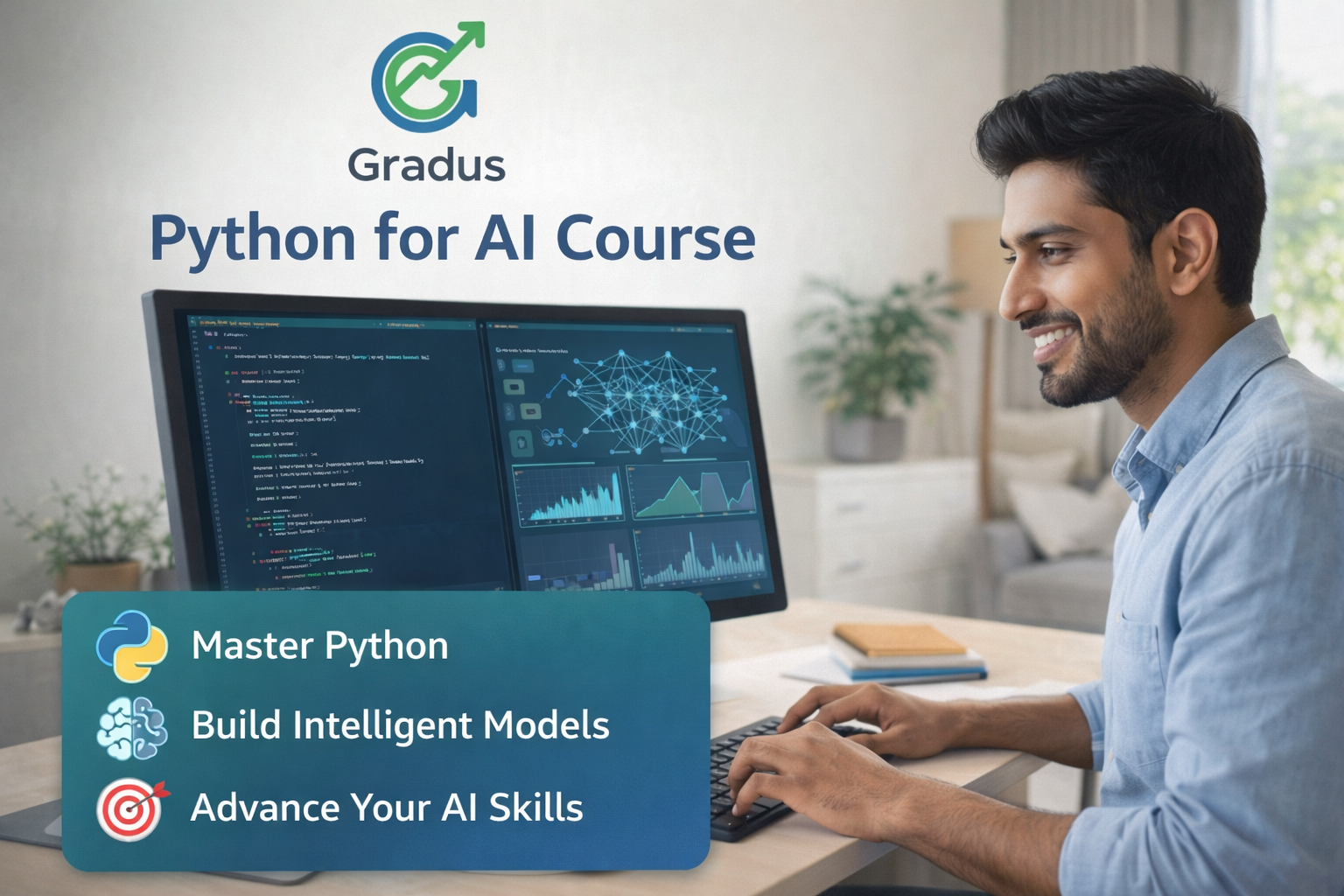
For those looking for a deeply practical, hands-on approach that cuts through the academic fluff, the Python for AI course by Gradus is a standout option in the current market. It’s designed for people who want to build, not just watch.
|
Learning Path |
Best For… |
Time Commitment |
|
Self-Paced Bootcamps |
Busy professionals |
5-10 hours/week |
|
University Certifications |
Academic prestige |
6-12 months |
|
Project-Based Tracks |
Portfolio building |
3 months (Intense) |
The “Human” Reality: Dealing with the Learning Curve
Let’s skip the marketing fluff for a second: Learning AI with Python is hard. There will be a Tuesday night where you’re staring at a “Linear Regression” error or a “Matrix Mismatch” in your code, and you’ll want to throw your laptop out the window. You’ll feel like everyone else “gets it” and you don’t.
Here is the secret: Every expert started exactly where you are. The difference between a Senior AI Engineer and a beginner isn’t brilliance—it’s persistence. The best AI with Python course isn’t the one with the fanciest certificate; it’s the one that provides a community or a mentor to pull you out of those ruts.
Is it Too Late to Start? (Hint: No)
I hear this a lot: “Has the AI ship already sailed? Is the market too crowded?”
Actually, we are just finishing the “Hype Phase” and entering the “Implementation Phase.” Companies have realized they can’t just “buy AI”—they have to build it into their specific workflows. They need people who can bridge the gap between business needs and Python code.
By taking an AI with Python certification, you aren’t just adding a line to your resume; you’re gaining a seat at the table where the future is being designed.
What Can You Build After a Course?
- Personalized Recommendation Engines: Think Netflix, but for your niche.
- Automated Content Systems: Agents that research and draft reports.
- Predictive Analytics Tools: Helping businesses forecast sales or inventory.
- Custom Chatbots: Intelligent interfaces that actually solve customer problems.
Frequently Asked Questions
Do I need to be good at Math?
You need to be comfortable with logic. While high-level AI research involves heavy calculus, AI Engineering with Python is more about understanding concepts (like probability and statistics) and knowing which Python library to call.
How long does it take to get “Job Ready”?
If you are starting from scratch, expect a 6-month journey. The first 2 months are about mastering Python basics, the next 2 are about Data Science, and the final 2 are about building and deploying AI models.
Why is Python better than R for AI?
While R is great for pure statistics, Python is a “general-purpose” language. This means you can use Python to build the AI and the website or app that hosts it. It’s a one-stop shop.
Final Thoughts: The First Step is the Hardest
The world is changing, but that change brings incredible opportunity. You don’t have to know everything on day one. You just have to know more than you did yesterday.
Whether you’re looking for a Python for Artificial Intelligence training to pivot your career, or you just want to understand the technology that is shaping our world, the time to act is now. The tools are free, the documentation is everywhere, and the only thing standing between you and a career in AI is the decision to start.