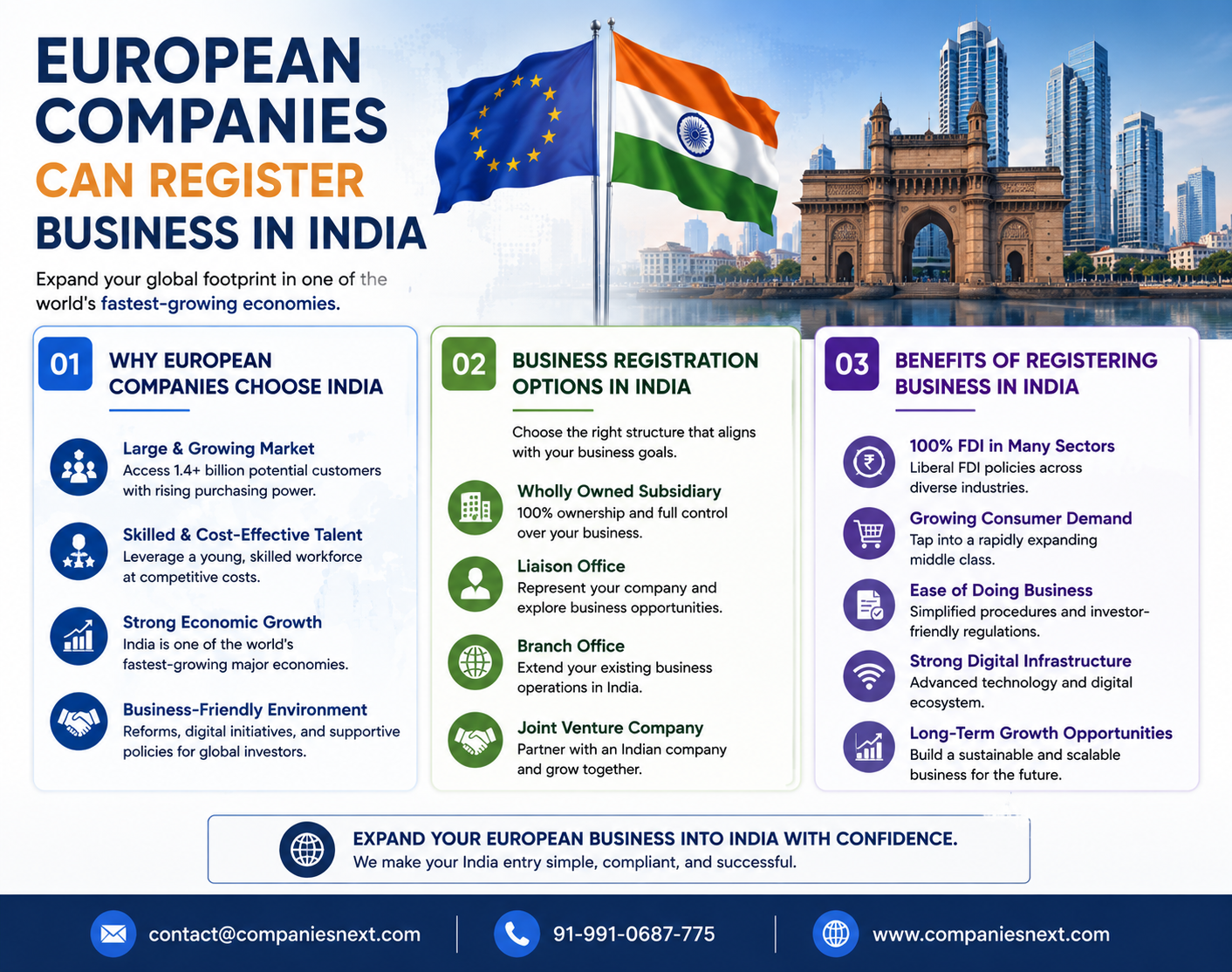
India has become an attractive destination for European companies looking to expand internationally. Its growing economy, large consumer base, skilled workforce, developing infrastructure, and expanding digital market create opportunities across industries. However, entering a new market requires careful planning, knowledge of local regulations, taxation, business structures, and compliance requirements.
For European entrepreneurs and companies, understanding How to Start a Business in India from Europe can make the expansion process more structured and efficient. From selecting the right business structure to completing registrations and maintaining compliance, each step plays an important role in establishing a successful presence in India.
Why European Companies Are Expanding Into India
India offers a combination of market size, talent, technology, and business opportunities that makes it attractive to international companies. European businesses can enter India to serve local customers, establish manufacturing operations, build technology teams, outsource services, or create a regional business hub.
Some major advantages include:
- Access to a large and diverse consumer market
- Availability of skilled professionals
- Growing demand for international products and services
- Competitive operating and talent costs in several sectors
- Strong growth in digital commerce and technology
- Opportunities in manufacturing, technology, finance, consulting, healthcare, renewable energy, and other industries
- Access to India’s expanding startup and innovation ecosystem
Before entering the market, European companies should assess their target customers, competitors, investment requirements, and long-term business objectives.
Choosing the Right Business Structure in India
One of the first decisions for a European company is selecting an appropriate legal structure. The right structure depends on the company’s activities, investment plans, ownership requirements, and business objectives.
Private Limited Company
A private limited company is a popular structure for foreign businesses planning to establish a long-term commercial presence in India. It provides a separate legal identity and allows foreign ownership subject to applicable foreign investment regulations.
This structure may be suitable for companies that want to conduct sales, provide services, hire employees, enter contracts, or establish operations in India.
Limited Liability Partnership
An LLP can be considered when the business wants a flexible structure with limited liability. It may be appropriate for certain professional and service-oriented businesses, depending on foreign investment and sector-specific rules.
Branch Office
A branch office can allow a foreign company to conduct permitted business activities in India while remaining connected to the parent company. However, its permitted activities and regulatory requirements are different from those of an Indian subsidiary.
Liaison Office
A liaison office is generally used for representative and communication activities rather than conducting regular commercial operations. European companies should carefully evaluate whether this structure matches their intended activities.
How to Start a Business in India from Europe
Understanding How to Start a Business in India from Europe involves more than simply registering a company. European businesses should follow a structured market-entry process.
1. Conduct Market Research
Start by identifying the Indian market opportunity. Research customer demand, competitors, pricing, distribution channels, industry trends, and local regulations.
A European company should determine whether its existing products or services require adaptation for Indian consumers. Local purchasing preferences, pricing expectations, language, and regional differences can influence market performance.
2. Select the Appropriate Business Model
Next, determine how the company plans to operate in India. Options may include establishing an Indian subsidiary, opening a branch office, partnering with an Indian business, outsourcing certain functions, or creating a local sales and distribution network.
The choice should be based on the company’s objectives, expected revenue, investment requirements, and desired level of control.
3. Understand Foreign Investment Regulations
Foreign companies investing in India need to consider Foreign Direct Investment regulations. The rules can vary depending on the industry and the percentage of foreign ownership.
Some sectors may permit foreign investment under the automatic route, while others may require government approval or have specific conditions.
Professional advice can help European businesses determine the applicable requirements before making an investment.
4. Complete Company Registration
If the company chooses to establish an Indian private limited company, incorporation is generally completed through India’s Ministry of Corporate Affairs.
The process involves selecting a suitable company name, preparing incorporation documents, identifying directors and shareholders, obtaining required digital signatures, and submitting the relevant forms and documents.
Foreign shareholders and directors may also need to provide appropriate identification and address documents according to applicable requirements.
5. Obtain Tax and Business Registrations
After incorporation, the business may need additional registrations depending on its activities.
These can include:
- Permanent Account Number (PAN)
- Tax Deduction and Collection Account Number (TAN), where applicable
- Goods and Services Tax (GST) registration
- Import Export Code (IEC), where applicable
- State-specific registrations
- Sector-specific licenses and approvals
Not every company will require every registration, so requirements should be assessed based on the actual business model.
Managing Taxation and Accounting Requirements
Tax compliance is an important consideration for European companies operating in India. Businesses may have obligations relating to corporate income tax, GST, withholding tax, transfer pricing, and other applicable taxes.
Companies with international transactions between the Indian entity and its European parent or group companies should also understand transfer pricing requirements.
Proper accounting records should be maintained from the beginning. Businesses should establish processes for invoicing, expense management, payroll, tax filings, financial reporting, and statutory records.
Working with an experienced accounting and compliance professional can help foreign companies maintain accurate records and meet filing deadlines.
Hiring Employees in India
India’s large talent pool can be a major advantage for European businesses. Companies can recruit professionals in technology, finance, sales, marketing, operations, customer support, research, and other areas.
Before hiring employees, companies should establish appropriate employment agreements, payroll processes, tax deductions, and statutory compliance procedures.
Depending on the location and workforce, businesses may also need to comply with applicable labour and employment regulations.
Setting Up Banking and Financial Operations
A properly established banking system is essential for managing an Indian operation. Depending on the business structure and regulatory requirements, the company may need an Indian corporate bank account.
European companies should establish clear procedures for receiving customer payments, paying suppliers and employees, managing expenses, and transferring funds between India and the European parent company.
Cross-border transactions should be handled in accordance with applicable foreign exchange regulations.
Building a Local Market Strategy
Registration is only the beginning of expansion. Long-term success requires a strong local market strategy.
European companies should consider working with Indian distributors, local consultants, technology providers, suppliers, or strategic partners where appropriate.
Digital marketing can also help businesses reach Indian customers. Search engine optimization, social media, content marketing, online marketplaces, and localized websites can support customer acquisition.
Understanding regional differences is particularly important because India’s consumer market varies significantly across states and cities.
Common Challenges for European Companies
Although India offers significant opportunities, international businesses can face challenges during market entry.
Common issues include:
- Understanding Indian regulatory requirements
- Selecting the correct business structure
- Managing tax and accounting compliance
- Understanding foreign investment regulations
- Hiring and managing local employees
- Adapting products to local customer expectations
- Managing cross-border payments
- Understanding state-level requirements
These challenges can be reduced through proper research and professional guidance before establishing operations.
Key Steps for a Successful India Expansion
European companies can use the following checklist when planning their expansion:
- Research the Indian market and competitors.
- Define the business objectives and investment plan.
- Select the appropriate business structure.
- Review foreign investment and sector-specific regulations.
- Prepare incorporation and KYC documentation.
- Complete the required registrations.
- Set up accounting, taxation, and payroll systems.
- Establish banking and financial processes.
- Hire local employees where required.
- Develop a localized sales and marketing strategy.
- Maintain ongoing statutory and tax compliance.
- Review business performance and scale operations gradually.
Conclusion
India presents substantial opportunities for European companies seeking international growth. Its large market, skilled workforce, expanding infrastructure, and growing demand across multiple industries make it an important destination for global businesses.
However, successful expansion requires more than registering a company. European businesses should carefully evaluate their market, choose an appropriate structure, understand foreign investment rules, complete required registrations, establish tax and accounting systems, and develop a local operating strategy.
For entrepreneurs and companies researching How to Start a Business in India from Europe, taking a structured approach can make the market-entry process more manageable and help build a strong foundation for long-term growth. With proper planning, regulatory compliance, and a clear understanding of Indian customers, European companies can establish and expand successful business operations in India.