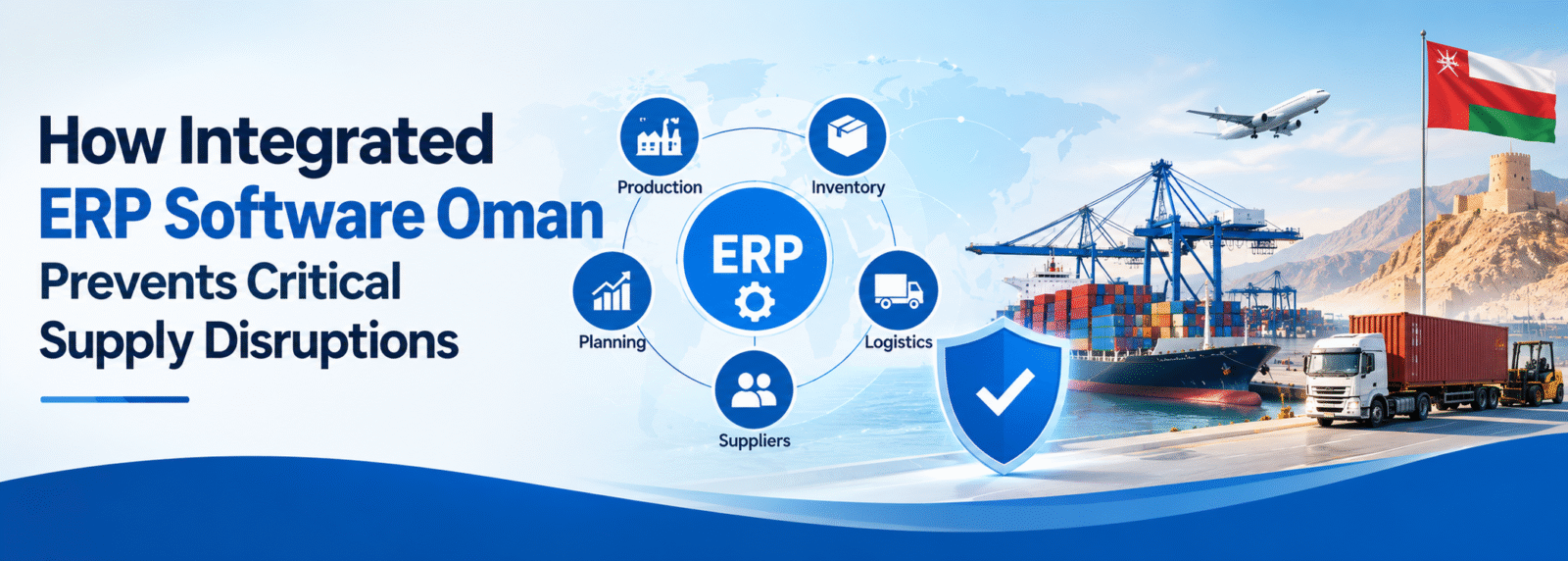
When supply disruptions occur because of third parties, they affect production, stocks, supply to clients, and money flow simultaneously. ERP systems integrate suppliers and information from procurement, inventory, finance, sales etc. into a single system, allowing businesses to detect supplier weaknesses and take actions before it becomes operationally threatening.
Map Supplier Dependencies Across Operations
The place many people begin to experience supply risk is when they don’t have complete visibility. If procurement records, stock levels, purchase orders and supplier information are stored in isolation, management may not have an awareness of their reliance on a specific supplier.
Businesses can link supplier records to purchasing workflows, inventory, production, and financial workflows using erp software oman. This provides a single source of truth on supplier support of critical materials and the operating dependencies.
Key controls include:
- Supplier-wise Purchase Volume & Dependency tracking.
- Identify critical items and vendors and map them.
- Documents related to purchase order and delivery status.
- Alternative supplier identification
- Past procurement performance
Helps managers to distinguish between normal supplier delays and dependencies that could potentially inhibit the full functioning of the business.
Monitoring Supplier Performance before Failure
It is easy to understand when suppliers have issues. Late deliveries or irregular deliveries, issues with quality of delivery, or unfulfilled purchase orders indicate a problematic supplier.
An integrated ERP system detects these signals while the procurement is being done instead of confirming them later on.. Businesses can check for committed and actual delivery dates, check purchase order history and find suppliers who regularly miss agreed services.
Monitor EWI’s
A supplier risk dashboard can identify:
- Increasing delivery delays
- Frequent order amendments
- Patterns of rejection or acceptance.
- Unfulfilled purchase commitments
- Increasing procurement costs
These indicators are easier to assess in a systematic manner when they are backed by supplier risk and performance management software and ERP processes. Rather than responding only after stock is out, procurement teams can look into the issue with the supplier at hand and do so in case corrective action can be taken.
Connect Supplier Risk With Inventory Exposure
When a business is low on stock they are at greater risk of experiencing a supplier delay. ERP integration provides procurement teams with a view of supplier performance, along with existing inventory, reorder points, demand, and open purchase orders.
Determine vulnerable stock levels.
The critical materials can be connected to the system:
- Current inventory levels
- Invitations to low- and safe-stocks.
- Pending purchase orders
- Expected delivery dates
- Historical consumption
This makes a more viable risk assessment. Suddenly one of these suppliers may be just not delivering, then you may be able to wait, if enough stock is on hand, but if it’s just one supplier, it may be an urgent issue.
The tie between supplier reliability and inventory exposure makes it possible for management to prioritize risks based on their impact to the operation.
Automate Procurement Response
Response speed is important when there is a disruption risk. Manual approval processes and disjointed spreadsheets can stall purchasing decisions, especially when multiple departments must coordinate.
The erp software oman environment can be automated to follow business rules for procurement activities. For instance, if the order is about to expire on its delivery date at a critical stage, or if the stock is near a set level, procurement staff can be alerted to take appropriate action.
The system can then facilitate quicker actions as follows:
- Increasing Repeat Orders that are overdue.
- Triggering replenishment workflows
- Pointing to the relevant managers for approvals.
- Checking with other supplier’s records
- Updating purchasing priorities
Automation is not about taking the place of the procurement judgment. It provides timely information and a clear process for what to do with it, to decision makers.
Collate Suppliers Data based on the Risk Principles
You should not only look at the cost of the item, but supplier selection as well. Unreliable deliveries, emergency purchases, or missed customer deadlines can result in additional hidden costs if the vendor is low cost.
Create a Supplier Risk Profile
Businesses can go through a variety of operational and financial metrics to assess vendors, including:
Risk factor What it reveals
Delivery reliability Probability of recurring delays
Quality performance Risk of rejected or unusable materials
Lead-time variation Difficulty in planning replenishment
Order fulfillment Supplier consistency against commitments
Cost movement Potential margin and procurement pressure
However, supplier risk and performance management software can help enhance this evaluation by providing a structured performance profile that brings together supplier metrics. Management can then focus corrective actions on vendors creating the greatest business exposure.
Strengthen Continuity With Alternative Suppliers
A supplier strategy implementation based on ERP should not end with identification of risk. It should also enable businesses to plan contingencies in advance of disruption.
Supplier records can store approved vendors, product associations, pricing history, lead times, purchasing conditions and much more! If a critical supplier becomes less reliable, procurement teams can evaluate the choices available to them based on existing operational data instead of beginning the sourcing activity “from scratch.
This visibility is also useful for businesses with multiple branches to achieve supplier diversification and coordinated procurement. For these inter-connected procurement and operational processes, the organization can move to a single business environment with the help of sowaan ERP.
Leverage Real-Time Data to make Management Decisions.
The last line of defence in terms of supply-risk control is the management’s visibility. Decision making must be knowledgeable about identifying the supplier that is under-performing, as well as the implications this may have on inventory, production, sales and finances.
Supplier data can be linked to other operational data via supplier dashboards and reports with erp software oman. This enables business owners to transition from on-off supplier tracking to Enterprise risk management.
Rather than a shortage of products or materials revealing a problematic vendor, management can spot potential issues and plan for vendor procurement and inventory responses sooner.
Conclusion
Integrated ERP transforms supplier risk from a simple procurement problem into an actual measurable process. Supplier performance integration with inventory exposure, purchasing processes, and management reporting provide a business with visibility into vulnerabilities and ensure continued business resilience when supplier situations evolve.