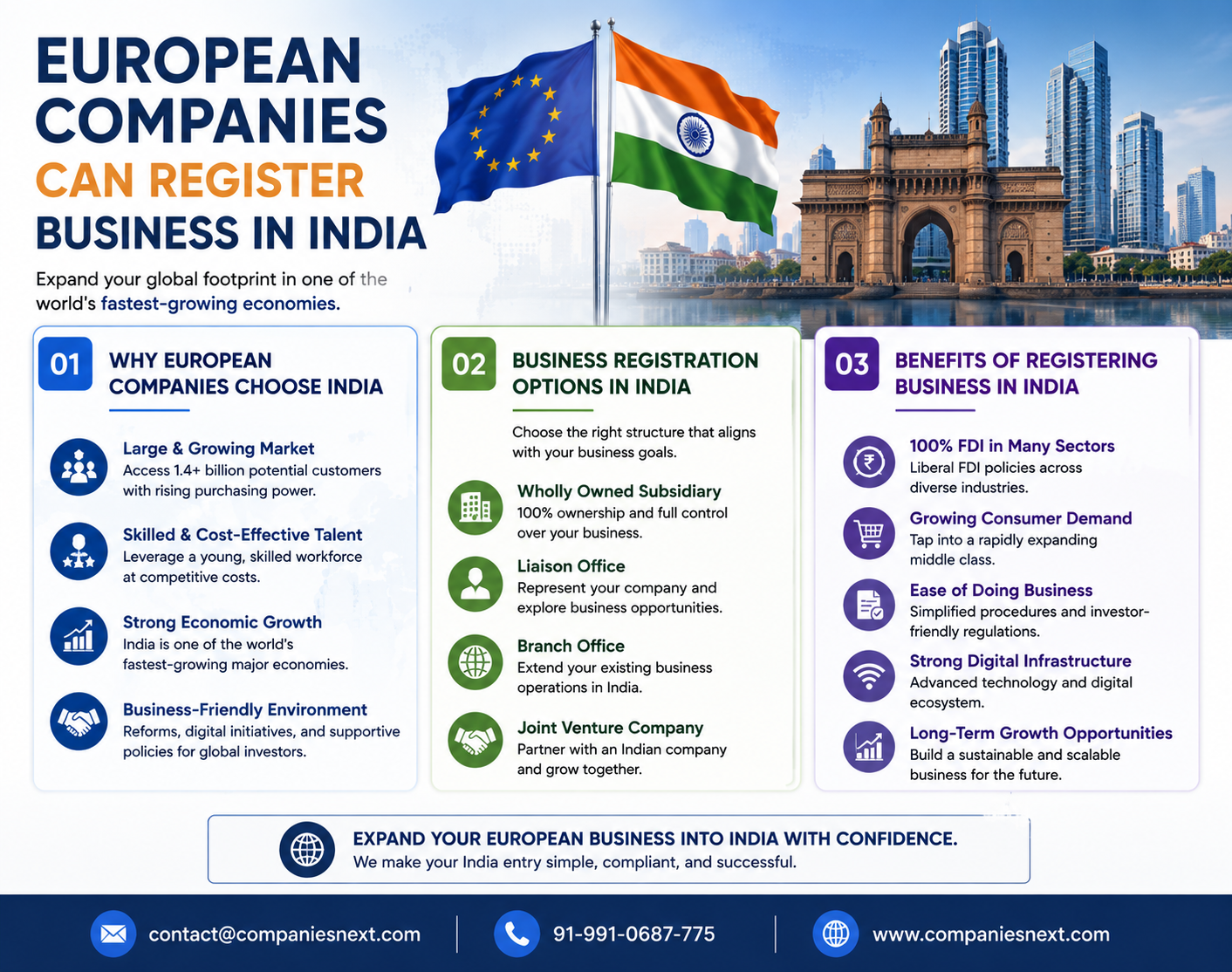
India has become an attractive destination for European businesses looking to expand into new markets, access a large customer base, and build long-term operations. With a growing economy, skilled workforce, developing infrastructure, and opportunities across industries, India offers significant potential for international companies.
For a European company, entering the Indian market requires more than simply choosing a business name and submitting an application. Foreign investors need to understand the appropriate business structure, investment regulations, documentation, taxation, and ongoing compliance requirements.
This guide explains the major steps involved in setting up an Indian company and helps European businesses understand How European Companies Can Register a Company in India efficiently.
Why Should European Companies Set Up a Business in India?
India provides opportunities for companies operating in technology, manufacturing, consulting, renewable energy, finance, healthcare, e-commerce, engineering, and many other sectors.
Some important advantages include:
- Access to a large and diverse consumer market
- Availability of skilled professionals
- Competitive operating and labour costs
- Growing digital infrastructure
- Opportunities for manufacturing and service businesses
- Increasing demand for international products and services
- Access to India’s expanding startup and business ecosystem
European companies can establish an Indian presence either as a subsidiary or through other permitted structures, depending on their business objectives.
Choose the Right Business Structure
The first major decision is selecting an appropriate legal structure. A foreign company can consider several options depending on its planned activities in India.
Private Limited Company
A private limited company is one of the most common choices for foreign investors establishing a long-term commercial operation in India. It provides a separate legal identity and allows eligible foreign investment subject to applicable regulations.
This structure can be suitable for businesses that want to conduct commercial activities, employ staff, enter contracts, open bank accounts, and develop operations in India.
Limited Liability Partnership
An LLP combines elements of a partnership and a limited liability structure. It can be considered by businesses where a flexible management structure is important and the proposed activities are permitted under applicable foreign investment rules.
Branch Office
A branch office can allow an overseas company to conduct specific permitted activities in India without establishing a completely separate Indian company. However, it is subject to approval and regulatory requirements depending on the circumstances.
Liaison Office
A liaison office is generally used for activities such as communication, market research, and representing the parent company. It is not normally intended to conduct independent commercial trading activities in India.
Choosing the right structure is important because it affects taxation, compliance, investment procedures, operational flexibility, and the company’s ability to conduct business.
Check Foreign Investment Rules
Before starting the registration process, European investors should determine whether their proposed business activity is open to foreign investment and whether any conditions or approvals apply.
India’s foreign investment framework is administered under applicable laws, regulations, and policies. Depending on the sector, foreign investment may be permitted through an automatic route or may require government approval.
Therefore, investors should review the rules applicable to their specific industry before incorporating the business.
Prepare the Required Documents
Documentation is an important part of company incorporation. European companies and their proposed directors or shareholders generally need to provide identity, address, and corporate documents.
Common documents may include:
- Passport or identity documents of foreign directors
- Address proof of directors
- Passport-size photographs where required
- Proof of registered office address in India
- Constitutional documents of the foreign parent company, where applicable
- Board resolution or authorization documents
- Details of proposed shareholders and directors
- Incorporation documents of the foreign company
Foreign documents may need to be notarized, apostilled, legalized, and accompanied by appropriate certification or translation depending on the country of origin and document type.
Preparing documents correctly can help avoid delays during incorporation.
Obtain Digital Signature Certificates
Company incorporation in India involves electronic filing. Proposed directors generally need a Digital Signature Certificate (DSC) for signing applicable electronic forms.
For European investors, this is one of the early practical steps in the incorporation process. The required documentation and verification procedure should be completed according to the applicable requirements.
Apply for Director Identification Number
Individuals appointed as directors of an Indian company need the appropriate director identification registration. The identification details are generally obtained through the prescribed incorporation process.
A foreign national can serve as a director of an Indian company if the applicable legal requirements are satisfied. The company must also meet the requirements concerning directors and its registered office.
Reserve the Company Name
The proposed company name should comply with India’s naming rules and should not conflict with an existing registered company, trademark, or restricted name.
Applicants can submit the proposed name through the applicable incorporation process. It is advisable to select a few suitable alternatives in case the preferred name is unavailable.
A clear and distinctive name can also make future branding and trademark protection easier.
File the Incorporation Application
Once the necessary information and documentation are ready, the incorporation application can be submitted through India’s Ministry of Corporate Affairs system.
The application generally includes details such as:
- Proposed company name
- Registered office details
- Directors’ information
- Share capital
- Shareholding pattern
- Business activities
- Subscriber information
- Supporting documents
The relevant government authorities review the submitted information and documents. If the application satisfies the requirements, the company receives its incorporation approval and Certificate of Incorporation.
Open a Corporate Bank Account
After incorporation, the company generally needs a bank account for conducting its financial operations.
The company can approach a suitable Indian bank with its incorporation documents, constitutional documents, KYC information, and other required records.
For a European parent company investing capital into its Indian subsidiary, the investment should also comply with applicable foreign exchange and reporting requirements.
Complete Tax and Other Registrations
Company incorporation is only the beginning. Depending on the company’s activities, additional registrations may be necessary.
These can include:
- Permanent Account Number (PAN)
- Tax Deduction and Collection Account Number (TAN)
- Goods and Services Tax (GST) registration, where applicable
- Import Export Code (IEC), where applicable
- Professional or local registrations, depending on the business
- Sector-specific licenses or approvals
The exact registrations depend on the nature, location, turnover, and activities of the business.
Understand Ongoing Compliance Requirements
European businesses should plan for compliance from the beginning. An Indian company may have recurring obligations relating to accounting, taxation, financial statements, annual returns, board meetings, statutory records, and audits.
Companies with foreign investment may also have additional reporting obligations under applicable foreign exchange regulations.
Maintaining accurate books of accounts and submitting required filings on time can help the company avoid penalties and maintain good regulatory standing.
Why Professional Assistance Can Help
Indian company registration involves several legal, financial, and administrative requirements. For a European company unfamiliar with India’s regulatory environment, handling every stage independently can be time-consuming.
Professional business consultants can assist with:
- Selecting a suitable business structure
- Preparing incorporation documents
- Foreign document certification
- Company incorporation filings
- Tax registrations
- Bank account assistance
- Foreign investment compliance
- Accounting and bookkeeping
- Annual compliance and tax filings
Having professional support can make the process more organized and help international investors focus on establishing their operations.
Common Mistakes European Companies Should Avoid
Foreign investors can face unnecessary delays if basic requirements are overlooked. Some common mistakes include choosing an unsuitable business structure, submitting incomplete documents, overlooking sector-specific investment restrictions, using an unavailable company name, or failing to plan for post-incorporation compliance.
Another important consideration is understanding the difference between company incorporation and actually starting business operations. Certain industries may require additional licenses or approvals even after the company has been incorporated.
Conclusion
India offers substantial opportunities for European businesses seeking international expansion. However, successful market entry requires careful planning, appropriate business structuring, accurate documentation, and compliance with Indian corporate, tax, and foreign investment regulations.
Understanding How European Companies Can Register a Company in India can help investors approach the incorporation process with greater clarity. From selecting the right structure and preparing documents to completing incorporation, tax registrations, banking, and ongoing compliance, each stage should be handled carefully.
With proper preparation and professional guidance, European companies can establish a strong legal foundation in India and focus on building sustainable business operations in one of the world’s major emerging markets.