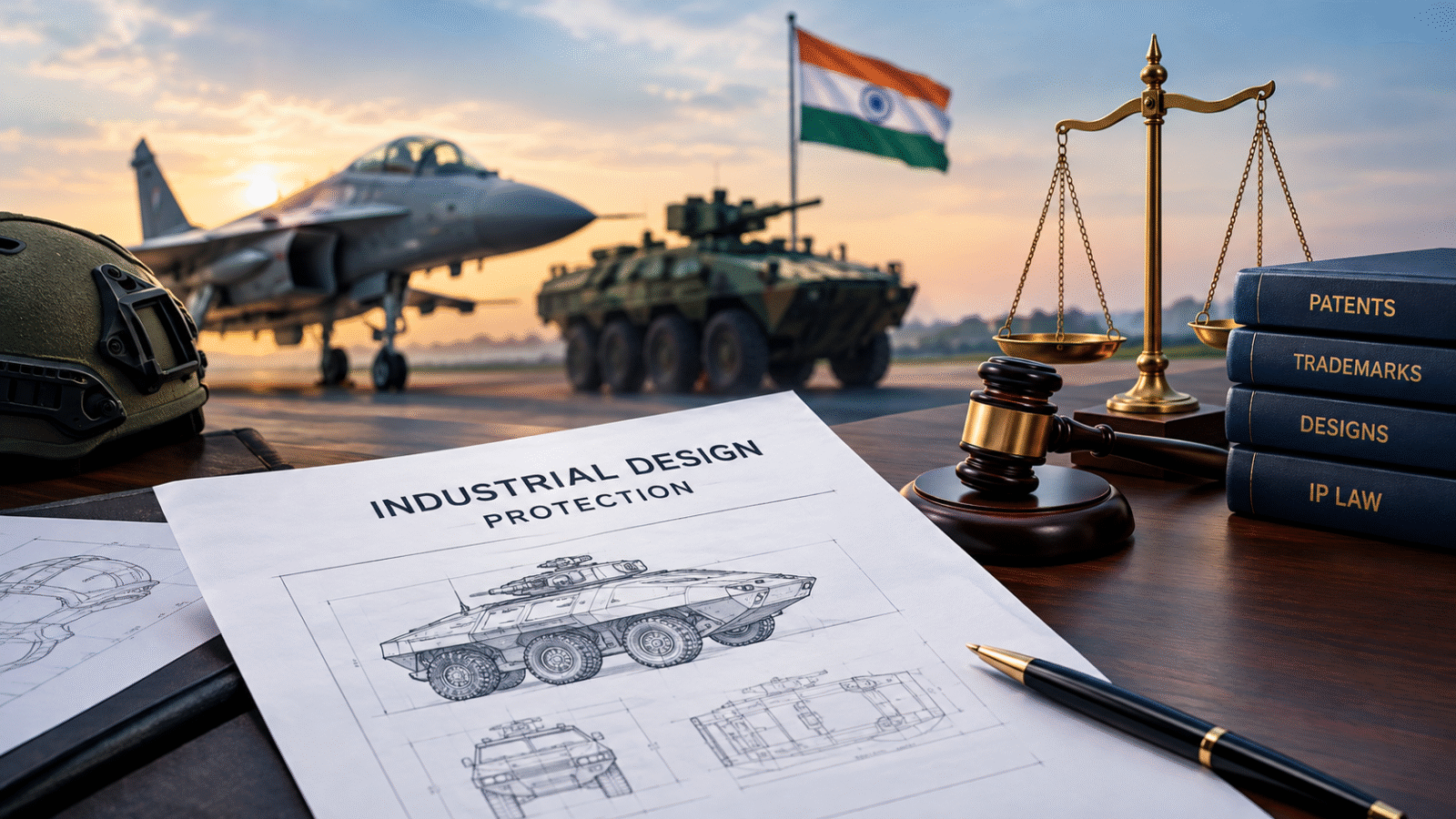
India’s defense sector is undergoing significant transformation, driven by technological innovation, domestic manufacturing, and increasing participation from private companies. As businesses develop new defense equipment, components, vehicles, protective systems, and other products, protecting the visual appearance and design of these products can become an important part of their intellectual property strategy. Industrial design protection can help businesses secure rights over eligible product designs and prevent unauthorized commercial use.
For companies operating in the India defense industry, understanding the legal framework governing industrial designs is particularly important because defense products may involve substantial research, development, investment, and collaboration between manufacturers, technology providers, and government entities.
Understanding Industrial Design Protection in India
In India, industrial designs are primarily governed by the Designs Act, 2000, along with the Designs Rules, 2001. The framework provides protection for the visual features of an article, including its shape, configuration, pattern, ornamentation, or composition of lines or colours, subject to the statutory requirements.
Unlike patents, which primarily protect technical inventions and functional innovations, design protection focuses on the visual characteristics of a product. Therefore, a defense manufacturer may potentially seek design protection for the distinctive appearance of an eligible product even where separate patent protection may be relevant to its underlying technology.
For businesses in the India defense industry, this distinction can be significant when developing products where appearance, configuration, ergonomics, or distinctive external features form part of the commercial identity of the product.
Why Design Protection Matters in the Defense Sector
Defense products often involve extensive development costs and specialized engineering. Their external appearance may be developed through multiple stages of design, testing, prototyping, and refinement.
Examples of potentially relevant products may include:
- Specialized equipment and protective gear
- Certain military vehicle components
- Communication or electronic equipment housings
- Specialized containers and equipment enclosures
- Product interfaces and physical configurations
- Components designed with distinctive visual characteristics
Not every defense product will qualify for design registration. However, where a product satisfies the legal requirements, industrial design protection can form one layer of a broader intellectual property portfolio.
This can be particularly relevant to private manufacturers and technology companies entering defense manufacturing and supply chains.
Key Requirements for Design Registration
Before applying for design registration, businesses should evaluate whether their design satisfies the requirements under Indian law.
A design generally needs to possess the required degree of newness or originality. A design that has already been publicly disclosed or made available in circumstances that affect its registrability may face difficulties.
Businesses should therefore consider design protection before publicly launching or disclosing a product.
Another important consideration is that the design must relate to features that are capable of being protected under the Designs Act. Purely functional or mechanical features may fall outside the scope of design protection where they are dictated solely by the function of the article.
This distinction can be especially important in the India defense industry, where product development is frequently driven by technical and operational requirements.
Conducting an IP Assessment Before Filing
Defense manufacturers should consider conducting an intellectual property assessment before filing a design application. The assessment can help identify:
- Whether the proposed design is new or original.
- Whether similar designs have already been registered or disclosed.
- Which visual features should be protected.
- Whether patent protection may also be appropriate.
- Whether confidential information needs to remain undisclosed.
- Who owns the design and associated intellectual property.
A search of existing design registrations and publicly available information can help businesses identify potential conflicts before investing further in a registration strategy.
For defense companies, this process can be particularly important because product development may involve multiple stakeholders, including employees, contractors, research organizations, manufacturers, and technology partners.
Confidentiality and Defense Product Development
Confidentiality deserves special attention in defense-related innovation. Companies may need to disclose designs to investors, manufacturers, consultants, testing facilities, or business partners before commercialization.
Uncontrolled disclosure can create intellectual property risks.
Businesses should therefore establish appropriate confidentiality measures, including non-disclosure agreements where appropriate, controlled access to design files, internal IP policies, and documentation of the development process.
A carefully managed disclosure strategy can help preserve the ability to pursue appropriate industrial design protection while supporting necessary collaboration.
Ownership and Contractual Considerations
Defense projects frequently involve collaborations between multiple parties. A design may be created by an employee, commissioned from an external designer, developed under a technology agreement, or produced as part of a joint project.
Consequently, determining ownership at the beginning of a project is important.
Contracts should clearly address:
- Ownership of newly created designs
- Existing intellectual property brought into the project
- Rights to modify or improve designs
- Confidentiality obligations
- Licensing and commercialization rights
- Responsibilities for registration and enforcement
- Rights following termination of the business relationship
For participants in the India defense industry, these provisions can reduce uncertainty when several organizations contribute to a product’s development.
Design Protection and Other Intellectual Property Rights
Industrial design registration should not necessarily be considered in isolation. A defense product may involve several different forms of intellectual property.
For example, a company could potentially consider:
Patents: Technical inventions and qualifying functional innovations may be protected through patent law.
Trademarks: Brand names, logos, and other distinctive identifiers may be protected through trademark registration.
Copyright: Certain original drawings, technical documentation, software, and artistic works may receive copyright protection subject to applicable law.
Trade secrets and confidentiality: Proprietary technical information and business information may be protected through contractual and organizational measures where appropriate.
A coordinated IP strategy can help businesses determine which aspects of a defense product should be protected through which legal mechanism.
Special Considerations for the India Defense Industry
The defense sector can involve regulatory requirements beyond ordinary commercial manufacturing. Companies may need to consider applicable procurement rules, licensing requirements, export controls, security obligations, and contractual restrictions depending on the nature of their activities and the specific product involved.
Accordingly, industrial design protection should be incorporated into a wider legal and commercial strategy rather than treated as a standalone filing exercise.
Companies should also carefully assess whether information relating to a defense product can be publicly disclosed and whether contractual or regulatory obligations restrict such disclosure.
Enforcement of Design Rights
Registration provides a legal foundation for protecting a qualifying design against unauthorized use in accordance with the applicable law. If infringement concerns arise, businesses may need to evaluate the relevant evidence, registration details, commercial circumstances, and available legal remedies.
Maintaining proper records can strengthen an organization’s ability to address disputes. Companies should preserve design drafts, development records, registration documents, agreements, product photographs, and evidence concerning commercial use.
For companies operating in the India defense industry, monitoring suppliers, competitors, distributors, and other market participants may also form part of an effective IP protection strategy.
Building an Effective Design Protection Strategy
Businesses developing defense products can take several practical steps to strengthen their approach to design protection:
- Identify protectable designs early in the development process.
- Conduct appropriate searches before filing.
- Avoid unnecessary public disclosure before registration.
- Maintain confidentiality around commercially sensitive designs.
- Establish clear ownership through employment and commercial contracts.
- Consider patents, trademarks, copyright, and trade secrets alongside design rights.
- Maintain accurate records of design creation and ownership.
- Monitor the market for potential unauthorized use.
- Obtain professional legal advice for complex or sensitive projects.
Conclusion
As India continues to expand domestic defense manufacturing and encourage innovation, intellectual property protection is becoming increasingly relevant to businesses participating in the sector. Industrial design protection can provide an important layer of protection for the visual characteristics of eligible defense products and complement other forms of intellectual property.
For companies operating in the India defense industry, the most effective approach is generally to consider design protection early, manage confidentiality carefully, establish clear ownership, and integrate design rights into a broader intellectual property strategy. Proper legal planning can help businesses protect valuable innovations while navigating the contractual and regulatory complexities associated with defense-related products and technologies.