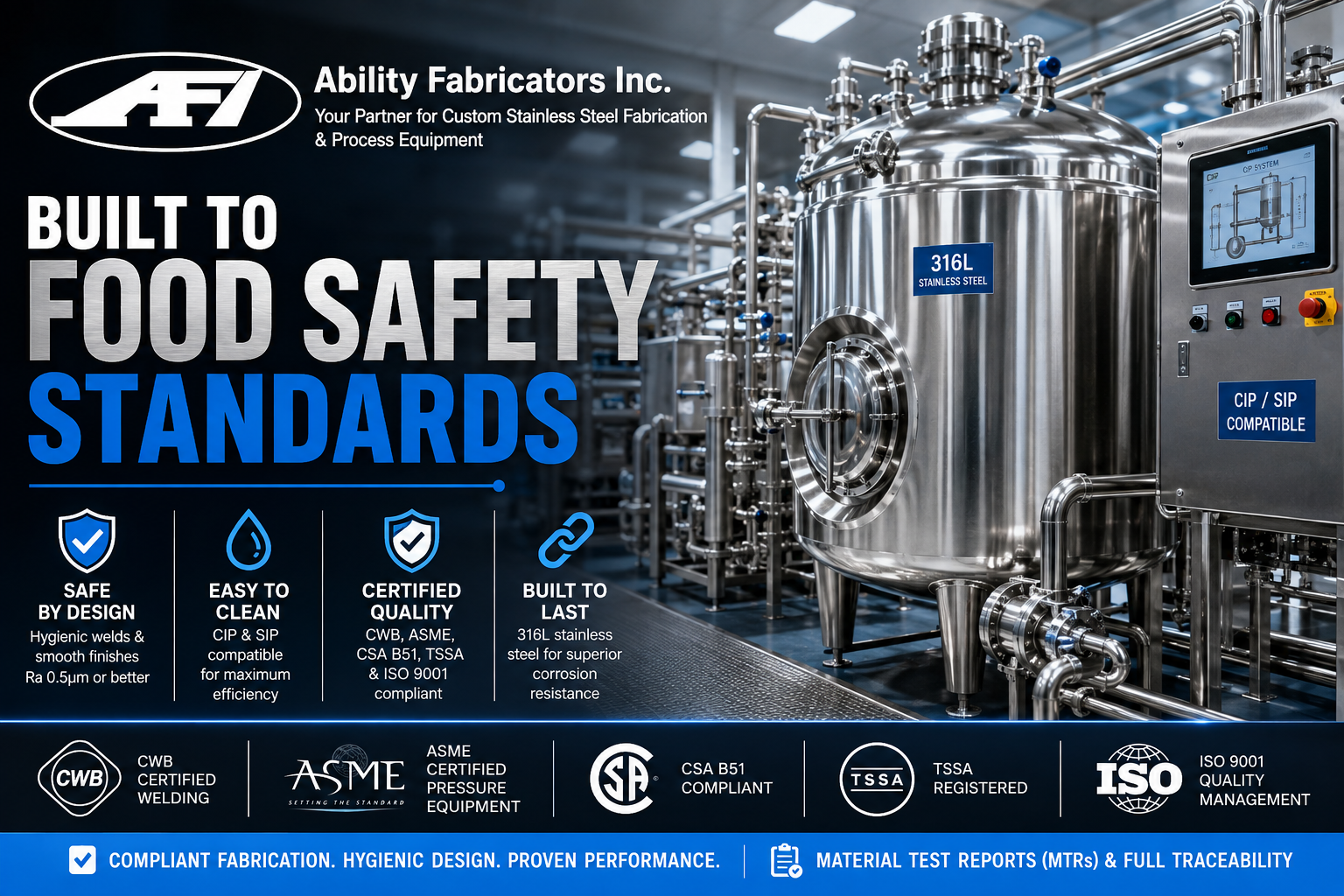
Quick Answer: Food processing equipment must be fabricated from 316L or 304 stainless steel, welded with crevice-free joints, finished to a surface roughness of Ra 0.5 µm or better, and designed for Clean-in-Place (CIP) and Sterilize-in-Place (SIP) operation. Compliance rests on four pillars: correct material selection, hygienic weld and surface standards, certified fabrication practices (CWB, ASME, ISO 9001), and documentation like Material Test Reports (MTRs) that prove traceability during a food safety audit.
Which Standards Actually Govern Food Processing Equipment Fabrication
Food processing equipment fabrication is governed by a combination of welding certifications, pressure equipment codes, and food-grade design standards, not a single universal rulebook. The certifications that matter most for food-contact equipment are:
- CWB (Canadian Welding Bureau) – certifies welders and welding procedures used on structural and process equipment.
- ASME (American Society of Mechanical Engineers) – governs pressure vessel design and fabrication for tanks, reactors, and jacketed equipment.
- CSA Standard B51 – Canada’s boiler and pressure vessel code, required for pressure-rated food processing equipment.
- TSSA (Technical Standards and Safety Authority) – Ontario’s regulatory body overseeing pressure equipment safety and installation.
- ISO 9001 – a quality management certification confirming a fabricator’s process consistency across projects.
- cGMP (current Good Manufacturing Practice) – the hygienic design standard applied to equipment surfaces, welds, and cleanability.
Material Selection: 304 vs. 316L Stainless Steel for Food Contact Surfaces
316L stainless steel is the correct choice for any surface that directly contacts food product, because it contains molybdenum, which gives it superior corrosion resistance against acids, salts, and cleaning chemicals compared to 304 stainless steel. 304 stainless steel remains appropriate for structural framing, non-wetted parts, and support components where direct product contact and chemical exposure are not concerns. Choosing the wrong grade for a product-contact surface is one of the most common compliance failures in food equipment fabrication, since it can lead to pitting, corrosion, and contamination risk over time.
Surface Finish and Weld Requirements for Hygienic Design
Hygienic design requires a surface finish of Ra 0.5 µm or smoother on all product-contact surfaces, since rougher finishes trap bacteria and residue that standard cleaning cycles cannot remove. Welds on food processing equipment must be crevice-free and fully penetrated, with no pinholes, undercuts, or gaps where product or bacteria could accumulate. Electropolishing is often applied after welding to remove microscopic surface irregularities and further reduce the risk of bacterial colonization on tanks, blenders, and conveyors.
CIP and SIP Compatibility: Why It Matters for Compliance
Equipment designed for Clean-in-Place (CIP) and Sterilize-in-Place (SIP) operation allows a facility to clean and sanitize internal surfaces without disassembling the equipment, which is now standard practice across food and beverage processing. CIP/SIP-compatible design requires smooth internal geometry, self-draining slopes, and spray-ball coverage inside tanks and vessels so no cleaning solution pools or bypasses a surface. Equipment that cannot run CIP/SIP cycles increases labor costs and contamination risk, since manual disassembly for cleaning introduces more opportunities for human error.
Certifications to Verify Before Choosing a Fabricator
Before selecting a metal fabrication partner for food processing equipment, verify these five items directly, since certifications on a website are not the same as certifications backing a specific project:
- Current CWB welding certification for the specific welders assigned to your project.
- ASME certification if the equipment includes any pressure-rated components like reactors or jacketed vessels.
- ISO 9001 registration confirming a documented quality management system.
- Material Test Reports (MTRs) for every batch of stainless steel used, verifying chemical composition and grade.
- cGMP-compliant design documentation, including surface finish specifications and weld inspection records.
Common Fabrication Mistakes That Fail Food Safety Audits
Four recurring fabrication mistakes account for most food safety audit failures on custom equipment:
- Using 304 stainless steel on product-contact surfaces where 316L was required for corrosion resistance.
- Leaving weld crevices or pinholes that trap residue and bacteria despite passing a visual inspection.
- Skipping electropolishing on high-touch or hard-to-clean geometry, leaving surface roughness above the Ra 0.5 µm threshold.
- Designing without CIP/SIP flow paths, forcing facilities into manual cleaning that increases contamination risk.
Step-by-Step: What a Compliant Fabrication Process Looks Like
- Define product-contact requirements – identify chemical exposure, temperature range, and cleaning method before material selection.
- Select the correct stainless steel grade – 316L for product-contact surfaces, 304 for structural components.
- Engineer for CIP/SIP compatibility – design self-draining geometry and spray-ball coverage into every vessel.
- Fabricate with certified welders – use CWB-certified welders following documented procedures for every weld.
- Finish to Ra 0.5 µm or better – apply mechanical polishing and electropolishing where required.
- Inspect and document – issue Material Test Reports and weld inspection records for full traceability.
- Validate before installation – confirm the finished equipment meets cGMP and facility-specific audit requirements.
Ability Fabricators Inc. has delivered certified custom Metal Fabrication for food processing industry equipment and pharmaceutical equipment manufacturers since 1999, holding CWB, ASME, CSA B51, TSSA, and ISO 9001 certifications. For related reading, see our guide on Top 5 Food Safety Trends in 2026. Request a custom quote to discuss your next compliant fabrication project.
Frequently Asked Questions
What stainless steel grade is required for food processing equipment?
316L stainless steel is required for product-contact surfaces due to its superior corrosion resistance; 304 stainless steel is acceptable for structural, non-wetted components.
What surface finish do food safety auditors look for?
Auditors generally look for a surface roughness of Ra 0.5 µm or smoother on all product-contact surfaces, since rougher finishes fail standard hygienic design requirements.
Is CIP/SIP compatibility mandatory for all food processing equipment?
It is not legally mandatory everywhere, but most modern food and beverage facilities require it, since manual cleaning introduces higher labor costs and contamination risk.
How do I verify a fabricator’s certifications are current?
Request current CWB welding certificates, ASME stamps, ISO 9001 registration, and Material Test Reports tied to your specific project, not just general company credentials.