

Nepal’s roads can change dramatically within a single journey. Smooth city roads may lead to winding highways, steep climbs, gravel sections, potholes, and uneven mountain tracks. For drivers who regularly travel beyond urban areas, choosing an electric SUV requires more than comparing battery capacity and claimed range.
The best off-road EVs in Nepal should be evaluated for ground clearance, suspension, traction, battery protection, tyres, driving modes, visibility, and charging access. These factors help determine whether an electric SUV is suitable for everyday roads or more challenging terrain.
What Makes an EV Suitable for Nepal’s Hill Roads?
Ground clearance is one of the most important considerations for uneven roads. Greater clearance provides additional space beneath the vehicle when crossing potholes, rocks, and raised surfaces.
Suspension also matters because it influences comfort and control on broken roads. Tyre quality, drivetrain configuration, and underbody protection can further affect a vehicle’s suitability for mountain travel.
However, ground clearance alone does not make an SUV a dedicated off-road vehicle. Buyers should consider the complete vehicle package, including traction, approach and departure angles, and battery protection.
OMODA E5 PRO: A Practical Option for Mixed Roads
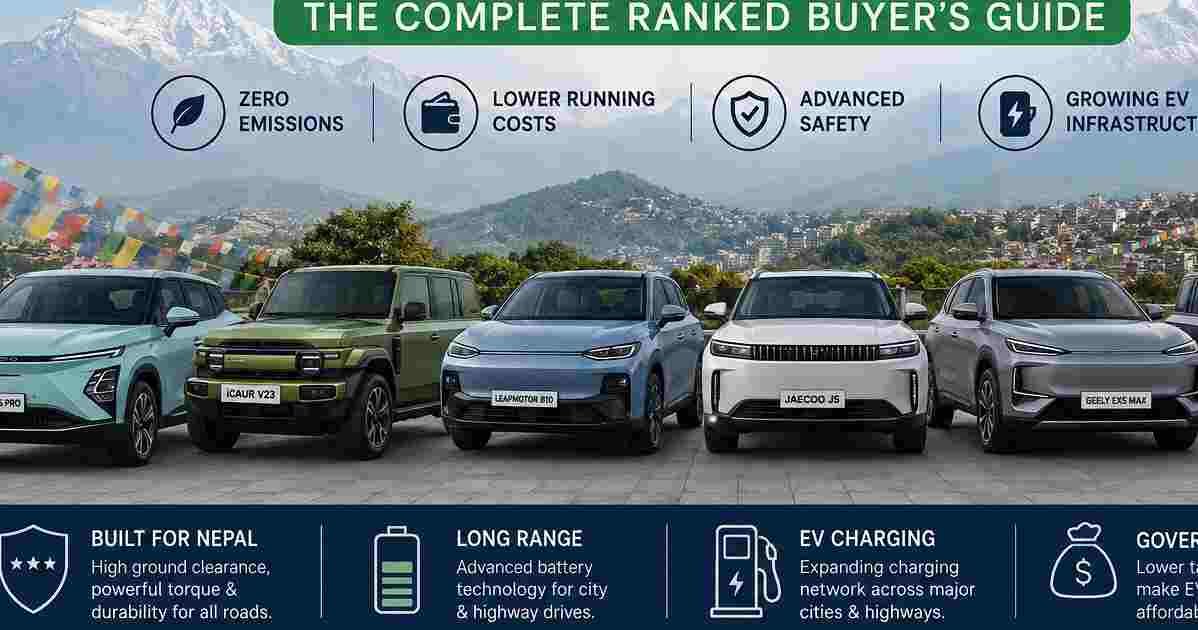
The OMODA E5 PRO is designed for everyday electric driving and mixed-road use. Its Nepal-market specifications list 191 mm ground clearance, a 50.7 kWh LFP battery, and a claimed WLTP range of up to 350 km.
With its front-wheel-drive configuration, the E5 PRO can be considered by drivers who mainly travel in cities and on highways but occasionally encounter moderately uneven roads.
Its ground clearance can be useful for speed breakers, potholes, and rough road sections. However, it should not be treated as a dedicated off-road SUV for extreme terrain.
JAECOO J5 EV: Balanced for Highway and Mountain Routes
The JAECOO J5 EV offers a combination of everyday practicality and features designed for varied road conditions.
Its listed Nepal specifications include a 58.9 kWh LFP battery, 155 kW motor, claimed range of 461 km, and up to 185 mm ground clearance. It also features a multi-link rear suspension and 235/55 R18 tyres.
The J5 EV includes a 540° panoramic view system and a listed 450 mm wading-depth figure. These features may be useful when navigating narrow roads and certain uneven conditions.
For drivers who regularly travel on highways, hills, and moderate rough roads, the J5 EV is worth considering.
JAECOO J6T EV: Designed for More Challenging Terrain
For buyers looking for an electric SUV with greater ground clearance, the JAECOO J6T EV deserves attention.
Its Nepal-market specifications list 225 mm ground clearance, a 65.69 kWh LFP battery, 135 kW motor, claimed range of 431 km, and 130 kW DC fast charging.
The higher ground clearance can provide additional space when travelling over uneven surfaces, gravel roads, and certain rural tracks.
For drivers who frequently encounter challenging road conditions, the J6T EV offers a more terrain-focused option among these three models.
Comparing Electric SUVs for Nepal’s Terrain
| Model | Ground Clearance | Claimed Range | Battery |
|---|---|---|---|
| OMODA E5 PRO | 191 mm | 350 km WLTP | 50.7 kWh LFP |
| JAECOO J5 EV | 185 mm | 461 km | 58.9 kWh LFP |
| JAECOO J6T EV | 225 mm | 431 km | 65.69 kWh LFP |
Range figures may use different testing standards. Actual driving range depends on road conditions, elevation, weather, speed, and driving style.
Range and Charging for Mountain Journeys
Mountain driving can increase energy consumption, particularly during long uphill climbs. Drivers should therefore plan charging stops before travelling to destinations with limited charging infrastructure.
It is important to maintain a reasonable battery reserve and avoid relying entirely on the advertised range.
Before a long journey, check charging station availability, connector compatibility, and the distance between charging points.
Which EV Is Suitable for Mountain Roads in Nepal?
The OMODA E5 PRO may suit drivers who primarily travel in cities and on highways, with occasional rough-road journeys.
The JAECOO J5 EV may appeal to buyers seeking a balance between everyday driving, highway travel, and moderate rough-road capability.
The JAECOO J6T EV is worth considering for drivers who frequently encounter more challenging terrain and prioritise higher ground clearance.
Final Thoughts
Choosing the right off-road EV in Nepal depends on the roads you regularly travel, not simply the vehicle’s appearance or claimed range.
Ground clearance, suspension, traction, battery protection, tyres, safety technology, and charging access should all be considered before purchasing an electric SUV.
The OMODA E5 PRO, JAECOO J5 EV, and JAECOO J6T EV offer different approaches to electric SUV ownership, from everyday urban driving to more demanding road conditions.
A practical buying decision begins with understanding your route and selecting a vehicle that matches your real-world driving requirements.