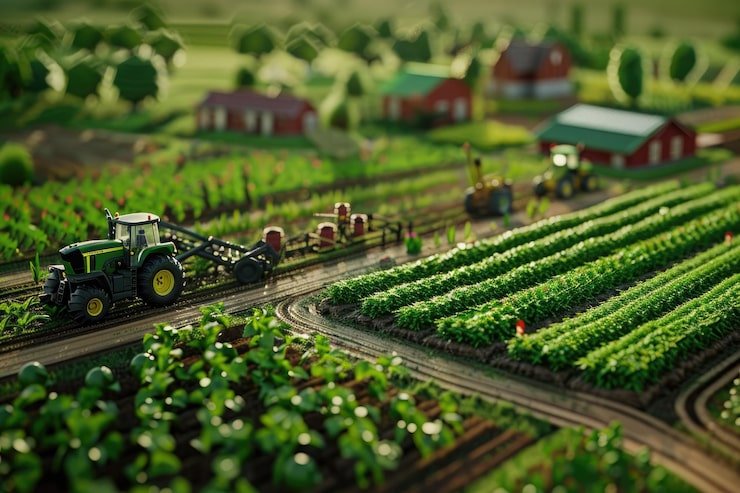
Spain’s agribusiness sector is evolving through a combination of strong domestic food consumption, resilient export demand, technological adoption, and investment in value-added processing. High-value crops, fruits, vegetables, olive oil, livestock products, and processed foods continue to connect agricultural production with international markets, while digital tools are changing how farms monitor resources, manage operations, and improve traceability.
The Spain agribusiness market report values the sector at USD 56.0 billion in 2025 and projects it to grow from USD 57.6 billion in 2026 to USD 67.0 billion by 2032, representing a CAGR of 2.55% during 2026–2032. Grains and cereals accounted for approximately 25% of the sector in 2026, while the food and beverage industry represented around 58%, reflecting the strong connection between agricultural output and downstream food processing.
Export Demand Strengthens Agricultural Production
International demand remains an important foundation for Spain’s agribusiness activity. The country has established strong export positions across fruits, vegetables, meat, olive oil, wine, and processed food products, creating a direct relationship between farm production and international trade.
Official government data cited in the study indicate that Spain’s agri-food and fisheries exports reached USD 77.9 billion in 2023, representing an annual increase of 3%. Export value increased further to approximately USD 78 billion in 2024, with fruits, vegetables, meat, and olive oil remaining important contributors.
The Spanish Ministry of Agriculture, Fisheries and Food provides national information on agricultural production, food policy, fisheries, and agri-food trade. Spain’s established export infrastructure continues to support investment in production, processing, packaging, and logistics.
Grains and Cereals Remain a Major Product Segment
Grains and cereals represented approximately 25% of Spain’s agribusiness sector in 2026, making them the leading product category. Wheat, barley, maize, and rice serve both domestic food requirements and downstream industries such as animal feed and food processing.
The importance of cereals extends beyond direct consumption. Grain production supports livestock operations by providing feed inputs, while processing activities generate flour, bakery products, breakfast cereals, and other value-added foods.
Mechanization and digital farming technologies are also supporting cereal production. Precision machinery, soil monitoring, variable-rate applications, and data-based farm management can help producers improve the efficiency of agricultural inputs while responding to changing field conditions.
Digital Agriculture Is Reshaping Farm Management
Digitalization is becoming one of the most significant trends within Spain’s agribusiness sector. The study reports that more than 90% of Spanish farms use digital tools, exceeding the cited EU average of 78%.
Sensors, IoT-based monitoring systems, data analytics, digital farm records, and precision machinery are increasingly being used to improve operational efficiency and traceability. These technologies allow farmers to collect more detailed information about soil conditions, water requirements, crop development, and input use.
The transition is also being supported by public investment. In September 2025, the Spanish government allocated approximately USD 250 million under the Plan de Recuperación, Transformación y Resiliencia to finance more than 6,700 precision-agriculture projects involving smart sensors, robotics, and integrated data systems.
Precision Farming Gains Institutional Support
Spain’s digital transition is extending beyond individual farm technology purchases. Government programs are supporting innovation under real agricultural conditions, helping farmers, cooperatives, and small and medium-sized enterprises test technologies before wider deployment.
The report highlights the launch of Europe’s first “Sandbox AgriFoodtech” initiative by the Government of Spain in partnership with Navarra and La Rioja. The initiative is designed to test agri-food innovations under real farming conditions and accelerate the deployment of automation and data-driven systems.
Such programs can reduce barriers to experimentation while helping agricultural businesses evaluate the practical value of emerging technologies. The resulting adoption can support more efficient resource management and strengthen agricultural competitiveness.
Food and Beverage Industry Drives Downstream Demand
The food and beverage industry accounted for approximately 58% of Spain’s agribusiness sector in 2026. Its leading position reflects the large volume of agricultural products directed toward food processing, beverages, packaged foods, and other consumer-oriented applications.
Spain has an established food-processing ecosystem covering olive oil, wine, dairy products, meat, cereals, fruits, vegetables, and ready-to-eat foods. Domestic consumption, tourism, and international trade all contribute to demand for processed agricultural products.
The study notes that Spain’s food and beverage industry includes nearly 30,000 companies. This extensive downstream base creates continued demand for agricultural raw materials while providing opportunities to capture additional value through processing, packaging, and product development.
Agro-Processing Creates Value-Added Opportunities
The development of agro-processing and bio-based products represents an important opportunity for Spain’s agricultural economy. Processing agricultural output domestically can increase value retention while reducing reliance on exports of unprocessed commodities.
The study reports that Spain’s agri-food sector generated approximately USD 136 billion in added value in 2024. Public initiatives under the Agro-Food PERTE are supporting modernization of processing facilities, energy-efficient production systems, traceability technologies, and circular-economy solutions.
Agricultural and livestock residues also provide opportunities for bio-based applications. Converting waste streams into biogas, biofertilizers, and other renewable products can create additional revenue channels while supporting more circular production systems.
Climate and Water Scarcity Remain Structural Challenges
Water scarcity remains one of the most important constraints facing Spain’s agricultural sector. Extended drought conditions have affected crop yields, irrigation systems, and farm operating costs, particularly in southern and eastern regions.
The study cites Banco de España data indicating that water shortages reduced yields of rain-fed cereals such as wheat and barley by 20–30%, while olive production declined by at least 10%. These effects illustrate the sensitivity of important agricultural commodities to rainfall conditions.
The challenge is particularly relevant for Andalusia and Catalonia, where constrained reservoir levels and irrigation pressures can influence production decisions. Farmers are increasingly required to reassess crop patterns, irrigation practices, and resource-management strategies in response to uncertain water availability.
Andalusia Remains the Leading Agricultural Hub
Andalusia is the dominant regional contributor to Spain’s agribusiness sector. The region generated more than 30% of Spain’s total agrarian output in 2024 and maintains strong positions in olive oil, fruits, vegetables, and industrial crops.
Jaén is internationally recognized for olive cultivation, while Almería has developed an extensive greenhouse horticulture ecosystem. These specialized agricultural clusters connect primary production with processing, packaging, logistics, and export markets.
The region also benefits from established cooperative networks and investment in irrigation, cold-chain logistics, and export infrastructure. These capabilities strengthen its role within Spain’s domestic food system and international agricultural trade.
Pistachio Production Creates New Value Chains
Spain’s expanding pistachio production illustrates the emergence of new agricultural opportunities. The report notes that national pistachio production increased by 73.6% during the 2025 season, rising from 8,200 tonnes in 2018 to 42,400 tonnes.
The increase is creating opportunities beyond primary cultivation. Processing, packaging, value-added food products, and export activities can develop alongside rising production, allowing the crop to become part of a broader agricultural value chain.
Such developments demonstrate how diversification can complement established Spanish agricultural products. New crops can create additional sources of rural income while strengthening processing and export opportunities.
Building a More Resilient Agricultural Value Chain
Spain’s agribusiness sector is developing through the interaction of export demand, food processing, digital agriculture, technological investment, and regional specialization. Grains and cereals remain a major product category, while the food and beverage industry continues to absorb a substantial share of agricultural output.
Digital tools are increasingly influencing farm management, with precision agriculture, IoT monitoring, robotics, and digital records supporting more data-driven operations. At the same time, agro-processing and bio-based products are providing opportunities to capture greater value from agricultural resources.
Water scarcity and climate variability remain significant constraints, particularly for water-intensive and rain-sensitive crops. The longer-term development of Spain’s agribusiness sector will therefore depend on how effectively producers combine technology, resource-efficient farming, processing capacity, and export-oriented value chains while adapting to changing environmental conditions.