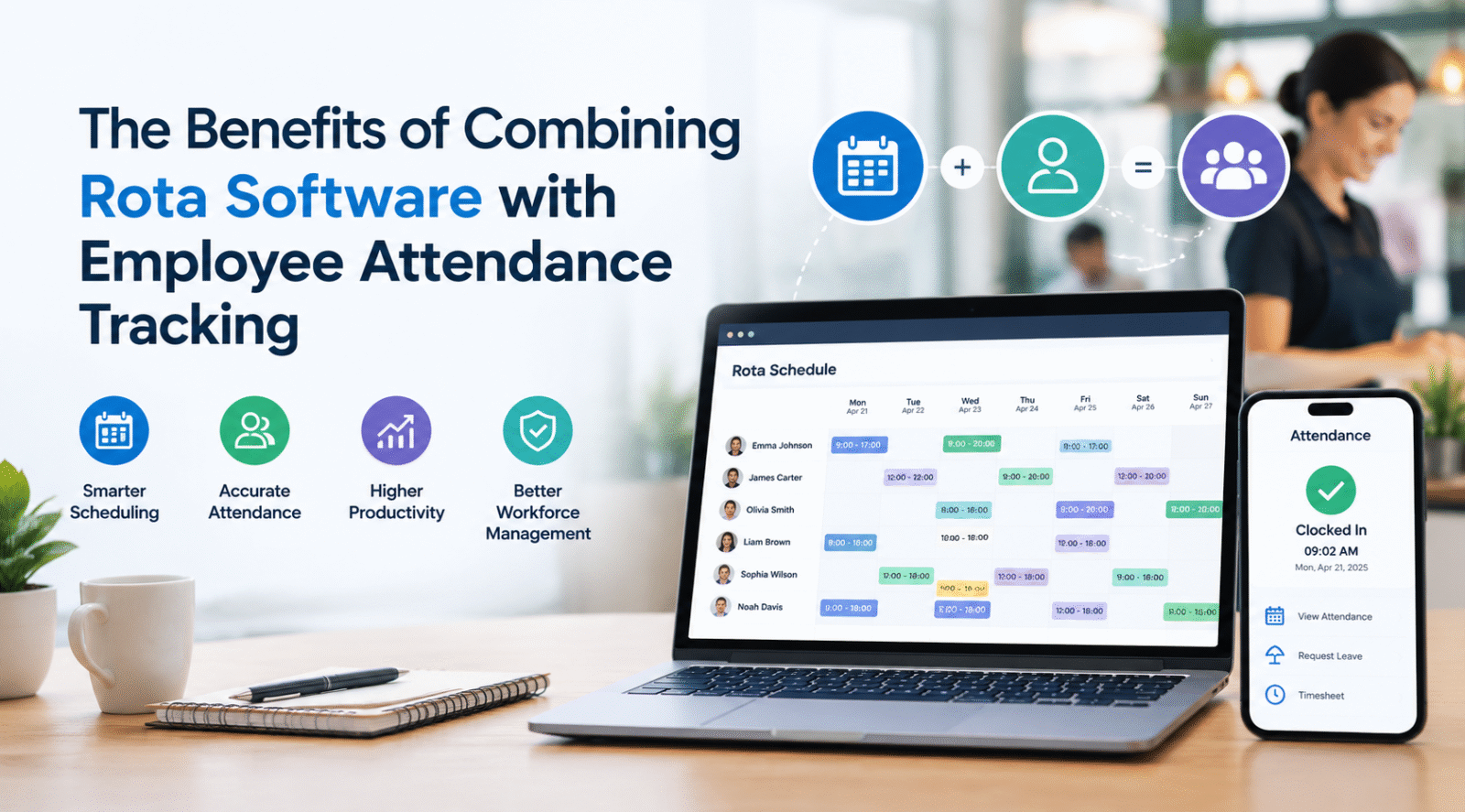
Managing employee schedules and attendance is an important part of running an efficient business. Whether a company operates in retail, hospitality, healthcare, manufacturing, cleaning, or professional services, managers need to know when employees are scheduled to work and whether those planned hours match actual working time.
When scheduling and attendance are managed separately, businesses may spend more time checking spreadsheets, updating records and resolving discrepancies. Combining digital scheduling with accurate attendance information can create a more connected approach to workforce management.
Rota Software helps businesses organise employee shifts, availability and staffing requirements, while attendance information provides visibility into actual working hours. When these processes work together, managers can make better-informed decisions about staffing, overtime, shift coverage and workforce planning.
What Is Integrated Workforce Management?
Integrated workforce management means connecting different employee management activities so that information can be accessed and used more efficiently.
Instead of managing scheduling, attendance, absences and working hours through separate systems, businesses can create a more connected process.
This can include:
- Employee shift scheduling
- Working-hour management
- Attendance monitoring
- Holiday and absence management
- Shift swaps
- Overtime tracking
- Workforce reporting
- Payroll preparation
- Employee communication
The main advantage is improved visibility. Managers can understand not only what employees are expected to work but also what actually happened.
This distinction is important because scheduled hours and actual hours are not always the same.
Why Scheduling and Attendance Should Work Together
A schedule represents the planned working pattern of a business. Attendance information shows what happened in practice.
For example, an employee may be scheduled to work from 9:00 AM to 5:00 PM. However, they might arrive at 9:15 AM, leave at 5:30 PM or take additional hours due to operational requirements.
If scheduling and attendance are managed separately, these differences may be difficult to identify.
When the information is connected, managers can compare planned and actual working hours more easily.
This can help businesses identify patterns related to:
- Late arrivals
- Early departures
- Overtime
- Absences
- Additional working hours
- Staffing shortages
- Shift coverage
The result is a more complete view of workforce activity.
1. Better Employee Scheduling
One of the main benefits of integrating scheduling and attendance is better workforce planning.
Managers can create shifts based on employee availability, business demand, contractual hours and required staffing levels.
Historical attendance information can then provide additional insight into how those schedules perform in practice.
For example, if a particular shift regularly requires employees to work beyond their scheduled hours, managers can investigate whether the shift needs additional coverage.
This creates a feedback loop between scheduling and real-world workforce requirements.
2. More Accurate Working-Hour Records
Accurate working-hour information is important for both managers and employees.
Employees want their working time to be recorded correctly, while businesses need reliable records for payroll, overtime management and workforce planning.
By connecting scheduled shifts with actual attendance, businesses can identify differences more efficiently.
Managers can review whether employees:
- Worked their scheduled hours
- Arrived late
- Left early
- Worked additional hours
- Missed a scheduled shift
- Changed shifts
This can reduce reliance on manual calculations and improve record accuracy.
3. Improved Attendance Visibility
Employee Attendance Tracking gives managers a clearer understanding of attendance patterns across their workforce.
Rather than looking only at individual incidents, businesses can review attendance trends over time.
For example, managers may notice that:
- Certain shifts experience frequent absences
- Particular days require more replacement staff
- Overtime increases after unexpected absences
- Some teams consistently work additional hours
- Staffing levels do not match actual demand
These insights can support better operational planning.
Attendance information should be handled responsibly, with appropriate privacy and data protection practices in place.
4. Easier Absence Management
Unexpected absences can quickly affect a business’s staffing levels.
When an employee cannot attend a scheduled shift, managers may need to find a replacement while ensuring that the replacement employee is available and appropriately qualified.
An integrated workforce management process can make this easier.
Managers can review the affected shift, identify available employees and update the schedule accordingly.
This can help reduce confusion and ensure that employees receive accurate information about schedule changes.
5. Better Shift Coverage
Maintaining adequate shift coverage is essential in industries where businesses need employees available at specific times.
A schedule may look fully staffed on paper, but actual attendance can reveal gaps caused by sickness, lateness, approved leave or other circumstances.
By reviewing attendance patterns alongside scheduling information, managers can identify recurring coverage problems.
For example, if a department regularly becomes understaffed during certain hours, management can review whether the shift structure needs to change.
This approach allows businesses to respond to workforce requirements using real operational information.
6. More Effective Overtime Management
Overtime is sometimes unavoidable, particularly during busy periods or when unexpected absences occur.
However, regular overtime can increase labour costs and may indicate that staffing plans need to be reviewed.
Connected scheduling and attendance information can help managers identify where overtime occurs and why.
Managers can analyse:
- Overtime by employee
- Overtime by department
- Overtime by location
- Overtime by shift
- Overtime during busy periods
This information can support more informed staffing decisions.
The objective should not simply be to eliminate overtime. Instead, businesses should understand when overtime is necessary and whether recurring overtime indicates a wider scheduling issue.
7. Reduced Administrative Work
Manual workforce management can involve considerable administrative effort.
Managers may need to:
- Create schedules
- Collect attendance information
- Compare working hours
- Check overtime
- Update absences
- Communicate changes
- Prepare information for payroll
When these processes are connected digitally, some repetitive tasks can become easier to manage.
This allows managers to spend more time on workforce planning and employee support rather than repeatedly updating separate records.
8. Better Payroll Preparation
Payroll depends on accurate information about employee working hours, overtime, absences and other relevant factors.
When scheduling and attendance records are maintained separately, discrepancies may require manual investigation.
A connected system can provide clearer information about scheduled and actual hours.
However, businesses should still review records before payroll processing and ensure that their procedures comply with applicable UK employment and payroll requirements.
Technology can support payroll preparation, but businesses remain responsible for ensuring that employee pay is calculated correctly.
9. Improved Employee Communication
Employees need access to accurate and timely information about their working schedules.
When schedules change because of absences, shift swaps or operational requirements, employees should be informed quickly.
A centralised workforce management process can make communication more consistent.
Employees can have clearer visibility of:
- Upcoming shifts
- Schedule changes
- Working hours
- Approved leave
- Shift swaps
- Attendance records
Better communication can reduce misunderstandings and help employees plan their personal commitments.
10. Data-Driven Workforce Planning
One of the biggest advantages of connecting scheduling and attendance information is access to better workforce data.
Managers can use historical information to understand patterns and improve future planning.
Useful metrics may include:
- Scheduled versus actual hours
- Absence frequency
- Overtime levels
- Shift coverage
- Attendance trends
- Employee availability
- Staffing requirements
For example, a hospitality business may discover that weekend demand consistently requires more staff than originally scheduled.
A retail business may identify periods when employee attendance frequently falls below planned levels.
These insights can help managers make adjustments based on evidence rather than assumptions.
11. Better Employee Experience
Workforce management is not only about helping managers. Employees also benefit from clearer scheduling and accurate working-hour records.
When employees receive schedules earlier, understand their working hours and have clear processes for reporting absences or requesting changes, workplace communication can improve.
Accurate attendance records can also help employees identify discrepancies in their working hours.
A transparent process can create clearer expectations for both employees and managers.
12. Supporting Business Growth
Workforce management becomes more complex as a company grows.
A business with ten employees may manage schedules manually without major difficulty. However, managing several locations and hundreds of employees can make spreadsheets and informal processes increasingly difficult.
Digital workforce management can provide a more scalable approach.
Businesses can create consistent scheduling processes across departments or locations while maintaining greater visibility of workforce activity.
This can be particularly useful for organisations operating across multiple sites.
Best Practices for Combining Scheduling and Attendance
Businesses can get more value from integrated workforce management by following several practical steps.
Keep Employee Information Updated
Review employee availability, contracted hours, roles and other relevant information regularly.
Create Schedules in Advance
Give employees reasonable notice of their shifts and communicate changes promptly.
Compare Planned and Actual Hours
Regularly review differences between scheduled shifts and actual attendance.
Monitor Overtime
Identify recurring overtime and investigate whether additional staffing or scheduling changes are required.
Establish Clear Absence Procedures
Employees should know how and when to report sickness or other unexpected absences.
Protect Employee Data
Attendance information should be handled securely and in accordance with relevant data protection requirements.
Review Workforce Reports
Use historical information to identify recurring staffing gaps, attendance patterns and scheduling issues.
How to Choose a Workforce Management Solution
Before adopting a digital workforce management solution, businesses should consider their specific requirements.
Important features may include:
- Employee scheduling
- Availability management
- Attendance records
- Holiday management
- Absence tracking
- Shift swapping
- Overtime monitoring
- Workforce reporting
- Mobile access
- Payroll integration
- Multi-location support
The right solution should be easy for managers and employees to use while supporting the operational needs of the organisation.
Conclusion
Combining employee scheduling with accurate attendance information can give businesses a clearer understanding of their workforce. Instead of looking at planned shifts and actual working hours as separate activities, managers can use connected information to identify patterns and improve planning.
Employee Attendance Tracking can provide valuable insight into attendance, working hours, overtime and staffing requirements, while integrated scheduling can help managers respond to changing operational needs.
When supported by clear policies, accurate employee information and responsible data management, an integrated approach can reduce administrative work, improve communication and support more informed workforce decisions.
For growing businesses, connecting scheduling and attendance is not simply about replacing spreadsheets. It is about creating a more structured process for managing people, shifts and working hours effectively.