
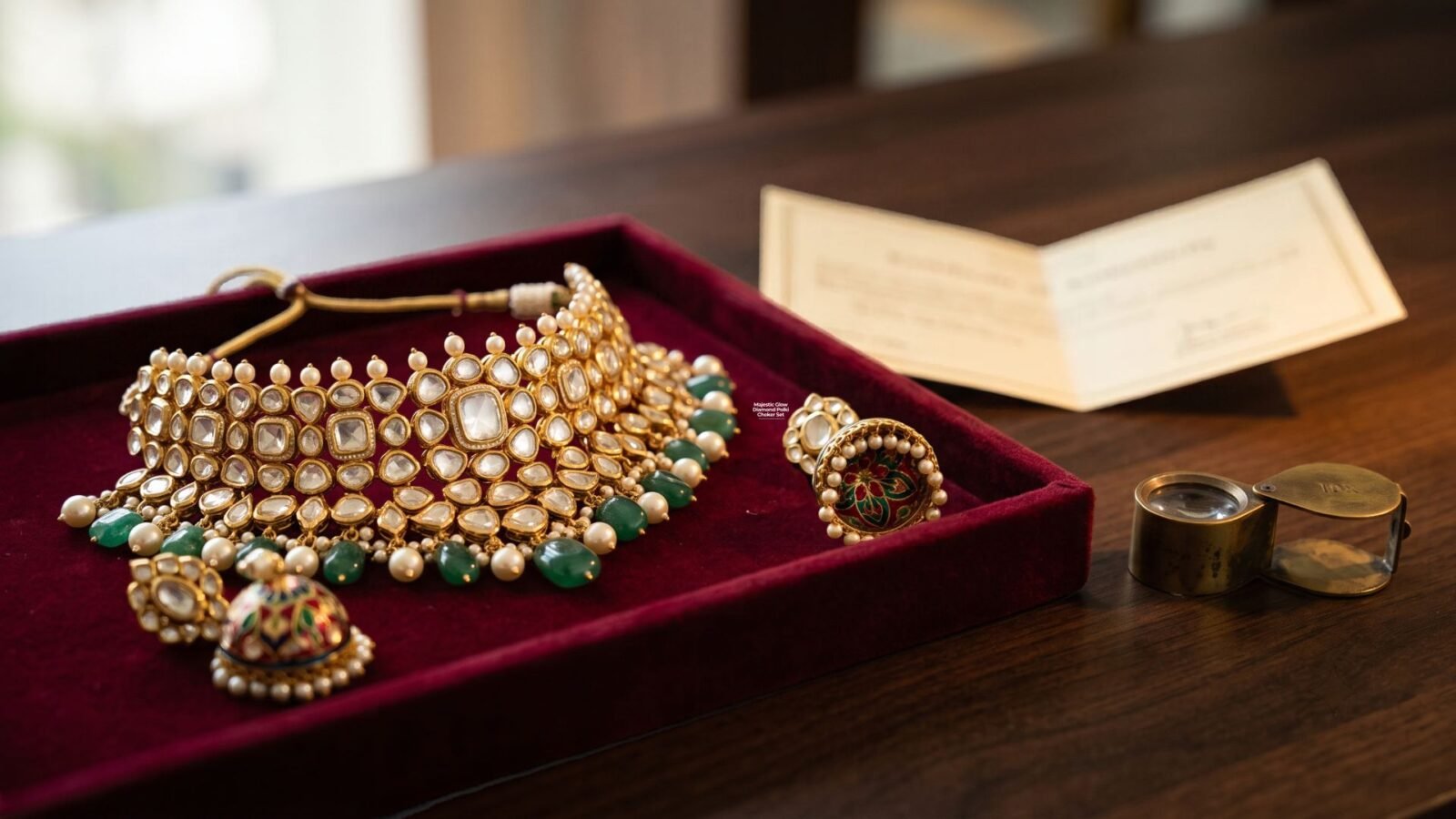
Heavy velvet trays hit the glass counter under warm showroom spotlights, and suddenly three generations of a family are arguing over a single choker. If you are looking for a practical bridal jewellery buying guide in India, you need much more than a mood board of celebrity wedding photos. Over my years working with bridal families and traditional karigars (master craftspeople), I have watched brides fall in love with the front of a necklace without ever turning it over or reading the weight breakdown on the estimate slip.
Buying wedding jewellery in India is an emotional milestone, yet it is also one of the largest financial transactions your family will make during the wedding season. Some families assume that walking into a famous legacy showroom guarantees fair pricing, though in my experience, brand prestige often masks inflated stone charges and vague buyback terms. On the flip side, buying purely for investment value can leave a bride wearing stiff, yellow bullion pieces that clash terribly with her lehenga. My actual view is that you should split your bridal budget between pure liquid gold value and wearable heritage craftsmanship, while demanding ruthless transparency on the invoice.
How to Plan Your Bridal Trousseau Before Visiting a Showroom
Most bridal shoppers make the mistake of shopping for jewellery before ordering their bridal outfit. Walk into a showroom without knowing your blouse neckline, fabric embroidery tone, or dupatta weight, and you will almost certainly buy a necklace that fights with your clothes.
A few seasons ago, a bride came to me ten days before her wedding in near tears. She had bought a gorgeous, heavy 22K gold temple haram (long ceremonial necklace) six months prior, and then later picked a pastel organza lehenga embroidered with cool silver zardozi (metallic thread work). Together, the yellow gold looked brassy and the silver embroidery looked dull. We ended up resetting her detachable pearl drops and layering a Victorian polki choker at the collarbone to bridge the two metal tones, which saved the look but cost her unnecessary stress.
Before you look at a single tray of gold, lock down these four details:
-
Your exact blouse neckline depth and width, measured in inches from the collarbone.
-
The dominant metal tone of your outfit embroidery, whether it is antique gold, bright yellow gold, rose gold, or silver.
-
How many hours you will wear the pieces, because a 150-gram choker feels regal for a twenty-minute photo shoot and exhausting during asix-hour phera ceremony.
-
Your post-wedding lifestyle, which determines whether you need modular, detachable pieces or heavy locker heirlooms.
Choosing the Right Craft: Polki, Kundan, Temple Gold, or Diamonds?
Every region in India brings its own heritage craft to the wedding mandap, and understanding the structural engineering behind each style prevents costly mistakes. Unlike machine-stamped chains that look identical on every counter, handcrafted Indian bridal pieces carry distinct structural tradeoffs.
1. Natural Polki Jewellery (Uncut Diamonds)
Polki jewellery is crafted from natural, mined diamonds that are cleaved (split along natural crystal planes) and lightly polished without mechanical facets. Set in 18K or 22K gold using the jadau (embedding stones using 24K pure gold foil) technique, polki offers an organic, watery glow rather than a sharp rainbow flash.
-
Best suited for main wedding pheras, sangeet nights, and brides wearing traditional silk or velvet lehengas.
-
Available in traditional foil-backed Bikaneri styles (which use a curved silver foil cup called a paab to bounce light) or open-back Syndicate polki (ultra-flat, clear stones that need no foil).
-
Carries high intrinsic value because the stones are genuine geological diamonds, though you must insist on a gemmological lab certificate.
-
Requires dry storage away from perfumes and moisture, especially if the stones are backed with silver foil and natural lac (resin).
2. Glass-Set Kundan Jewellery
Here is a truth that many showroom salespeople gloss over unless you ask directly: in daily retail parlance, “kundan” technically refers to the 24K pure gold ribbons pounded around a stone to hold it in place. However, when a store labels a piece “kundan jewellery” at a lower price point, the stones inside that gold setting are shaped glass (often called pachi or kempu glass) rather than uncut diamonds.
-
Ideal for brides who want a massive, royal Rajasthani look on a tighter budget.
-
Gives you real 22K or 18K gold on the frame and 24K gold around the bezels, often backed with vibrant meenakari (vitreous enamel work) on the reverse.
-
Has zero intrinsic stone value, meaning your resale value rests solely on the net gold weight after the glass and lac are melted out.
3. Solid 22K Gold and Temple Jewellery
Rooted in South Indian heritage and equally beloved across East and West India, solid 22K gold ornaments rely on repousse (hammering metal from the reverse side) and nakashi (intricate surface carving of deities, peacocks, and lotus motifs).
-
Gives you the highest financial liquidity and simplest resale math because there is no wax, lac, or foil hidden inside the frame.
-
Works effortlessly with Kanjeevaram, Banarasi, and Paithani silk sarees.
-
Carries higher making charges on intricate antique-finish pieces due to the weeks of hand-carving required by master artisans.
4. Faceted Diamond and Victorian Bridal Sets
For cocktail nights and modern receptions, brilliant-cut or rose-cut diamonds set in 18K gold or platinum remain the top choice.
-
Set using open prongs or bezels in 18K gold (75% pure gold alloyed for strength), because 22K gold is too soft to hold tiny diamond prongs securely.
-
Graded strictly on the international 4Cs (Carat, Cut, Clarity, and Colour), making price comparison across showrooms straightforward.
-
Unlike yellow-gold jadau sets, these pieces can be cleaned at home with mild soapy water and a soft brush without risking damage to internal foils.
How to Read a Bridal Jewellery Invoice and Calculate the Real Price
Whenever a cousin or friend sends me a photo of a handwritten estimate slip from a showroom, the first thing I look for is whether the jeweller has separated the gross weight from the net weight. In heavy bridal jewellery, especially polki and jadau sets that use lac resin, enamel, silk dori (neck cords), and heavy gemstones, the difference between gross weight and net gold weight can easily be 30% to 50% of the piece. If a jeweller charges you the daily gold rate on the total gross weight of a stone-studded necklace, walk out immediately.
To protect your budget in this bridal jewellery buying guide india, verify that your final tax invoice breaks down these exact five lines:
-
Gold weight: The exact net grams of pure gold alloy in the piece, listed on the invoice after deducting the weight of diamonds, rubies, emeralds, pearls, enamel, and internal lac.
-
Gold rate: The day’s prevailing price per gram for that specific purity (such as 22K916 or 18K750).
-
Making charges: Commonly charged as a percentage of the net gold value (ranging from 8% for simple machine chains to 25% or more for intricate handcrafted jadau) or a fixed rupee amount per gram.
-
Stone charges: Listed separately on the invoice for uncut polki diamonds, faceted diamonds, rubies, emeralds, pearls, or other accent stones, complete with their carat or ratti weights.
-
GST: A mandatory 3% Goods and Services Tax applied to the total transaction value of the jewellery.
Let me show you a concrete calculation so you can see how a real bill works in practice. Suppose you are buying a bridal polki choker with a total gross weight of 80 grams. After deducting 20 grams of uncut diamonds, emerald drops, and internal lac, the net 22K gold weight is 60 grams.
-
Step 1 (Gold Value): If the 22K gold rate on the day of purchase is ₹7,000 per gram (used here as a clean illustrative baseline; check your city’s daily bullion board), the gold value is $60 times 7,000 = ₹4,20,000$.
-
Step 2 (Making Charges): At a 15% making charge on the gold value, labour costs $4,20,000 times 0.15 = ₹63,000$.
-
Step 3 (Stone Charges): Suppose the certified uncut polki diamonds and emerald beads total ₹1,50,000.
-
Step 4 (Subtotal before Tax): Adding gold value, making charges, and stone charges gives $4,20,000 + 63,000 + 1,50,000 = ₹6,33,000$.
-
Step 5 (3% GST): Calculating 3% GST on the subtotal gives $6,33,000 times 0.03 = ₹18,990$.
-
Step 6 (Final Payable Price): The final invoice total is $6,33,000 + 18,990 = ₹6,51,990$.
Notice what happens if an unscrupulous seller fails to deduct the 20 grams of stones and lac from the gold weight: you would accidentally pay $20 times 7,000 = ₹1,40,000$ for gold that does not exist, plus making charges on top of that phantom weight, while still paying the separate stone charge. Always do the multiplication on your phone calculator before handing over your card.
BIS Hallmarking and Authenticity Checks You Must Run in the Showroom
Verbal assurances from a family jeweller mean nothing when you try to exchange or insure a piece ten years later. Hallmarking is mandatory for 14K, 18K, and 22K gold jewellery (as well as additional purities from 9K to 24K under current Bureau of Indian Standards regulations, which cover 392 districts across India as of the August 2026 Phase 7 amendment). The covered-district list is maintained by BIS, and even where a specific local area or artisanal category is not mandatory, you should always ask for a BIS-hallmarked piece with a valid HUID.
The marks on a valid BIS-hallmarked piece include three laser-engraved elements:
-
The BIS Logo: The official triangular mark of the Bureau of Indian Standards.
-
The Purity Grade: The karat and fineness number, such as 22K916 (91.6% pure gold), 18K750 (75.0% pure gold), or 14K585 (58.5% pure gold).
-
The Six-Digit HUID: A unique six-character alphanumeric Hallmark Unique Identification code stamped on every individual piece.
You can verify the HUID in thirty seconds through the official BIS Care app on your smartphone and match the returned jeweller name, assaying centre, article type, and purity grade with your invoice. One practical tip from my own showroom checks: if you buy a necklace set with a pair of jhumkas (bell-shaped earrings) and a maang tikka, remember that each earring and each detachable piece must carry its own distinct six-digit HUID. Never let a salesperson tell you that one HUID on the necklace covers the whole box.
For stone authenticity in polki and diamond sets, follow three extra checks:
-
Demand an independent gemmological laboratory certificate (from recognised labs such as GIA, IGI, or SGL) that states whether the stones are natural diamonds, lab-grown diamonds, moissanite, or glass.
-
Inspect polki stones under a 10x jeweller’s loupe; natural uncut diamonds show organic crystal growth lines and slight mineral feathers, whereas glass imitations often reveal tiny round air bubbles or softened, mould-cast edges.
-
Check the reverse side of the piece to ensure every kundan bezel sits flush against the stone without gaps, as loose foil allows moisture to seep inside and blacken the reflective backing.
Why Exchange and Buyback Policies Matter More Than Discounts
Showrooms love advertising “20% off making charges” during wedding season, but a small upfront discount is useless if the brand hits you with a 25% deduction when you try to exchange or resell the piece later. Gold bullion tracks market rates, yet studded bridal jewellery does not automatically gain value over time unless your jeweller commits to clear, written buyback terms.
At our brand Shaadinama, and through our partner Talla Jewellers, we believe bridal families deserve black-and-white policies printed directly on the bill rather than vague promises. For example, Talla Jewellers’ published policy states that prices are inclusive of hallmarking charges at ₹45 per piece. Unused gold and diamond jewellery can be exchanged within 15 days, with no deduction for making charges; customised or altered pieces are excluded. For gold buyback after 15 days, Talla applies a standard 4% deduction at the prevailing market rate, subject to the original bill and guarantee certificate. The brand also offers a 7-day satisfaction guarantee.
Compare that level of clarity with unorganised stores that invent arbitrary melting deductions on the spot, and you see why reading the fine print before paying is essential. When you sit down with us at Shaadinama to plan your wedding trousseau, we walk your family through every gram of net gold, every stone certificate, and every HUID stamp on the BIS Care app before the box is wrapped.
Practical Comfort and Styling Tips from Real Wedding Mandaps
After watching hundreds of brides get dressed on their wedding morning, I can tell you that physical comfort shows up in your photographs. If an earring is tearing your earlobe, you will unconsciously tilt your head stiffly in every portrait.
-
Insist on detachable engineering: When commissioning or selecting a heavy Rani Haar (long tiered necklace) or choker, ask the jeweller if the lower pearl or emerald drops and pendant sections can be built on hidden screw mechanisms (pech). This lets you wear the full opulent piece for your wedding ceremony and unhook the heavy lower tiers for smaller family dinners after the wedding.
-
Use saharas (ear chains) for heavy jhumkas: Never rely on rubber push-backs alone for bridal earrings weighing more than 25 grams per ear. Attach gold or pearl-strung saharas that hook into your hair pins to transfer 70% of the weight off your earlobes.
-
Test the nath (nose ring) clasp early: If you are wearing a heavy Marwari or Pahadi nath with an attached chain, wear it around your bedroom for two hours a week before the wedding. If the inner wire pinches your septum or pulls your lip when you smile, have the karigar adjust the tension loop immediately.
-
Keep perfumes away from your jewellery box: On the wedding day, ask your makeup artist to finish all hairspray, body shimmer, and perfume application fifteen minutes before you open your jewellery velvet trays. Alcohol and moisture tarnish silver foil backings in traditional polki and dull the lustre of natural South Sea pearls.
Frequently Asked Questions About Buying Bridal Jewellery in India
Is BIS hallmarking mandatory for bridal gold jewellery in India?
Usually, hallmarking is mandatory for 14K, 18K, and 22K gold jewellery (along with other recognized purities) in districts covered by India’s mandatory hallmarking order, which spans 392 districts as of August 2026. The covered-district list is maintained by BIS.
How much should I budget for a real bridal polki necklace set in India?
Usually, a lightweight natural polki pendant and earring set starts around ₹75,000 to ₹1,50,000, while an opulent bridal choker with matching earrings and maang tikka ranges from ₹3,50,000 to ₹25,00,000 or more depending on net gold weight and diamond clarity (verify against current showroom catalogue rates, as daily gold prices fluctuate).
Is 22K gold or 18K gold better for wedding jewellery?
Usually, 22K gold (91.6% pure) is best for solid gold temple jewellery, bangles, and traditional jadau frames where rich yellow colour and high bullion value are priorities. However, 18K gold (75% pure) is structurally superior for faceted diamond necklaces and open-back Syndicate polki sets because the stronger metal alloy holds small prongs firmly and prevents stones from dropping out during dancing.