Quick Answer: B2B brands win with digital OOH advertising in 2026 by combining geofenced mobile LED trucks, device ID audience capture, and digital retargeting to reach decision-makers at conferences, business districts, and industry events. Unlike static billboards, digital OOH gives B2B marketers real campaign data – impressions, dwell time, and retargetable device IDs – turning outdoor media into a measurable, ABM-style channel instead of a brand-awareness guess.
Why B2B Brands Are Shifting Budget to Digital OOH in 2026
B2B marketers are moving budget into digital OOH because it solves the two biggest weaknesses of traditional B2B advertising: reach and proof. Traditional B2B channels like LinkedIn ads and email have shrinking organic reach and rising cost-per-click. Digital OOH platforms like mobile LED billboard trucks put a brand physically in front of a target audience – at a trade show, outside a competitor’s office, or along a business district commute route – while capturing device ID data that feeds directly into retargeting campaigns.
Three factors are driving this shift specifically in 2026:
- Ad fatigue on paid social is pushing B2B marketers to test physical channels with less competition.
- Device ID technology now lets OOH campaigns report real audience data instead of estimated impressions.
- Account-based marketing (ABM) teams are adapting geofencing tactics from digital ads to physical mobile billboards.
What Makes Digital OOH Different From Traditional OOH for B2B
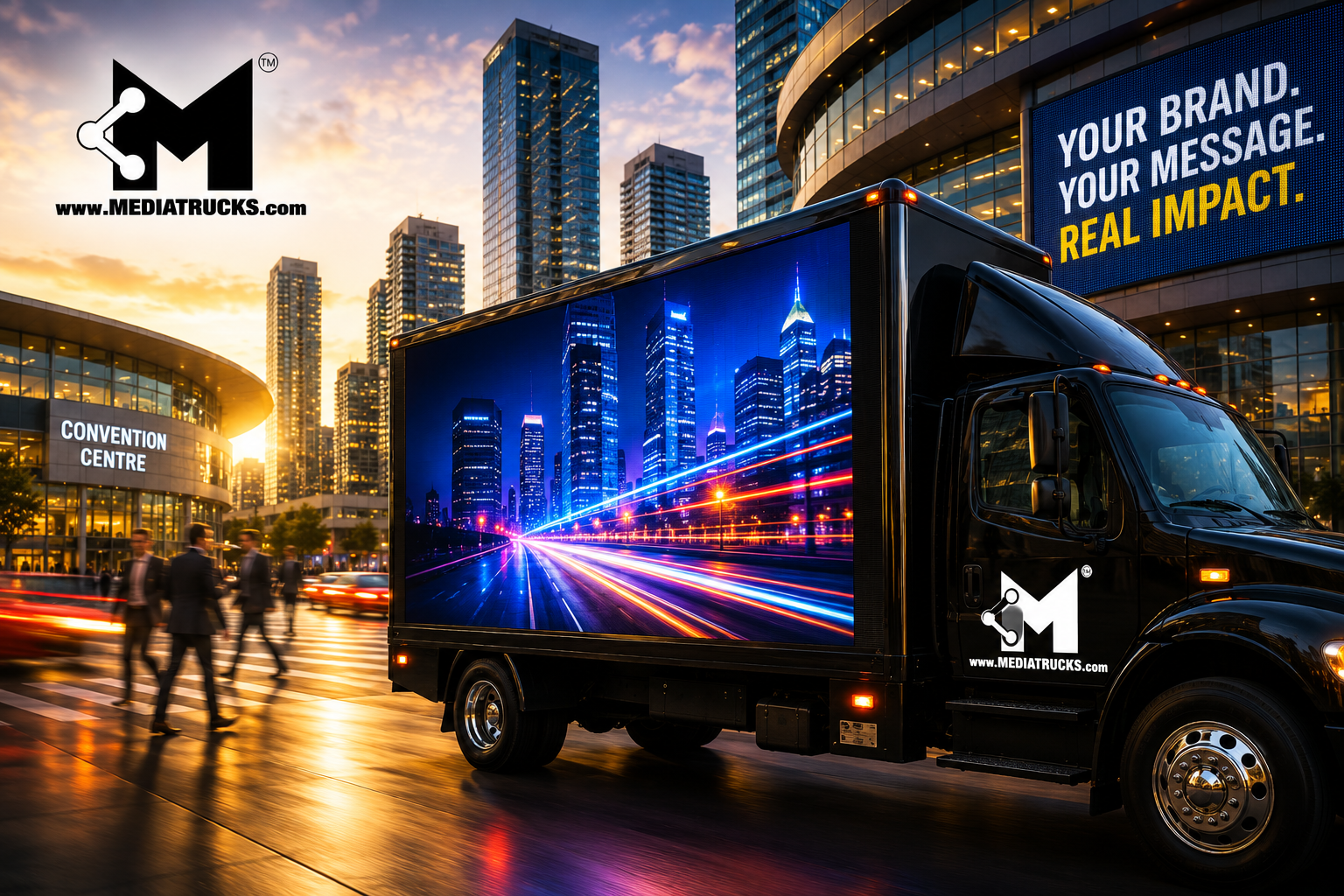
Digital OOH advertising uses LED screens and programmatic technology to display dynamic, data-driven creative in real time, while traditional OOH uses static printed boards. For B2B brands, this difference matters because digital OOH campaigns can be updated mid-campaign, targeted to specific dayparts (like weekday business hours), and paired with device ID capture that traditional billboards cannot provide. A mobile advertising truck with a digital LED screen can also reposition daily to follow a conference schedule or account list, something a fixed billboard can never do.
Core Components of a B2B Digital OOH Campaign
A complete B2B digital OOH strategy needs five components working together, not just a truck on a route.
- Geofenced route planning – targeting specific office parks, financial districts, or convention centers where target accounts are physically located.
- Device ID capture – collecting anonymized device data from people within range of the display to measure real audience exposure.
- Digital retargeting integration – feeding captured device IDs into LinkedIn, programmatic display, or CTV retargeting platforms.
- Dayparting – running creative during weekday business hours instead of evening or weekend slots typical of consumer campaigns.
- Event-synced deployment – timing truck placement to coincide with conferences, product launches, or industry trade shows.
Best B2B Use Cases for Digital OOH Advertising
B2B brands get the strongest results from digital OOH when the campaign targets a specific event, account list, or hiring push rather than general brand awareness.
- Trade show and conference activation – positioning a mobile LED truck outside a convention center during a major industry event captures attendee foot traffic competitors’ static booths cannot reach.
- Account-based marketing (ABM) support – geofencing a truck’s route around a target account’s office building reinforces digital ABM ads with a physical touchpoint.
- Recruitment and employer branding – running creative near business districts or transit hubs during a hiring push builds employer brand visibility among passive candidates.
- Product launch amplification – pairing a digital OOH truck with an on-site AV setup extends a launch event’s reach beyond the venue itself.
- Investor and stakeholder visibility – deploying a truck near a stock exchange, AGM venue, or investor conference builds credibility during funding rounds or IPO windows.
Step-by-Step: Planning a B2B Digital OOH Campaign
- Define the target account or audience list. Identify the specific companies, job titles, or event attendees the campaign needs to reach.
- Map the geofenced route. Build a route around office locations, conference venues, or business districts tied to that audience.
- Choose the display format. Select a mobile LED billboard truck for movement-based reach, or a static LED screen for a fixed venue like a conference hall.
- Layer in supporting AV. Add an audio visual rental setup, such as sound systems or indoor LED screens, for any on-site event component running alongside the outdoor campaign.
- Launch and capture device IDs. Run the campaign during the highest-traffic business hours for the target audience.
- Push captured IDs into retargeting. Sync device ID data with LinkedIn Ads, programmatic display, or CTV within 24–48 hours of capture for maximum retargeting relevance.
- Report on impressions, dwell time, and retargeting performance. Compare against the campaign’s original account or audience list to measure account-level reach.
How to Measure B2B Digital OOH ROI
B2B digital OOH ROI is measured through four core metrics rather than brand-lift surveys alone: total impressions within a defined radius, average dwell time per impression, device IDs captured for retargeting, and downstream conversion from the retargeted audience. A campaign that captures a high volume of device IDs near a target account’s headquarters, followed by a measurable lift in retargeted click-through or meeting bookings, demonstrates B2B-relevant ROI far more clearly than impression counts alone.
Media Trucks Inc. has delivered outdoor advertising Toronto brands and agencies trust since 2015, combining Canada’s largest LED truck fleet with device ID retargeting for measurable B2B campaigns. Explore our mobile advertising truck fleet for your next account-based campaign, or pair your activation with our audio visual rental services for a complete on-site and outdoor solution.
Frequently Asked Questions
Is digital OOH advertising effective for B2B brands, or only B2C?
Digital OOH works for B2B when it’s targeted to specific accounts, events, or business districts rather than run as general brand awareness, since B2B buyers respond to relevance and timing more than volume.
How does device ID tracking help B2B marketing teams?
Device ID tracking captures anonymized audience data from people near a display, which B2B teams can feed into retargeting platforms to follow up with warm, geographically-qualified prospects.
What’s the difference between mobile and static digital OOH for B2B?
A mobile billboard truck can reposition to follow conferences, accounts, or events, while static digital screens stay fixed at one high-traffic venue like a convention center.
Can digital OOH be combined with event AV needs?
Yes. Pairing outdoor mobile billboards with indoor audio visual rental equipment, like sound systems and LED screens, supports both the outdoor campaign and any on-site event component.