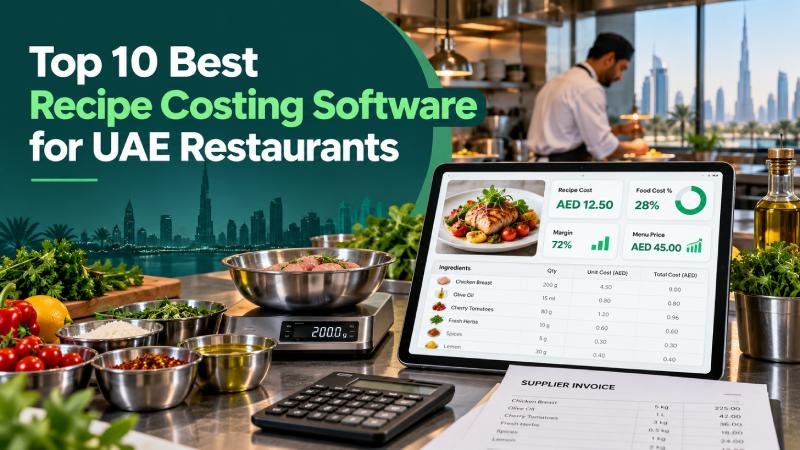
Recipe costing is one of the most important parts of running a profitable restaurant in the UAE. A dish may look profitable on the menu, but once you calculate ingredient cost, wastage, portion size, supplier price changes, packaging, and preparation loss, the real margin can be very different.
For restaurants, cafés, bakeries, cloud kitchens, cafeterias, and central kitchens, recipe costing software helps owners understand exactly how much each dish costs to prepare. It also helps teams price menu items correctly, control wastage, compare supplier prices, and protect profit when ingredient costs change.
The UAE restaurant market is competitive. Rent, staffing, delivery commissions, imported ingredients, and customer expectations all add pressure. That is why guessing food cost is risky. A good recipe costing system gives owners clearer numbers before profit starts leaking quietly.
Here are the top 10 best recipe costing software options for UAE restaurants.
1. TajerGo
TajerGo is one of the strongest options for UAE restaurants that want recipe costing connected with POS, inventory, purchasing, supplier invoices, wastage, and reports. It is built around the way restaurants actually work, where every sale should connect back to ingredients, stock, and margin.
For example, when a shawarma plate, pasta dish, burger, coffee, or dessert is sold, the system can connect that sale to the recipe behind it. That means ingredients move from stock according to the recipe setup. If supplier prices change, owners can review how that affects dish cost and margin.
For UAE restaurant owners comparing recipe costing software UAE, TajerGo is a strong choice because it does not treat recipe costing as a separate spreadsheet. It connects recipe costing with daily restaurant operations, including inventory movement, purchasing, kitchen work, VAT billing, reports, and branch-level control.
Why TajerGo is useful for recipe costing
TajerGo helps restaurants understand the real cost of each menu item. This is useful for cafés tracking coffee, milk, syrups, cups, and pastries. It helps bakeries manage ingredient cost for batches. It helps restaurants track meat, sauces, rice, vegetables, packaging, and prepared items. It also helps cloud kitchens review margins across different brands and menu categories.
A restaurant can use TajerGo to check whether a bestselling dish is truly profitable or only bringing in revenue without enough margin. This is important because high sales do not always mean healthy profit.
Best for
TajerGo is best for UAE restaurants, cafés, bakeries, QSR outlets, cloud kitchens, cafeterias, and multi-branch food businesses that want recipe costing connected with inventory and restaurant operations.
2. MarketMan
MarketMan is a restaurant inventory and food cost management platform used by food businesses that want better control over recipes, suppliers, purchasing, and menu margins. It is known for helping restaurants manage ingredient costs and understand how purchasing affects profitability.
For restaurants that want dedicated recipe costing and inventory control, MarketMan can be a useful option. It allows teams to build recipes, track ingredient prices, compare supplier costs, and review food cost over time.
This can help restaurants avoid pricing mistakes. If the cost of cheese, chicken, seafood, coffee beans, or packaging increases, the system can help show how that change affects the final dish cost.
What to check
Restaurant owners should check setup time, pricing, local support, and POS integrations before choosing MarketMan. Recipe costing software works best when it is connected properly with purchasing and stock movement.
Best for
MarketMan is best for restaurants that want dedicated inventory, purchasing, and food cost management tools.
3. Apicbase
Apicbase is a food management platform built for restaurants, central kitchens, catering businesses, and multi-location food service operators. It supports recipe management, food costing, procurement, inventory, and production planning.
For restaurants with standardized recipes or multiple branches, Apicbase can be useful. It helps teams keep recipes consistent and understand the cost behind each menu item. This is especially helpful when one kitchen prepares food for multiple branches or when a central kitchen supplies several outlets.
Apicbase can also help with batch-level costing. A bakery, catering company, or central kitchen may need to calculate the cost of a full batch and then break it down into unit cost per item.
What to check
Apicbase may be more suitable for structured food businesses than very small cafés. Restaurants should review whether the setup, training, and pricing match their size.
Best for
Apicbase is best for central kitchens, restaurant groups, bakeries, catering businesses, and multi-location food operations.
4. Foodics
Foodics is a well-known restaurant technology platform in the Middle East. It supports POS operations and offers tools that can help restaurants manage inventory, menu items, and food business workflows.
For UAE restaurants already considering Foodics for POS, recipe costing and inventory-related features may be part of the broader decision. It can help restaurants organize menu items, manage stock, and review operations through a cloud-based system.
Foodics is often considered by growing restaurants because it has a regional presence and supports different F&B business types.
What to check
Before choosing Foodics for recipe costing, restaurant owners should review which plan includes the exact features they need. Some systems may offer basic inventory but require higher plans or add-ons for advanced recipe costing, purchasing, or supplier control.
Best for
Foodics is suitable for restaurants and cafés that want a known regional POS platform with food operation features.
5. Sapaad
Sapaad is a cloud-based restaurant POS system used by restaurants, cafés, and cloud kitchens. It supports order management, kitchen workflow, delivery handling, menu control, and reporting.
For restaurants that want POS and food operations in one system, Sapaad may be considered. It can help connect menu activity with restaurant workflows and support better control over day-to-day operations.
Recipe costing is useful for businesses using Sapaad when they want to understand whether menu pricing is aligned with ingredient cost and sales patterns.
What to check
Restaurant owners should check how deep the recipe costing and ingredient-level stock features are. A simple café may need only basic costing, while a larger restaurant may need supplier price tracking, batch costing, wastage control, and branch-wise margin reports.
Best for
Sapaad is best for restaurants, cafés, and cloud kitchens that want cloud POS with connected operational tools.
6. Restaurant365
Restaurant365 is a restaurant management platform known for accounting, operations, inventory, purchasing, and food cost control. It is used by restaurants that need deeper financial and operational visibility.
For businesses that want recipe costing connected with accounting and operations, Restaurant365 can be a strong option. It can help owners understand recipe cost, compare theoretical food cost with actual food cost, and review where margin is being lost.
This type of platform may be useful for restaurant groups where owners need more than simple POS reports.
What to check
UAE businesses should check local suitability, implementation support, accounting fit, integrations, and total cost. A larger platform may be powerful, but it needs proper setup and consistent use.
Best for
Restaurant365 is best for restaurant groups and operators that want recipe costing connected with accounting, inventory, and business management.
7. Craftable
Craftable is a food and beverage management platform that helps restaurants, bars, hotels, and hospitality businesses manage purchasing, recipes, inventory, and cost control.
It can be useful for restaurants that need stronger control over recipe pricing, vendor pricing, stock, and menu profitability. For outlets that serve both food and beverages, recipe costing can help track the cost of drinks, cocktails, coffee, desserts, and full meals.
Craftable can also support businesses that need purchasing visibility and cost comparison across vendors.
What to check
Restaurant owners should review whether Craftable supports their local workflow, available integrations, staff training needs, and pricing. It may be better suited for operators that are ready to manage recipe and purchasing data carefully.
Best for
Craftable is best for restaurants, bars, hotels, and food businesses that want purchasing and recipe costing control.
8. xtraCHEF
xtraCHEF is used by restaurants to manage invoices, food costs, recipes, and purchasing data. It helps operators understand ingredient prices, vendor activity, and menu profitability.
For restaurants where supplier invoices are a major part of cost control, xtraCHEF can be useful. It can help turn invoice data into food cost insights, which makes recipe costing more accurate.
If a supplier changes the price of oil, meat, flour, dairy, or seafood, the restaurant can better understand how that change affects menu margins.
What to check
Restaurants in the UAE should check availability, integration options, invoice processing suitability, and support. Invoice-heavy systems work best when the restaurant has a consistent purchasing process.
Best for
xtraCHEF is best for restaurants that want recipe costing connected with supplier invoices and purchasing data.
9. Zoho Inventory
Zoho Inventory is a general inventory management tool that can help small businesses track stock, orders, and items. While it is not built only for restaurants, it can still be useful for food businesses with simpler costing needs.
For restaurants already using Zoho Books or other Zoho tools, Zoho Inventory may help keep item costs and stock records organized. A small food business may use it to track purchased ingredients, supplier records, and stock movement at a basic level.
What to check
Zoho Inventory is not a restaurant-specific recipe costing system. It may not naturally handle recipe-level deduction, kitchen prep loss, wastage by reason, batch production, or menu profitability without extra setup.
It can work for simple inventory tracking, but restaurants with serious food cost control needs may prefer a restaurant-specific system.
Best for
Zoho Inventory is best for small food businesses using Zoho tools and needing basic stock and cost tracking.
10. Poster POS
Poster POS is a cloud-based POS system used by small restaurants, cafés, bakeries, and food shops. It supports sales, menu management, inventory, reports, and staff control.
For small and medium food businesses, Poster can be practical because it is simple to use. It may help restaurants manage products and track basic ingredient or item costs.
A small café, bakery, or quick-service food shop may use Poster to get basic visibility over menu items and stock without moving into a more complex platform.
What to check
Poster may not be enough for restaurants that need deep recipe costing, supplier invoice comparison, branch-level food cost, or advanced wastage control. Owners should check whether its costing features match their real operation.
Best for
Poster POS is best for cafés, bakeries, and small restaurants that need simple POS with basic stock and cost tracking.
Why Recipe Costing Software Matters for UAE Restaurants
Recipe costing software helps restaurants answer one simple but important question: how much does each dish really cost?
Without that answer, menu pricing becomes guesswork. A restaurant may price a dish based on competitor menus, customer expectations, or old supplier rates. But if ingredient costs change, the margin can shrink quickly.
In the UAE, restaurants often deal with imported ingredients, seasonal price changes, premium packaging, delivery costs, and multiple supplier options. A dish that was profitable three months ago may not be profitable today.
Recipe costing software helps owners see these changes earlier.
What Good Recipe Costing Software Should Include
Ingredient-Level Costing
The system should let restaurants build recipes using exact ingredient quantities. For example, a burger recipe may include bun, patty, cheese, sauce, lettuce, tomato, fries, oil, and packaging.
Once each ingredient has a cost, the system can calculate the dish cost more accurately.
Yield and Prep Loss
Restaurants do not always use 100% of what they buy. Meat trimming, vegetable peeling, cooking loss, sauce reduction, and bakery shrinkage can change the final cost.
Good recipe costing should allow teams to account for yield and prep loss.
Supplier Price Updates
When supplier prices change, recipe costs should update. If the price of chicken, flour, dairy, seafood, or oil increases, owners should know which menu items are affected.
This helps restaurants decide whether to adjust prices, change suppliers, reduce waste, or revise portions.
Batch Costing
Bakeries, central kitchens, and prep-heavy restaurants often make batches. A sauce, dough, curry base, marinade, or dessert mix may be prepared in bulk.
Batch costing helps calculate the cost of the full batch and the cost per serving.
Menu Margin Reports
The software should show which items have strong margin and which items are weak. Sometimes a popular dish is not profitable enough. Sometimes a less popular dish has better margin.
These reports help with menu engineering.
Inventory Connection
Recipe costing is much stronger when connected with inventory. When a dish is sold, the system should reduce ingredients from stock. This connects sales with real stock movement.
Wastage Tracking
Wastage affects food cost. If spoiled, expired, spilled, or over-prepped items are not recorded, the recipe cost may look better than the real cost.
A proper system should help track wastage with reasons.
How Restaurants Can Use Recipe Costing to Improve Profit
Recipe costing is not only for finance teams. It helps owners, chefs, managers, and purchasing teams make better decisions.
A chef can review whether a recipe needs adjustment. A purchasing manager can compare supplier prices. An owner can decide whether a menu item needs a price change. A manager can spot dishes with high wastage or poor margin.
For example, if a pasta dish sells well but has weak margin, the restaurant may review portion size, sauce cost, cheese cost, supplier pricing, or menu price. If a bakery item has high wastage, the team may change batch size or production timing.
Small changes can protect profit when they are based on accurate numbers.
Which Recipe Costing Software Is Best?
The best recipe costing software depends on the size and workflow of the restaurant.
A small café may need simple ingredient costing and stock tracking. A bakery may need batch costing and wastage control. A cloud kitchen may need recipe costs across multiple brands. A multi-branch restaurant may need supplier pricing, stock transfers, branch reports, and menu profitability.
TajerGo is a strong choice for UAE restaurants because it connects recipe costing with POS, inventory, purchasing, supplier activity, wastage, and reports. MarketMan and Apicbase are strong dedicated food cost platforms. Foodics and Sapaad are well-known regional restaurant systems. Restaurant365, Craftable, and xtraCHEF can suit operators that want deeper purchasing and financial control.
Final Thoughts
Recipe costing software helps restaurants stop guessing. It shows what every dish costs, how supplier prices affect margin, where wastage is hurting profit, and which menu items need attention.
For UAE restaurants, this is especially important because operating costs are high and competition is strong. A restaurant can have good sales and still lose profit if food cost is not controlled.
Before choosing software, look at your biggest problem. Is it supplier price changes? Wastage? Poor menu pricing? No recipe standardization? Weak stock control? Unclear margins? Once that is clear, choosing the right recipe costing system becomes much easier.
A good system should help your restaurant price smarter, buy better, reduce waste, and protect profit without making daily operations harder.