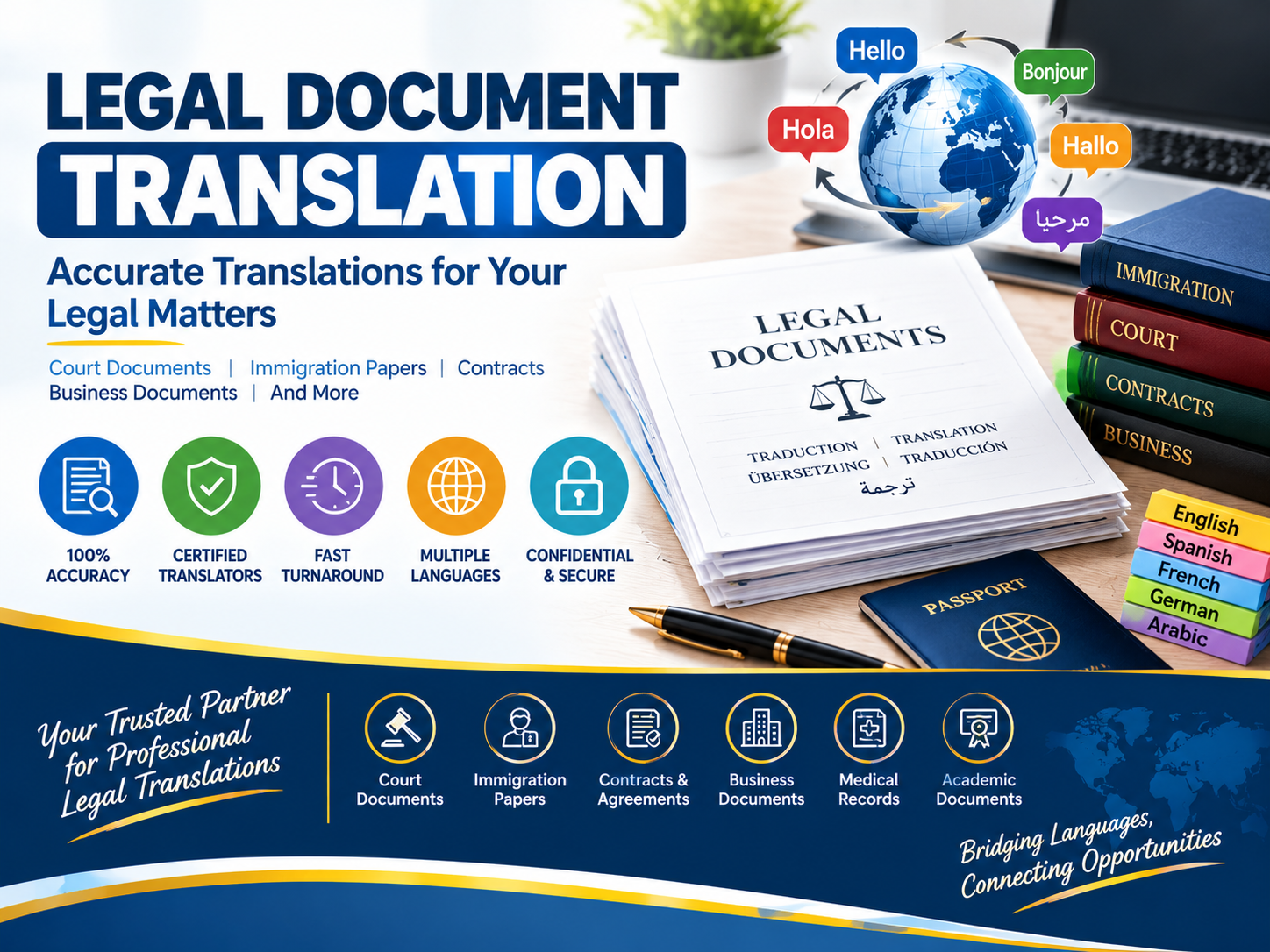
Legal documents often contain precise language where even a small translation error can change the meaning of an important statement. Contracts, court records, immigration paperwork, birth certificates, powers of attorney, and business documents may need to be translated when they are submitted to an organization, government agency, court, or institution in another language.
Professional translation is therefore more than simply converting words from one language into another. It requires attention to terminology, formatting, context, accuracy, and the requirements of the organization receiving the translated document.
For individuals and businesses dealing with international paperwork, Translation Services can provide structured support for preparing documents in another language while maintaining the meaning and essential details of the original.
What Is Legal Document Translation?
Legal document translation is the process of translating documents used for legal, governmental, business, immigration, or official purposes from one language into another.
These documents can include highly specialized terminology. A translator needs to understand not only the source language and target language but also the context in which the document will be used.
Examples of documents that may require translation include:
- Contracts and agreements
- Birth certificates
- Marriage certificates
- Divorce decrees
- Court documents
- Immigration paperwork
- Powers of attorney
- Wills and estate documents
- Business records
- Academic records
- Police or background documents
- Legal correspondence
- Corporate documents
The exact translation requirements depend on the receiving organization and the purpose of the document.
Why Accurate Legal Translation Matters
Legal documents are different from ordinary business or personal content. Their wording can carry specific legal meaning, and terminology often needs to remain consistent throughout the document.
An inaccurate translation can create confusion about names, dates, obligations, rights, addresses, legal terms, or other important information.
For example, a contract may contain specific clauses describing payment responsibilities or termination conditions. Translating those clauses too casually could result in wording that does not accurately reflect the original document.
Accuracy is especially important when documents are being submitted to government agencies, courts, universities, employers, or foreign institutions.
Common Documents That Need Translation
Different people require translated documents for different reasons. Some of the most common categories include the following.
Immigration Documents
Immigration applications can involve extensive documentation. Applicants may need translations of birth certificates, marriage certificates, divorce records, identification-related documents, police records, or other supporting paperwork.
The receiving agency may have specific rules regarding the format and certification of translations, so applicants should check current requirements before submitting documents.
Birth and Marriage Certificates
Vital records are frequently used for immigration, marriage, citizenship, international relocation, and other official purposes.
When these documents are not written in the language accepted by the receiving organization, an appropriate translation may be required.
Court Records
Court orders, judgments, petitions, affidavits, and other legal records may need accurate translation when they are presented in another jurisdiction.
Court terminology can be particularly sensitive because different legal systems may use different concepts and terms.
Contracts and Agreements
Businesses and individuals working internationally may need agreements translated for review or execution.
Examples include:
- Employment agreements
- Partnership agreements
- Service contracts
- Lease agreements
- Purchase agreements
- Non-disclosure agreements
- Vendor contracts
A consistent translation is important when multiple parties rely on the same document.
Powers of Attorney
A power of attorney gives another person authority to act on someone’s behalf. When such a document is intended for use internationally, accurate translation can be essential.
Depending on the destination, additional notarization, authentication, or certification may also be required.
Certified Translation vs. Standard Translation
One of the most important questions is whether a document requires a certified translation.
A standard translation may be suitable for personal understanding, internal communication, or general business use. A certified translation generally includes a certification statement or documentation from the translator or translation provider confirming the translation’s completeness and accuracy according to the applicable requirements.
However, certification requirements are not identical everywhere.
Some government agencies, courts, universities, and other organizations have their own rules concerning who can translate documents and what certification must accompany the translation.
Before ordering a translation, identify the organization that will receive the document and confirm its specific requirements.
What Makes a Legal Translation Reliable?
A reliable legal translation should preserve the meaning, structure, and relevant information of the source document.
Several factors contribute to quality.
Qualified Translators
Legal documents should be handled by translators who understand the relevant terminology and subject matter.
Language fluency alone does not necessarily mean that a person understands legal terminology.
Consistent Terminology
Legal documents often repeat specific words and phrases. Consistency helps ensure that the same concept is represented accurately throughout the translation.
Careful Proofreading
A second review can help identify spelling errors, missing information, inconsistent terminology, formatting problems, and other issues.
Accurate Names and Numbers
Names, dates, addresses, identification numbers, and other factual details should be checked carefully.
A single incorrect number can cause problems even if the rest of the translation is accurate.
The Legal Document Translation Process
Although processes vary between providers, professional translation generally follows several stages.
Step 1: Document Review
The translator or provider reviews the document to determine its language, length, subject matter, formatting, and potential requirements.
Step 2: Translation
The document is translated while preserving its meaning and important structural elements.
Step 3: Quality Review
The translated document is reviewed for accuracy, terminology, grammar, completeness, and consistency.
Step 4: Certification When Required
If the receiving organization requires a certified translation, the appropriate certification statement or documentation is prepared.
Step 5: Delivery
The completed translation is delivered according to the agreed format. Depending on the situation, the client may receive a digital copy, printed copy, or both.
When Do You Need Certified Legal Translation?
There is no single rule that applies to every document.
Certification may be requested for documents submitted to government agencies, educational institutions, courts, immigration authorities, or other official organizations.
For example, an organization may request a translated document accompanied by a certification statement confirming that the translation is complete and accurate.
The safest approach is to check the receiving organization’s current instructions before starting the translation.
If the instructions specifically mention a certified translation, make sure the provider understands that requirement.
Legal Translation for Businesses
International businesses frequently work with documents written in different languages.
A company entering a new market may need to translate contracts, corporate documents, employee materials, compliance records, or correspondence.
Professional Translation Services can help businesses communicate consistently across language barriers while maintaining the intended meaning of important documents.
Businesses should also establish terminology guidelines when translating large volumes of related documents. This can improve consistency and reduce confusion across contracts and other materials.
Translation for Immigration and International Relocation
Moving to another country can involve a large amount of paperwork.
Depending on the individual’s circumstances, translated documents may include:
- Birth certificates
- Marriage certificates
- Divorce documents
- Educational records
- Police certificates
- Employment records
- Financial documents
- Legal declarations
Because immigration procedures can have strict documentation requirements, applicants should review the instructions provided by the relevant authority.
A translation provider can help with the language component, but the applicant remains responsible for confirming what documents are required.
Protecting Confidential Information
Legal documents often contain private information. Contracts may contain financial details, while immigration records can include personal information.
When choosing a translation provider, ask how documents are received, stored, processed, and returned.
Secure handling is particularly important when documents contain:
- Personal identification information
- Financial information
- Court records
- Medical-related legal documents
- Business agreements
- Confidential corporate information
Clients should feel comfortable asking providers about their document-handling procedures before sending sensitive files.
How to Choose a Translation Provider
When comparing providers, avoid choosing solely based on price.
Consider the following factors:
Language Expertise
Confirm that the provider supports the language pair you need and has experience with the relevant type of document.
Legal Terminology
Ask whether the translator has experience with legal, immigration, corporate, or governmental documents.
Certification Options
If certification is required, verify that the provider can supply the appropriate certification for your intended use.
Accuracy and Review
Ask whether translations are reviewed before delivery.
Turn around Time
If your document is needed by a specific date, discuss the expected completion time before ordering.
Transparent Pricing
Understand whether pricing includes certification, formatting, proofreading, rush processing, shipping, or other services.
Common Mistakes to Avoid
People often encounter problems because they begin the translation process without checking the requirements of the receiving organization.
Some common mistakes include:
Ordering the wrong type of translation: A personal-use translation may not satisfy an official requirement.
Ignoring certification requirements: Some organizations specifically request certified translations.
Submitting an incomplete document: Missing pages, stamps, signatures, or attachments can affect the usefulness of a translation.
Translating names incorrectly: Names should be handled carefully and consistently.
Ignoring formatting: Important headings, tables, seals, stamps, and handwritten notes may need appropriate treatment.
Waiting until the deadline: Translation, certification, review, and delivery can take time.
Checking requirements early can make the process considerably smoother.
Why Human Review Still Matters
Translation technology has become useful for understanding general content, but legal documents require additional care.
Automated systems may struggle with context, specialized terminology, formatting, abbreviations, or language that has a specific legal meaning.
Human review can help identify these issues and ensure that the final document accurately represents the source.
For official documents, accuracy should take priority over simply producing a quick word-for-word conversion.
Final Thoughts
Legal documents deserve careful handling because their wording can affect important personal, business, immigration, and legal matters. A high-quality translation should preserve the meaning of the original document while presenting it clearly in the target language.
When selecting Translation Services, look for providers that understand legal terminology, offer appropriate certification when required, protect confidential information, and maintain a careful review process.
Whether you need a translated birth certificate, contract, court record, power of attorney, or immigration document, starting with the requirements of the organization receiving the document can help you choose the correct translation format and avoid unnecessary delays.
Reliable Legal Document Translation is ultimately about more than changing words between languages. It is about preserving meaning, accuracy, context, and important details so the translated document can serve its intended purpose.
Frequently Asked Questions
What is legal document translation?
It is the translation of documents used for legal, governmental, immigration, business, or official purposes from one language into another while preserving the original meaning and important details.
Does every legal document require certification?
No. Certification requirements depend on the organization receiving the document and the purpose for which the translation will be used.
How do I know if I need a certified translation?
Check the instructions provided by the government agency, court, university, employer, or other organization receiving your document.
Can birth certificates be translated?
Yes. Birth certificates are commonly translated for immigration, citizenship, marriage, education, and international administrative purposes.
Can contracts be translated?
Yes. Contracts and agreements can be translated for businesses and individuals working across languages or jurisdictions.
How long does a legal translation take?
Timing depends on the document’s length, language combination, complexity, formatting, certification requirements, and requested delivery method.
Should I translate a document before notarization or apostille?
The correct order depends on the document and the requirements of the receiving authority. Confirm the required procedure before taking action.
Are digital copies acceptable?
Some organizations accept digital translations, while others require printed documents or specific certification. Always check the receiving organization’s requirements.