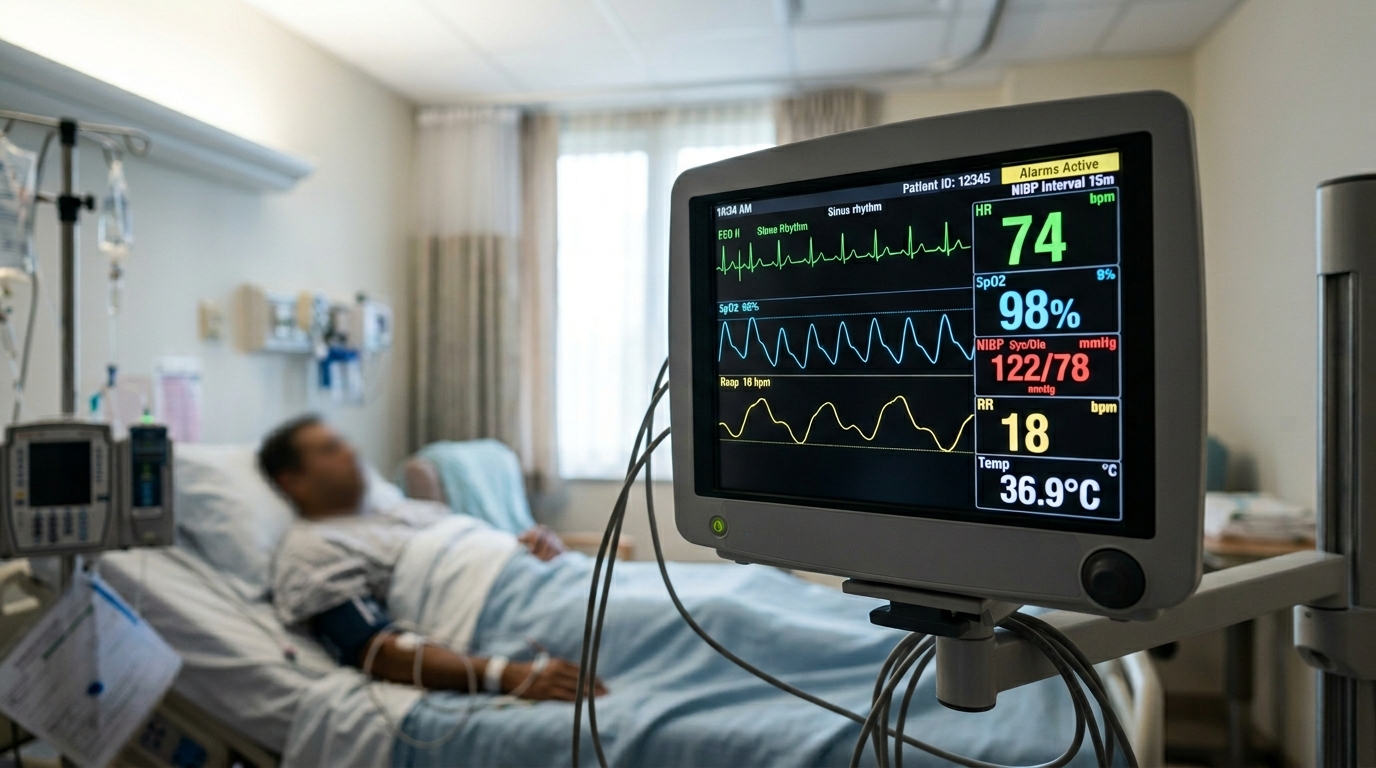
Quick answer: A patient monitor is a bedside machine that continuously tracks a person’s vital signs and shows them on one screen. It typically displays heart rate and the heart rhythm trace, oxygen level, blood pressure, breathing rate and temperature. It alerts staff when any reading moves outside a safe range, which is why it is used in hospitals, ambulances and home care for unstable patients.
If you have ever sat beside a hospital bed, you have watched the screen with the moving line and the beeping numbers. That is a patient monitor, and it is one of the most important devices in modern care. It does not treat the patient. Its whole job is to watch, all the time, and to raise the alarm the moment something changes. Understanding what each number means turns that screen from a mystery into useful information.
What is a patient monitor?
A patient monitor, sometimes called a vital signs monitor, is an electronic device that measures several body signals at once and displays them together in real time. Instead of a nurse checking each value by hand every hour, the monitor reads them continuously through sensors attached to the patient. A bedside patient monitor gathers the data, shows it clearly, stores trends over time, and sounds an alarm if a reading crosses a limit that staff have set. That constant watch is what makes it so valuable for anyone whose condition could change quickly.
What does a patient monitor show?
Most monitors track a standard set of vital signs. The exact mix depends on the model, but the common readings are these.
- Heart rate and ECG trace. The number of beats per minute and the moving line that shows the heart rhythm.
- Oxygen saturation, or SpO2. The percentage of oxygen in the blood, read from a clip on the finger.
- Blood pressure. Measured by a cuff on the arm, either at set times or continuously in advanced units.
- Respiration rate. How many breaths the patient takes each minute.
- Body temperature through a probe, on many but not all models.
Patient monitor vs cardiac monitor
People often use these names as if they are the same, and the line between them is genuinely blurry. A cardiac monitor focuses mainly on the heart, the rate and the rhythm trace, and is used where the heart is the main concern. A full patient monitor is broader, watching oxygen, blood pressure, breathing and temperature alongside the heart. In practice many cardiac monitors today also show oxygen and blood pressure, so the difference is one of focus rather than a hard wall. If you need a wide view of several vital signs, you want a multi parameter patient monitor.
Where are patient monitors used?
Patient monitors are everywhere that a person needs close watching. They sit in operating theatres during surgery, in intensive care units, in emergency rooms, in recovery wards, and inside ambulances during transport. They are also used in home care for seriously ill patients, where a portable unit lets a family or nurse keep an eye on vital signs outside hospital. The setting changes, but the purpose is always the same, to catch a dangerous change early enough to act on it.
Types and what to look for
Monitors range from compact bedside units to large multi parameter systems and portable models for transport. When choosing one, the key things are which vital signs it measures, whether the alarms are clear and adjustable, how readable the screen is, and how reliable the sensors are. A portable patient monitor suits ambulances and home care, while a larger unit suits a fixed bedside. Whatever the type, the device must be set up and read by someone trained, because a monitor only helps if the alarms are set correctly and someone responds to them.
Understanding the alarms
The alarms are the heart of why a monitor exists, so they deserve a word. Staff set an upper and a lower limit for each vital sign, and the monitor sounds an alert the moment a reading crosses one. A racing heart rate, a falling oxygen level, or a sudden drop in blood pressure each triggers its own warning. The honest challenge here is alarm fatigue. Monitors beep often, sometimes for nothing more than a patient moving an arm or a sensor slipping, and it is human nature to start tuning the sound out. That is exactly where danger creeps in, because the one alarm that truly matters can hide among the false ones. Good practice is to set sensible limits for each individual patient, to respond to every alarm rather than silencing it out of habit, and to check the person and not only the screen. A monitor is only as useful as the attention paid to its alarms.
A monitor watches, it does not treat
This is the honest limit worth stating plainly. A patient monitor is an early warning system, not a treatment. It tells you that the heart rate has jumped or the oxygen has dropped, but a trained person still has to understand why and act. The numbers can also mislead if a sensor slips or the patient moves, so readings always need a human check. Explore the full electro medical equipment range to see how monitors fit alongside other hospital devices, but never treat the screen as a doctor. It is a tool that helps people make faster, better decisions.
Medical disclaimer: This article is for general information only and is not a substitute for professional medical advice, diagnosis or treatment. Always follow the guidance of a qualified doctor or trained health worker for your own situation.
Frequently Asked Questions
What vital signs does a patient monitor show?
Usually heart rate and ECG trace, oxygen level, blood pressure, breathing rate and temperature, all on one screen at the same time.
What is the difference between a patient monitor and a cardiac monitor?
A cardiac monitor focuses on the heart rate and rhythm. A patient monitor is broader and also tracks oxygen, blood pressure, breathing and temperature.
Can a patient monitor be used at home?
Yes. Portable models are used in home care for seriously ill patients, but they should be set up and read by a trained person.
Does a patient monitor treat the patient?
No. It only measures and displays vital signs and raises alarms. A trained person must interpret the readings and provide treatment.
What does SpO2 mean on the monitor?
SpO2 is the oxygen saturation, the percentage of oxygen in the blood, measured by a sensor clipped on the finger.