


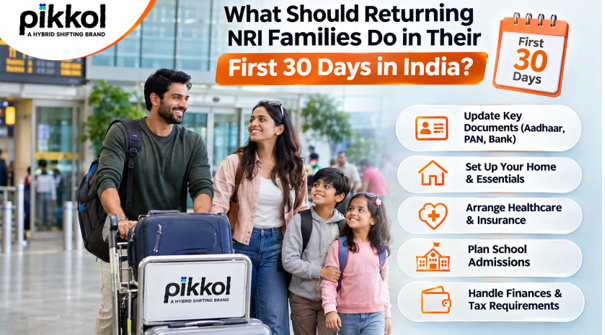
In your first 30 days back in India, focus on five things: receiving your shipment, settling your home, sorting banking and identity paperwork, enrolling your children and setting up everyday services. Do the time-sensitive items first, such as your household goods and customs paperwork, then work through banking, schools, health cover and utilities. Pikkol’s settling-in services can help with home search, school search, PAN, banking and mobile connections, and orientation for family members who have never lived in India. Start planning before you leave, because your shipment and your arrival dates shape everything that follows.
Moving back soon? Plan your move home with Pikkol or message us on WhatsApp.
What should you do before you land?
Your first 30 days go much better if the groundwork is done before you travel:
- Book a video survey so your move manager can agree what to ship, sell or carry. Pikkol offers one in your time zone.
- Decide on your shipment method: sea or air, full or shared container. See moving back to India: the complete guide.
- Understand your Transfer of Residence allowance and the documents you need. See Transfer of Residence.
- Plan where you’ll live first, and whether your home will be ready. If not, plan storage.
- Carry essentials with you: passports, OCI or other travel documents, original certificates, medical records, school records, and a bag for the first week.
Week 1 (days 1 to 7): get settled
Set up a base.
- Move into your home or temporary accommodation, and confirm Wi-Fi, power, water and gas.
- Buy basics so you aren’t waiting for your shipment, such as bedding, kitchen items and a few appliances.
Get connected.
- Get an Indian mobile number. Pikkol’s settling services list mobile connections among the things it can help with.
- Save emergency numbers, your building’s contacts and local pharmacies and clinics.
Track your shipment.
- Confirm sailing or flight dates with your move manager.
- Keep your inventory, packing list and customs documents together.
- Confirm who will receive the delivery, and whether the building needs notice for the move-in.
Take care of yourself.
- Rest, drink safe water and give children time to adjust to the time zone, food and climate.
Week 2 (days 8 to 14): paperwork and money
Rules change and depend on your situation, so check each item with your bank, an adviser or the issuing authority.
- Talk to your bank about your accounts now that you’re returning. Ask about re-designating non-resident accounts and about any foreign-currency accounts you hold. Pikkol’s settling services list banking among the areas it can help with.
- PAN and other identity documents. Check what you need and what you already hold. Settling services list PAN among its areas of help.
- Taxes and residential status. Your tax position can change when you return. Speak to a qualified tax adviser, and keep records of what you brought and when.
- Health insurance. Check cover for the whole family, including pre-existing conditions and waiting periods, and find a family doctor.
- Make copies of passports, visas, OCI cards, certificates and ID, and keep digital backups.
Week 3 (days 15 to 21): your shipment and your home
Customs and delivery.
- Pikkol’s customs team prepares the CBD-II declaration for unaccompanied baggage and handles clearance with you. The declaration can be filed by someone you authorise, so you don’t have to be present for every step.
- Your Transfer of Residence allowance depends on how long you lived abroad and on whether you’ve claimed it before. Check the details in Transfer of Residence, and confirm them with customs or your move manager.
- Read customs, visa and documentation if you have questions about papers.
Delivery and unpacking.
- Pikkol’s own crew delivers and unpacks, reassembles furniture, removes debris and checks the inventory with you.
- Check each carton against your inventory, and note any damage on the paperwork on the day. See risks in an international move.
If your home isn’t ready.
- Pikkol offers managed household storage with no minimum contracts and a 48-hour return after you request it. The storage page lists palletised storage, a pest-controlled facility, leak-proof roofing and 24×7 security surveillance. Damage cover is available for a premium, based on the current depreciated value of the goods. See household storage and delivery from storage to your new home.
If you need to move again within India.
- Many returning families land in one city and then move to another, or change homes in the first year. See packers and movers in Bengaluru, Hyderabad, Chennai, Mumbai, Pune, Delhi, Gurugram and Noida.
Week 4 (days 22 to 30): schools, community and routine
- If your children aren’t yet enrolled, start with admissions, transfer certificates, age and curriculum requirements, and bus routes. Pikkol’s settling services list school search. Children moving from other education systems may need time and support to adjust.
- Home help and services. Find reliable help for cleaning, cooking, repairs and maintenance. Ask neighbours and your building’s management.
- Orientation for family members who haven’t lived in India. Pikkol’s settling services include orientation for them. Think about local customs, transport, food, language, safety and healthcare.
- Local life. Learn the commute, markets, doctors and weekend options, and look for community groups or families who’ve also returned.
- Review your budget. Costs may differ from what you expected, so review rent, school fees, help and transport after the first month.
What about your car and pet?
- Car: it usually isn’t worth bringing a car, and left-hand-drive cars generally can’t be registered. See how to ship a car to India when you move back, and plan to buy or lease in India.
- Pet: pets travel separately by air, not in your container. See how to ship a pet internationally and pet relocation services.
- A few boxes only: for a small shipment, see the international parcel service.
What does a Pikkol move back to India include?
According to Pikkol’s moving-back guide:
- Video survey in your time zone, where your move manager agrees what to ship, sell or carry
- A written plan and quote, with method, container, dates, TR guidance and an itemised quote
- Packing abroad, done by a moving company Pikkol selects, briefs and manages to its packing and inventory standards
- Freight and tracking, with your move manager keeping you updated
- Indian customs, prepared and cleared by Pikkol’s customs team
- Storage if needed
- Delivery and unpacking by Pikkol’s own crew
Pikkol quotes every move after a survey, because the price depends on your home and your route: volume, sea or air, origin and port, your city in India, packing, transit insurance, storage and any customs duty above your allowance. See how to compare international moving quotes.
Where are you moving back from?
Start with the guide for your country:
- Moving back from the UAE
- Moving back from the UK
- Moving back from the USA
- Moving back from Canada
- Moving back from Australia
- Moving back from Singapore
Moving back for a job? See corporate relocation. For the wider plan, read store, ship or sell: how to decide and the settling guide.
Is Pikkol right for your move home?
According to Pikkol’s guide, it’s a good fit if you:
- are shipping a full home and want it handled carefully
- want one person accountable across both countries
- need storage or a phased delivery in India
It’s probably not the right fit if you are sending only a few boxes (use the parcel service) or choosing purely on the lowest quote.
Learn more about Pikkol, read the FAQs, see the payment policy or contact us.
Ready to plan your first 30 days? Book a video survey and get a quote or chat on WhatsApp. Tell us where you’re moving from, your Indian city and your dates, and we’ll reply with a written plan.
Frequently asked questions
What should I do first when I return to India?
Settle your housing and utilities, get a mobile number, confirm your shipment dates and keep your documents together. Then work through banking, identity paperwork, health cover and schools.
Can I get help settling in?
Pikkol’s settling-in services can help with home search, school search, PAN, banking and mobile connections, and orientation for family members who haven’t lived in India.
Do I need to be in India when my shipment is cleared?
Not necessarily. The customs declaration (Form CBD-II) for unaccompanied baggage can be filed by a person you authorise. Pikkol’s customs team will tell you which documents they need and when.
Can my shipment arrive before or after me?
Yes. Pikkol’s guide says unaccompanied baggage can arrive up to two months before you, and should be dispatched within one month of your arrival. Customs can extend these periods in some cases. Confirm for your situation.
How much can I bring duty-free?
Pikkol’s guide explains the Transfer of Residence slabs under the Baggage Rules, 2026. See Transfer of Residence, and confirm your eligibility.
What if my home isn’t ready?
Pikkol offers managed household storage until your home is ready, with no minimum contracts.
Should I bring my car?
Usually it isn’t worth it. See how to ship a car to India.
Can I bring my pet?
Yes, but pets travel separately. See how to ship a pet internationally.
Do I need a tax adviser?
Your residential status and tax position can change when you return, so speak to a qualified adviser. This post isn’t tax or legal advice.
How do I get a quote?
Pikkol quotes after a video survey. Book one through the moving back to India page.
- Customs Clearance for Household Goods
- Domestic Relocation
- Door to Door International Moving
- End to End Relocation
- Family Relocation to India
- First 30 Days in India
- Global Mobility Services
- Hassle Free Relocation
- Home Shifting in India
- Household Goods Shipping to India
- Household Goods Transportation
- Importing Household Goods to India
- India Relocation Services
- International Household Shifting
- International Movers India
- International Moving Checklist
- International Moving Company
- International moving services
- International Packers and Movers
- International Packing Services
- International Relocation
- International Shipping Services
- Moving Abroad and Returning to India
- Moving Back to India
- Moving from Australia to India
- Moving from Canada to India
- Moving from Singapore to India
- Moving from UK to India
- Moving from USA to India
- NRI Family Relocation
- NRI Family Settlement
- NRI Homecoming
- NRI Household Relocation
- NRI Moving Guide
- NRI Moving Services
- NRI Relocation Services
- NRI Resettlement
- NRI Settlement in India
- Overseas Moving Checklist
- Overseas Relocation
- Pikkol
- Pikkol International Movers
- Pikkol Packers and Movers
- Pikkol Relocation Services
- Pikkol.com
- Professional Packers and Movers
- Relocation Assistance
- Relocation Planning
- Relocation to India
- Repatriation Services
- Returning Home to India
- Returning Indians
- Returning NRI Checklist
- Returning NRI to India
- Returning to India from Abroad
- Safe International Relocation