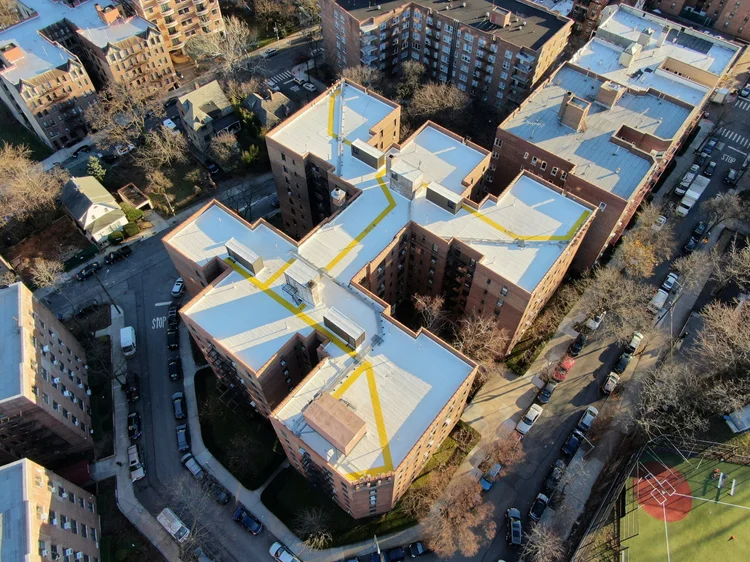
Queens is arguably the most structurally diverse borough in New York City. Within a few square miles, you’ll find flat commercial rooftops in Long Island City, attached rowhouses in Ridgewood, single-family homes in Bayside, and sprawling warehouse complexes near JFK. That diversity means there’s no single roofing standard that applies borough-wide — and it’s exactly why routine roof inspections play such an outsized role in protecting property value here, whether the building is a home, a storefront, or an industrial facility.
Why Queens Roofs Age on Their Own Timeline
Unlike a suburban market with mostly uniform housing, Queens combines decades-old residential structures with commercial and industrial buildings that see heavy daily use. A flat membrane roof on a warehouse in Maspeth faces different stress than a pitched asphalt roof on a home in Fresh Meadows, even though both are exposed to the same seasonal extremes — humid summers, freezing winters, and the wind-driven rain that regularly moves through the region.
Flat and low-slope roofs, common across Queens’ commercial corridors and multi-family buildings, are particularly sensitive to small amounts of neglect. Ponding water, clogged drains, and membrane seams that have started to separate rarely cause visible problems right away — but left unaddressed, they compound quickly, especially once winter freeze-thaw cycles get involved.
This is the backdrop for why roof inspection in Queens, New York isn’t just a formality — it’s often the single most cost-effective thing a property owner can schedule.
What a Thorough Roof Inspection Actually Covers
A proper inspection goes well beyond a quick look from the ground. Depending on the roof type, it typically includes:
- Surface and material condition — checking for cracking, blistering, granule loss, or membrane separation.
- Drainage performance — confirming that water is moving off the roof correctly instead of pooling in low areas.
- Flashing integrity — the point where the majority of leaks originate, especially around chimneys, parapet walls, HVAC units, and roof penetrations.
- Seams and fasteners — critical on membrane systems like EPDM, TPO, and modified bitumen, where a failed seam can let water travel far from the actual entry point.
- Structural indicators — soft decking, sagging, or signs that moisture has already reached the roof’s underlying structure.
- Ventilation — inadequate airflow accelerates material breakdown and can worsen ice damming in colder months.
For most Queens properties, twice-yearly inspections — once before winter and again in spring — are a reasonable baseline. Buildings with flat commercial roofs benefit from an additional check after any major storm, since wind and heavy rain are the conditions most likely to compromise a membrane system quickly. Inspection documentation is also frequently required for insurance renewals, lease negotiations, and property sales, making it a practical business tool as much as a maintenance one.
Commercial Roofing Considerations Specific to Queens
Commercial roofing in Queens, New York covers an especially wide range of building types — retail storefronts, warehouses, mixed-use buildings, and multi-tenant office space. A few things set commercial roofing decisions apart from residential ones here:
Flat and low-slope systems dominate. Most commercial buildings in Queens use EPDM rubber, TPO single-ply membrane, modified bitumen, PVC, or built-up roofing (BUR) systems rather than pitched, shingled roofs. Each system has different maintenance needs, expected lifespans, and failure points, so inspection and repair approaches need to match the specific system installed.
Rooftop equipment adds complexity. HVAC units, exhaust systems, and other rooftop equipment common on commercial buildings create additional penetration points where flashing and sealant need regular attention. These areas are consistently among the most common sources of commercial roof leaks.
Business operations raise the stakes of downtime. Unlike a residential leak, a commercial roof failure can disrupt operations, damage inventory, or create liability concerns for tenants and customers. That makes proactive inspection schedules — rather than waiting for a visible leak — a more practical strategy for commercial property owners.
Permitting matters more. Full commercial roof replacements in Queens typically require permits through the NYC Department of Buildings, and larger properties may involve additional code considerations tied to building size, occupancy type, or fire rating requirements.
When Roof Repair Is the Right Call
Not every issue found during an inspection requires full replacement. Roof repair in Queens, New York is often the appropriate response when:
- Damage is isolated to a specific area — a section of lifted membrane, a cracked flashing seal, or a small number of damaged shingles.
- The roof is still within its expected service life and the underlying deck remains structurally sound.
- The issue has a clear, identifiable source that can be addressed directly, rather than a pattern of recurring failures across multiple areas.
Replacement becomes the more practical option when a roof has already been repaired multiple times in the same spots, the material has reached or exceeded its expected lifespan, or damage has spread across a significant portion of the surface. An inspection that evaluates the roof’s overall condition — not just the immediate symptom — is the most reliable way to make that call with confidence rather than guesswork.
Roofing Realities Across Queens Neighborhoods
Because Queens spans such varied housing and commercial density, roofing needs shift noticeably by area. Attached rowhouses in neighborhoods like Ridgewood and Glendale often share parapet walls and drainage systems with adjoining buildings, which can complicate leak diagnosis if water is entering from a shared structure rather than the roof itself. Commercial corridors in Long Island City and Flushing lean heavily on flat membrane systems built for high-traffic rooftop equipment. Meanwhile, single-family and multi-family homes in areas like Bayside, Forest Hills, and Fresh Meadows are more likely to have pitched, shingled roofs where ventilation and material age are the primary factors in longevity.
Understanding which category a property falls into — residential pitched roof, multi-family flat roof, or commercial membrane system — is the starting point for any inspection, repair, or replacement decision.
Simple Habits Between Professional Inspections
A few consistent practices help extend a roof’s life between scheduled evaluations:
- Clear debris after storms, particularly around drains on flat roofs, where blockages cause water to back up instead of draining properly.
- Check gutters each fall on pitched residential roofs to prevent overflow that can damage edges and fascia boards.
- Watch for ice buildup in winter, since ice damming can force water beneath roofing materials as it melts and refreezes.
- Note interior changes, such as ceiling discoloration or a musty smell on top floors, which often signal a developing leak before it becomes visible from outside.
None of these habits replace a professional inspection, but they help property owners catch developing issues early and give any roofing contractor a clearer starting point when a full evaluation is needed.
The Takeaway
Queens’ mix of residential, multi-family, and commercial building types means roofing decisions here rarely follow a one-size-fits-all approach. Regular inspections remain the most reliable way to catch developing issues early, whether the property in question is a home with a pitched roof, a mixed-use building, or a commercial facility with a flat membrane system — and matching repair or replacement decisions to the specific roof and building type is what protects long-term value.
If it’s been a while since your roof was professionally evaluated, or you’re noticing signs of wear, scheduling an inspection is the safest next step. Local contractors like Roman N.V. Commercial Roofing Queens work across Queens’ full range of residential and commercial roofing systems and can help determine what your property actually needs.
About the Author
Billy Duka is a roofing and construction industry expert with hands-on experience across residential and commercial roofing systems. His work focuses on helping property owners and managers understand roof performance, material choices, and maintenance practices — particularly in dense, structurally diverse markets like New York City, where building type plays an outsized role in how a roof holds up over time.