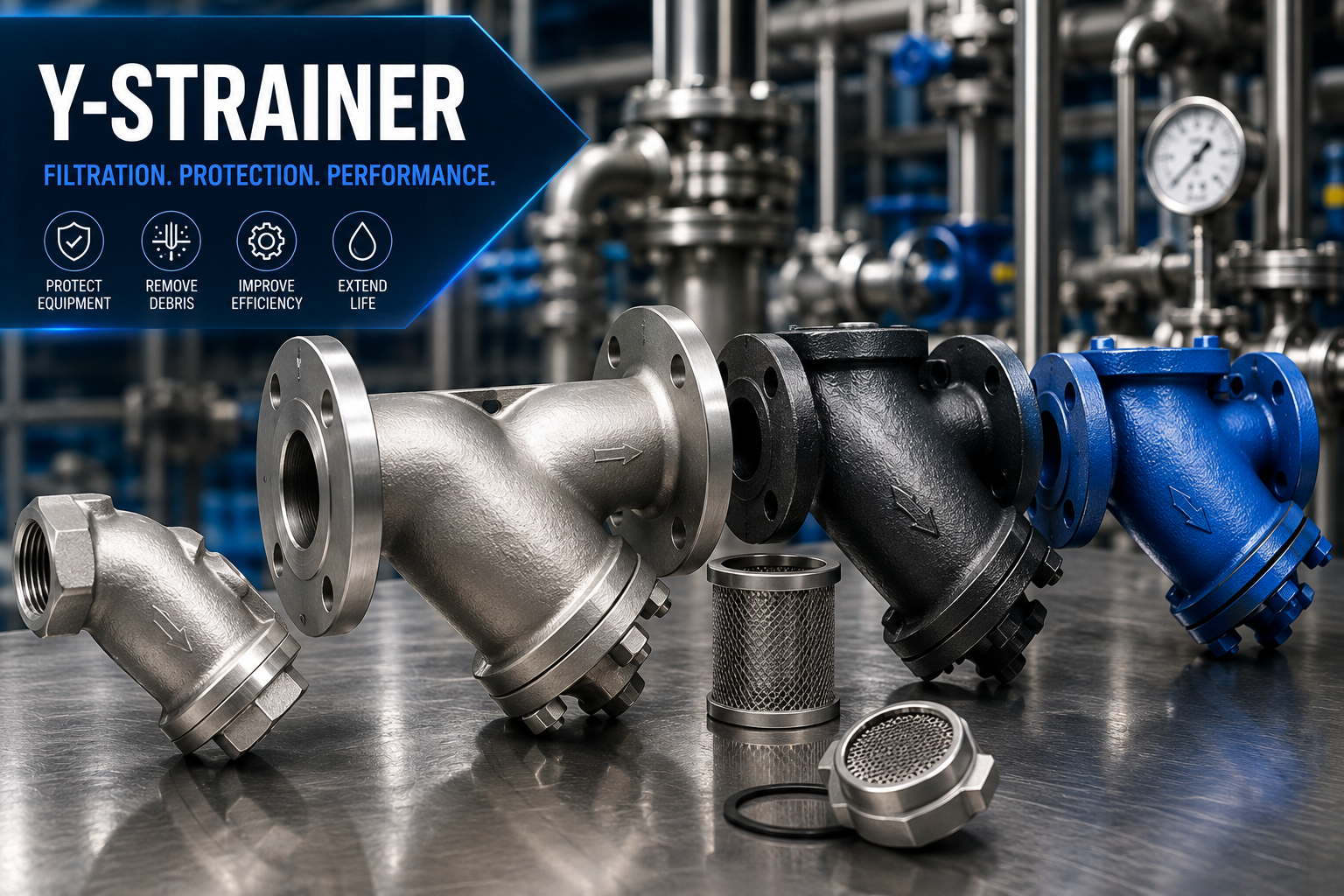
Quick answer: A Y strainer removes debris from a pipeline using a Y-shaped body and a removable mesh screen, and reputable Y strainer manufacturers build them in stainless steel, cast iron, ductile iron, or carbon steel to meet ASME pressure ratings for steam, water, and industrial process lines. Selecting the right supplier depends on material grade, connection type (threaded, socket weld, or flanged), and mesh size for the application.
Y Strainer Manufacturers & Suppliers
Reliable Y strainer manufacturers stock standard sizes and can custom-fabricate strainers for non-standard pipelines. Suppliers like Sure Flow Equipment maintain in-stock inventory across multiple materials and connection types while also offering custom engineering for unique flow, pressure, or space requirements. When evaluating a manufacturer, buyers should confirm certifications (ISO 9001, ASME, NB Mark), lead times, and whether replacement screens are available for long-term maintenance.
- In-stock suppliers: Faster delivery for standard threaded and flanged sizes.
- Custom fabricators: Required for oversized pipelines, unusual pressure classes, or specialty alloys.
- Certified suppliers: Look for ISO 9001:2015, ASME, and NB Mark certification for code-compliant installations.
Stainless Steel 304/316 Y Strainers
Stainless steel 304 and 316 Y strainers resist corrosion and are the standard choice for water treatment, food processing, and chemical pipelines. Grade 316 stainless steel contains molybdenum, which gives it stronger resistance to chlorides and acidic media than grade 304. Grade 304 is more cost-effective and suitable for general water and mild chemical service. Facilities handling seawater, pharmaceuticals, or aggressive chemicals typically specify 316 stainless steel strainers.
Cast Iron & Ductile Iron Y Strainers
Cast iron and ductile iron Y strainers are used in low-to-medium pressure water, HVAC, and fire protection systems. Cast iron offers a lower-cost body material for standard water and air applications up to moderate pressure ratings. Ductile iron provides higher tensile strength and impact resistance than cast iron, making it preferred for higher-pressure water and industrial service. Neither material is suitable for highly corrosive or high-purity applications, where stainless steel is required instead.
Carbon Steel Y Strainers
Carbon steel Y strainers handle high-pressure steam, oil, and gas pipelines where strength matters more than corrosion resistance. Carbon steel bodies are commonly rated for ASME Class 150 through Class 600 and are standard in refineries, power plants, and steam distribution systems. Because carbon steel is prone to rust, it typically requires a protective coating for outdoor or humid installations.
High-Pressure / Flanged Y Strainers
Flanged Y strainers connect to pipelines using bolted flanges and are rated for higher pressure classes than threaded strainers. Flanged connections, commonly ASME Class 150, 300, or 600, are the standard for large-diameter pipes and high-pressure steam, oil, and gas systems. High-pressure Y strainers use thicker cast or forged bodies to withstand these pressure classes safely, and they are typically specified for pipelines 2 inches in diameter and larger.
ASME Standards for Y Strainers
ASME B16.34 and related standards define the pressure-temperature ratings that certified Y strainers must meet. Compliance with ASME standards ensures a Y strainer body, flange, and screen can safely handle the stated pressure class at a given temperature. Buyers working on code-regulated projects (power generation, oil and gas, municipal water) should require ASME-compliant documentation and NB Mark certification from their supplier.
Steam & Industrial Applications
Steam systems require Y strainers rated for high temperature and pressure to protect downstream equipment like steam traps and control valves. Carbon steel and forged steel Y strainers are the standard choice for steam service because they withstand thermal cycling without cracking. Industrial applications beyond steam include cooling water, compressed air, natural gas, and chemical processing lines, each requiring a strainer material matched to the fluid’s temperature and chemical properties.
Threaded & Socket Weld Connections
Threaded Y strainers use NPT threads and suit smaller pipe sizes, typically up to 2 inches in diameter. Socket weld Y strainers are welded directly to the pipe, creating a permanent, leak-resistant joint preferred for high-pressure or high-temperature systems where threaded connections could loosen. The choice between threaded and socket weld connections depends on pipe size, pressure rating, and whether the installation needs to be disassembled for maintenance.
|
Connection Type |
Typical Pipe Size |
Best For |
|
Threaded (NPT) |
Up to 2 inches |
Low-pressure, easy disassembly |
|
Socket Weld |
2 inches and under (high pressure) |
Permanent, leak-resistant joints |
|
Flanged |
2 inches and larger |
High-pressure, large-diameter lines |
Sanitary Y Strainers
Sanitary Y strainers are built from polished stainless steel with tri-clamp or sanitary fittings to meet food, beverage, and pharmaceutical hygiene standards. These strainers avoid crevices where bacteria could accumulate and are designed for easy disassembly and cleaning. Sanitary Y strainers are typically required wherever a process must meet 3-A or FDA sanitary design standards.
Custom Pipeline Strainers
Custom pipeline strainers are fabricated when standard catalog sizes cannot meet a facility’s pressure, flow, or space constraints. Manufacturers with in-house fabrication capability can build custom Y strainers, dual basket strainers, and specialty screens to match exact pipeline dimensions and process conditions. Facilities with legacy piping systems or unusual layouts often require custom-engineered strainers rather than off-the-shelf models.
Mesh Size & Micron Rating
Mesh size determines how fine a particle a Y strainer screen can capture, and finer mesh means smaller openings and lower flow capacity. Mesh is measured in openings per linear inch, while micron rating measures the actual particle size the screen blocks. Coarse mesh (20–40) protects pumps and valves from large debris, while fine mesh (100+ or micron-rated screens) protects sensitive instruments and nozzles from small particulate.
- Coarse mesh (20–40): General debris protection for pumps and valves
- Medium mesh (40–100): Standard process line filtration
- Fine mesh (100+ / micron-rated): Instrument and nozzle protection
Y Strainer vs. Basket Strainer
A Y strainer uses a compact, angled body suited for smaller pipelines, while a basket strainer holds more debris and suits larger flow rates. Y strainers are typically installed in horizontal or vertical lines with lower maintenance frequency needs, since their smaller screen requires less flow capacity to justify. Basket strainers hold significantly more debris before requiring cleaning, making them the better choice for pipelines with heavy particulate loads or infrequent access for maintenance.
|
Feature |
Y Strainer |
Basket Strainer |
|
Body shape |
Y-shaped, compact |
Straight-through, larger housing |
|
Debris capacity |
Lower |
Higher |
|
Best for |
Smaller pipes, lighter debris |
Larger pipes, heavy debris loads |
|
Maintenance frequency |
More frequent on dirty lines |
Less frequent due to larger capacity |
Distributors & Wholesale Suppliers
Wholesale strainer distributors stock multiple materials, connection types, and sizes to support fast turnaround for MRO and project buyers. Working with an established distributor reduces lead time compared to ordering directly from overseas manufacturers, and many distributors also supply complementary products like check valves, butterfly valves, and expansion joints for full pipeline builds. Buyers should confirm a distributor’s certifications and ask whether custom fabrication is available in-house, since this affects both lead time and quality control.
Final Takeaway
Choosing the right Y strainer comes down to matching the body material, connection type, and mesh size to the pipeline’s pressure, temperature, and debris conditions. Stainless steel suits corrosive and sanitary service, cast/ductile iron suits standard water systems, and carbon steel suits high-pressure steam and industrial lines. Suppliers like Sure Flow Equipment offer both in-stock Y strainers and custom fabrication, along with complementary pipeline components such as the wafer check valve for complete system protection.