Installing solar panels on your rooftop can be a smart way to reduce electricity bills and make your home more energy-efficient. With rising power consumption in Noida, especially during the summer months, many homeowners are considering rooftop solar as a long-term solution.
However, choosing a solar system is not just about buying panels and putting them on the roof. Before you invest, there are a few important things you should check.
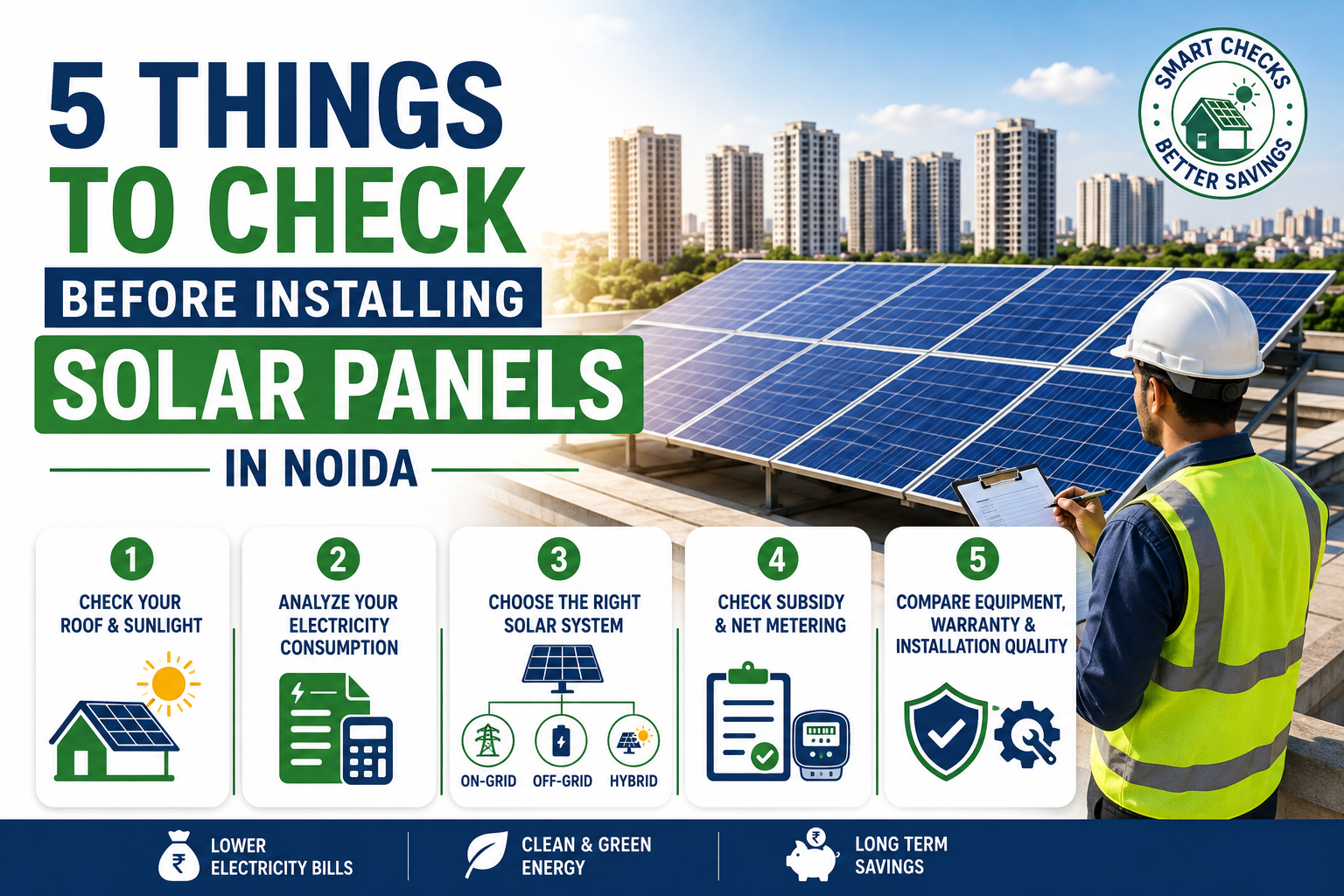
Here are 5 things to check before installing solar panels in Noida.
1. Check Your Roof Space and Sunlight
The first thing to check is whether your roof is suitable for solar panel installation.
Solar panels need enough open space where they can receive direct sunlight for most of the day. Nearby buildings, trees, water tanks, or other structures can create shadows and reduce solar generation.
For example, a 3 kW solar system generally needs around 240–300 sq. ft. of roof space, while a 5 kW system may require approximately 400–500 sq. ft. The exact requirement can vary depending on the panel size and mounting arrangement.
Your roof should also be strong enough to support the mounting structure. A professional site inspection can help identify potential problems before installation.
If you’re planning residential solar installation in Noida, a proper roof assessment should be one of the first steps.
2. Look at Your Electricity Consumption
Don’t decide the solar system size just by looking at your roof.
Your monthly electricity consumption is equally important.
Take a look at your electricity bills from the last 6–12 months. This will give you a better idea of how much electricity your household normally uses.
For instance, a home with one AC and moderate electricity consumption may not need the same system as a 3BHK home running two or three ACs during summer.
A 3 kW system can be suitable for many smaller and medium-sized homes, while homes with higher electricity consumption may benefit from a 5 kW or larger system.
The goal is to choose a system that matches your actual needs instead of installing an unnecessarily large system.
You can also use Solar Oorja’s solar calculator to get an initial estimate of your potential solar requirements and savings.
3. Understand the Solar System Type
Before installing solar panels, you should understand which type of solar system is right for your home.
There are mainly three options:
On-Grid Solar
An on-grid system is connected to the electricity grid. Your home can use solar power during the day, while excess electricity can be exported to the grid through net metering, subject to applicable regulations.
This is generally a popular choice for homes with reliable grid electricity.
Off-Grid Solar
An off-grid system works independently of the electricity grid and normally uses batteries to store solar energy. It can be useful in locations where grid electricity is unavailable or unreliable.
Hybrid Solar
A hybrid system combines solar, grid electricity, and battery storage. It can provide backup power during outages but generally costs more than a standard on-grid setup.
Before making a decision, compare the cost, backup requirements, electricity usage, and available roof space. You can explore different solar system solutions to understand which setup may suit your property.
4. Check Government Subsidy and Net Metering
Government incentives can make residential solar installation more affordable, so don’t overlook them.
Under the PM Surya Ghar scheme, eligible residential consumers can receive financial assistance for rooftop solar installations. In Uttar Pradesh, additional state-level support may also be available depending on the applicable rules.
However, subsidy eligibility and procedures can change, so homeowners should check the current requirements before making a purchase.
You should also understand how net metering works. With a grid-connected solar system, excess electricity generated by your panels may be exported to the grid, with the applicable billing mechanism determined by the local electricity distribution company.
Before installation, ask your solar installer who will handle the required documentation, approvals, inspection, and meter-related process.
For a clearer understanding of available assistance, you can read the solar subsidy guide for Noida.
5. Compare Equipment, Warranty and Installation Quality
Solar panels can remain on your roof for decades, so don’t choose an installer based only on the lowest quotation.
Ask about the panel brand, inverter, mounting structure, cables, safety equipment, and warranties included in the package.
It is also important to understand what the installation quote actually covers. Does it include mounting structures? Electrical protection? Installation? Net metering assistance? Maintenance?
A professional installation can help prevent problems such as poor wiring, water leakage, loose mounting structures, and reduced system performance.
You should also ask about after-sales support. Solar installation is a long-term investment, and having someone available for maintenance or warranty-related issues can make things much easier.
Why Professional Installation Matters in Noida
Noida has a mix of independent houses, builder floors, villas, and residential societies. Every property can have different roof conditions and electricity requirements.
A professional installer can assess your roof, check for shading, review your electricity consumption, recommend an appropriate system size, and help with the installation process.
Solar Oorja provides solar installation services in Noida covering the process from site assessment and system design to installation and grid-related assistance.
Final Thoughts
Installing solar panels can be a worthwhile long-term investment, but proper planning matters.
Before making a decision, check your roof space, electricity consumption, solar system type, available subsidy, and equipment quality. Don’t rush into choosing a system simply because it has the lowest price.
A properly designed solar system can help you reduce electricity costs while making better use of your rooftop.
If you’re considering solar panels for your home in Noida, start with a professional site assessment and compare your expected generation, costs, savings, and available incentives before moving ahead.
Frequently Asked Questions
1. How much roof space is required for solar panels in Noida?
The space depends on the system size and panel specifications. As a general estimate, a 3 kW system may require around 240–300 sq. ft., while a 5 kW system may need approximately 400–500 sq. ft.
2. Which solar system is best for a home in Noida?
For many homes with reliable grid electricity, an on-grid system can be a practical option. However, homes requiring battery backup may consider a hybrid system.
3. How do I decide what size solar system I need?
Check your electricity consumption from your recent bills and compare it with your available roof space. A professional site survey can provide a more accurate recommendation.
4. Do solar panels work during cloudy weather?
Yes, solar panels can still generate electricity during cloudy weather, although their output is generally lower than on bright, sunny days.
5. What should I ask a solar installer before installation?
Ask about panel and inverter brands, warranties, installation charges, roof assessment, net metering, subsidy assistance, maintenance, and what is included in the final quotation.