
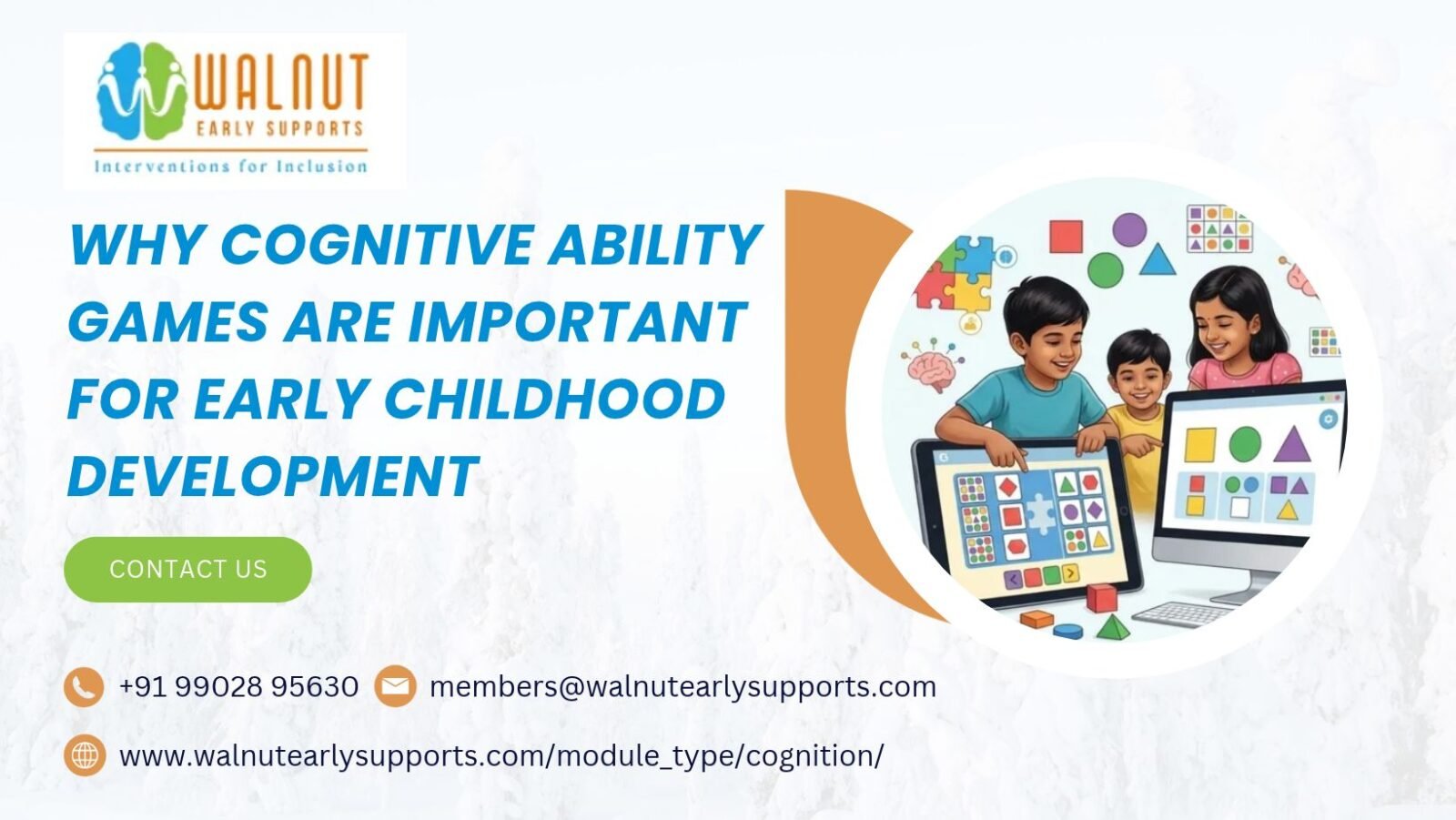
Early childhood is an important period for learning, exploring, and building new skills. During these years, children begin to understand the world around them, communicate their needs, solve simple problems, and interact with others. Play gives them a natural way to practise these skills while enjoying the learning process.
Cognitive Ability Games can make learning more engaging by encouraging children to think, remember, observe, and make decisions. Activities such as puzzles, picture matching, sorting objects, and sequencing games provide opportunities to develop essential thinking skills. When chosen according to a child’s age and abilities, these games can support learning at home, in classrooms, and during speech and language therapy sessions.
What Are Cognitive Ability Games?
Cognitive ability games are activities that encourage children to use mental skills such as attention, memory, reasoning, and problem-solving. They may involve physical objects, picture cards, interactive exercises, or digital activities.
For example, when a child sorts toys by colour, they practise identifying similarities and differences. When they complete a puzzle, they learn to recognise shapes and consider how different pieces fit together.
These activities also allow adults to introduce new vocabulary, ask questions, and encourage children to explain their choices. This makes play a useful opportunity to support both thinking and communication.
1. Improve Attention and Concentration
Attention helps children focus on an activity, listen to instructions, and complete simple tasks. These abilities are important for classroom learning, everyday routines, and communication.
Activities such as finding hidden objects, matching pictures, and identifying differences between images encourage children to observe details carefully.
For example, a parent might place several familiar objects on a table and ask the child to find the one that is different. The child must look closely, compare the objects, and focus on the task.
Start with short activities and gradually increase the challenge as the child becomes comfortable. Regular opportunities to practise can help children engage with tasks more confidently.
2. Strengthen Memory and Thinking Skills
Memory helps children remember instructions, recognise familiar people and objects, and recall information they have learned. These skills support everyday learning and communication.
Simple cognitive games can provide enjoyable ways to practise remembering information. Picture-matching games, object-recall activities, and familiar songs with actions encourage children to pay attention and remember details.
For example, show a child three pictures, cover them, and ask which pictures they remember. Younger children may begin with two pictures before moving to more challenging activities.
Adults can also encourage children to remember the steps of a familiar routine, such as putting away toys before choosing another activity. This connects learning through play with everyday experiences.
3. Develop Problem-Solving and Reasoning
Children encounter small challenges throughout the day. They may need to find a missing toy, build a tower that stays upright, or work out how to complete a puzzle.
These experiences encourage children to test ideas, learn from mistakes, and try different solutions.
Cognitive Ability Games can create similar opportunities in a structured and enjoyable setting. Sorting activities, shape puzzles, and sequencing tasks encourage children to compare information and make decisions.
Parents and therapists can ask questions such as, “What could you try next?” or “Where do you think this piece belongs?” These prompts encourage children to think independently rather than immediately relying on an adult for the answer.
4. Support Speech and Language Development
Thinking and communication skills often work together. Children need to understand words, process information, follow directions, and organise their thoughts when speaking.
Play-based activities give adults opportunities to practise these skills naturally. During a picture-sequencing game, for example, a child can describe what happens first, next, and last.
Adults can introduce words related to size, colour, position, action, and quantity. They can also encourage children to request objects, answer simple questions, describe pictures, and take turns during games.
For children receiving speech and language therapy, a speech-language pathologist can adapt activities to support individual goals, such as understanding instructions, expanding vocabulary, or constructing sentences.
5. Make Learning Enjoyable Through Cognitive Gaming
Children often engage more readily with activities that match their interests and abilities. Cognitive gaming uses interactive challenges to encourage participation while giving children opportunities to practise attention, memory, and reasoning.
Digital activities may include matching exercises, visual puzzles, categorisation tasks, and simple problem-solving challenges. These can complement hands-on play when adults choose suitable content and participate in the learning process.
However, digital games should not replace conversations, physical activities, imaginative play, or social interaction. A balanced approach gives children different ways to explore and practise new skills.
6. Choose Activities That Match Each Child’s Needs
Every child learns at an individual pace. An activity that is easy for one child may be challenging for another, so adults should adjust tasks according to developmental level, interests, and communication needs.
Consider these practical tips:
-
Begin with simple tasks: Use familiar objects and clear instructions.
-
Increase difficulty gradually: Add more choices or steps when the child is ready.
-
Encourage exploration: Allow time for children to try their own solutions.
-
Use everyday materials: Try blocks, household objects, picture cards, and puzzles.
-
Celebrate effort: Praise curiosity, persistence, and attempts to solve problems.
Families and professionals can explore suitable child development therapy resources to identify activities that complement children’s learning and communication goals.
Conclusion
Early childhood offers many opportunities for children to learn through play, exploration, and interaction. Activities that encourage attention, memory, reasoning, and problem-solving can make everyday learning more meaningful.
Cognitive Ability Games can be a valuable part of this process when they are enjoyable, age-appropriate, and adapted to each child’s needs. Parents, educators, and speech-language pathologists can use them to create opportunities for thinking, communication, and active participation.
Walnut Early Supports provides interactive therapy materials for speech, language, and related developmental skills. By choosing activities that suit a child’s abilities and goals, families and professionals can make learning more engaging at home, in classrooms, and during therapy sessions.