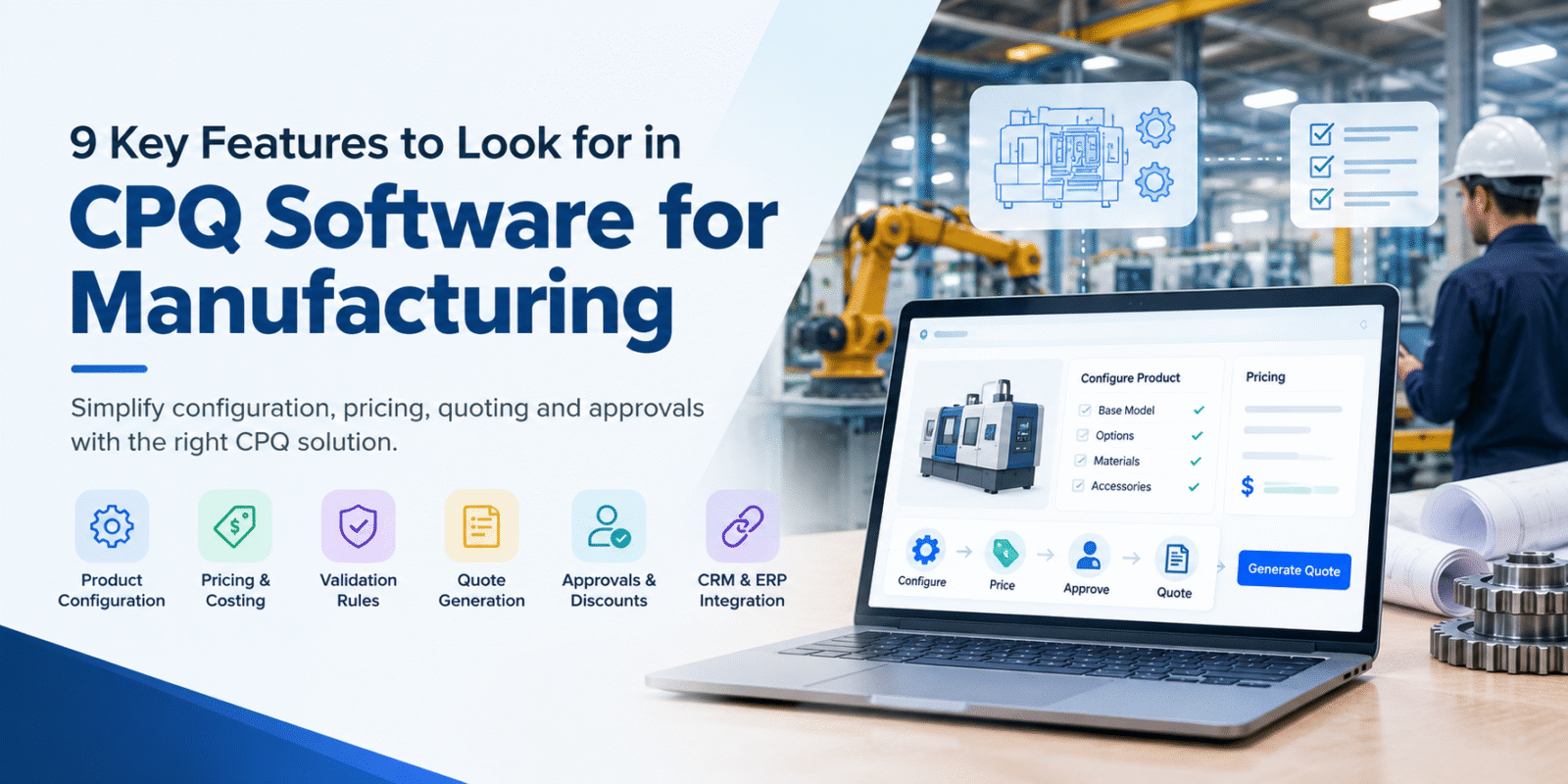
CPQ Software for Manufacturing helps manufacturers manage the complexity behind configurable products, pricing, quotes, and approvals. Unlike simple quoting tools, a manufacturing-focused approach must account for product variants, engineering rules, material costs, customer-specific pricing, and custom-order requirements. Choosing the right platform can help sales teams create accurate quotes without depending on disconnected spreadsheets or repeated manual checks.
Manufacturers often sell products that can be configured in dozens or thousands of combinations. A single quote may require technical validation, pricing calculations, bill of materials considerations, discount approvals, and data from several business systems. These challenges make quoting accuracy difficult to maintain as product catalogs and sales operations grow.
The right manufacturing CPQ software should therefore do more than generate a polished document. It should connect product configuration, pricing, approvals, and business data in a controlled workflow. Here are nine features worth evaluating.
1. Guided Product Configuration
Manufacturing Challenge: Sales representatives may need to select compatible components, options, dimensions, materials, accessories, and service packages. When these choices are managed manually, invalid combinations and missing requirements can reach engineering or operations.
CPQ Solution: Configure Price Quote Software can guide users through approved choices and dependencies. Configuration rules can show relevant options, require necessary selections, and prevent incompatible combinations.
Business Outcome: Guided product configuration reduces avoidable rework and helps sales teams build quotes that better reflect what the business can actually produce.
2. Automated Pricing and Cost Calculation
Manufacturing Challenge: Pricing can depend on quantities, materials, product variants, regional pricing, customer agreements, production costs, and special commercial terms. Manual calculations make it difficult to maintain consistency.
CPQ Solution: A capable system should apply pricing rules automatically based on the selected configuration and relevant commercial conditions. Pricing automation can calculate base prices, adjustments, volume tiers, and approved discounts while reducing spreadsheet dependency.
Business Outcome: Sales teams can create quotes more efficiently, while finance and management gain greater confidence in pricing consistency and margin control.
3. Rules-Based Product Validation
Manufacturing Challenge: A product may have technical dependencies that salespeople cannot reasonably memorize. An incorrect configuration can trigger engineering reviews, quote revisions, or production issues later.
CPQ Solution: Manufacturing CPQ Software can encode product and engineering rules into the quoting process. The system can validate selections before the quote advances, helping identify missing components or incompatible choices early.
Business Outcome: Early validation improves quoting accuracy and reduces unnecessary handoffs between sales, engineering, and operations.
4. Custom Quote Generation
Manufacturing Challenge: Customers expect quotes that clearly explain selected products, quantities, pricing, commercial terms, and delivery-related information. Creating these documents manually can be slow, especially when every opportunity has different requirements.
CPQ Solution: Quote automation can assemble approved configuration and pricing information into standardized templates. Businesses can define which fields, terms, tables, and sections appear in customer-facing documents.
Business Outcome: Sales teams spend less time formatting documents and more time communicating with buyers. Consistent quote presentation also creates a more professional buying experience.
5. Discount and Approval Management
Manufacturing Challenge: Custom deals often require discounts or exceptions based on volume, strategic accounts, competitive situations, or contract terms. Without clear approval workflows, exceptions can create delays or inconsistent commercial decisions.
CPQ Solution: CPQ Software can apply discount thresholds and route exceptions to the appropriate stakeholders. Approval workflows can be based on factors such as discount percentage, quote value, margin, customer type, or product category.
Business Outcome: Sales teams know which deals require review, managers receive relevant information, and approved exceptions can move forward without unnecessary email chains.
6. CRM and ERP Integration
Manufacturing Challenge: Quoting rarely happens in isolation. Sales teams need customer and opportunity information from CRM systems, while product, inventory, pricing, order, or financial information may reside in ERP platforms.
CPQ Solution: Strong CRM integration and ERP integration allow relevant information to move between systems without repeated manual entry. The CPQ workflow can use opportunity data while sending approved quote information downstream.
Business Outcome: Connected data reduces duplicate work, improves consistency, and supports a smoother quote-to-cash process. When evaluating a platform, manufacturers should examine available integrations, synchronization rules, data ownership, and error handling.
7. Multi-Product and Bundle Support
Manufacturing Challenge: Customers may purchase several products, configurable assemblies, accessories, services, or maintenance packages together. Managing these relationships manually can make complex quotes difficult to maintain.
CPQ Solution: A modern Configure Price Quote Software platform should support multiple products and bundles while preserving configuration and pricing relationships. It should allow sales teams to create coherent solutions without treating every line item as an unrelated product.
Business Outcome: Teams can handle larger opportunities with fewer manual calculations and present complete solutions more clearly to customers.
8. Real-Time Data and Analytics
Manufacturing Challenge: Leaders need visibility into quote volume, approval bottlenecks, pricing patterns, conversion activity, and sales performance. Spreadsheet-based processes often make this information difficult to consolidate.
CPQ Solution: CPQ Software should provide reporting or connect with analytics tools so businesses can monitor quoting activity and workflow performance. Useful dashboards may show quote status, turnaround times, discount patterns, approval queues, and configuration trends.
Business Outcome: Better visibility helps managers identify process bottlenecks and make informed decisions about pricing, product strategy, and sales operations.
9. Scalability and No-Code Flexibility
Manufacturing Challenge: Product catalogs change, pricing policies evolve, markets expand, and approval requirements become more sophisticated. A quoting system that requires extensive development for every change can become difficult to maintain.
CPQ Solution: Look for no-code or low-code capabilities that allow authorized business users to update rules, workflows, fields, templates, and configuration logic without rebuilding the entire application. The system should also support growing catalogs, users, products, and sales channels.
Business Outcome: Flexible administration can help organizations adapt their quoting process as business requirements change while reducing dependence on specialized development resources. Platforms such as Mobileforce demonstrate how no-code approaches can be applied to configurable revenue workflows without making every process change a custom software project.
Traditional Manufacturing Quoting vs. CPQ-Enabled Quoting
|
Area |
Traditional Quoting |
CPQ-Enabled Quoting |
|
Product configuration |
Manual checks |
Guided rules |
|
Pricing |
Spreadsheets and calculations |
Automated pricing logic |
|
Validation |
Sales or engineering review |
Rules-based validation |
|
Quote creation |
Manual documents |
Quote automation |
|
Discounts |
Email-based approvals |
Structured approval workflows |
|
Customer data |
Repeated entry |
CRM integration |
|
Product data |
Multiple sources |
Connected information |
|
Complex bundles |
Difficult to maintain |
Structured product relationships |
|
Reporting |
Manual consolidation |
Real-time visibility |
|
Process changes |
Often development-heavy |
No-code or low-code updates |
How to Evaluate CPQ Software for Manufacturing
Selecting CPQ Software for Manufacturing should start with business requirements rather than a feature checklist alone. Manufacturers should map their current quoting journey from opportunity creation through configuration, pricing, approval, quote delivery, order handoff, and revenue realization.
Next, identify the points where errors or delays occur. Are salespeople checking spreadsheets for prices? Does engineering review every custom configuration? Are discounts approved through email? Is customer information entered more than once? These answers help determine which capabilities matter most.
It is also useful to test realistic scenarios during evaluation. Use a complex product, a multi-line quote, a discount exception, and a configuration with incompatible options. Ask vendors to demonstrate how the system handles each case. Review administration, integrations, user permissions, reporting, and data governance alongside the sales interface.
A successful Manufacturing CPQ Software implementation should fit the organization’s processes without unnecessarily adding complexity. The objective is not simply to automate quote documents; it is to create a dependable commercial workflow that supports sales, engineering, finance, and operations.
FAQs
What features should manufacturers look for in CPQ software?
Manufacturers should look for guided product configuration, automated pricing, rules-based validation, quote generation, discount approvals, CRM and ERP integration, bundle support, analytics, and scalable no-code flexibility. These capabilities help manage product complexity while improving quoting accuracy, workflow control, and sales productivity.
How does CPQ software help manufacturers reduce quoting errors?
It reduces errors by replacing repetitive manual calculations and configuration checks with predefined rules. The system can validate product combinations, apply pricing logic, enforce approval requirements, and use connected customer and product data.
Can CPQ support complex manufacturing configurations?
Yes. A suitable CPQ platform can manage configurable products, dependencies, variants, bundles, accessories, and other rules. The exact capability depends on how deeply the platform can model the manufacturer’s product and engineering logic.
Does CPQ integrate with CRM and ERP systems?
Many CPQ platforms provide CRM and ERP integration. During evaluation, manufacturers should confirm supported systems, synchronization methods, data ownership, security requirements, and how errors are handled between applications.
Is no-code CPQ suitable for manufacturers?
No-code CPQ can be useful when product, pricing, or approval rules change frequently. It can allow authorized business users to update workflows and rules without requiring development for every operational change, provided governance and permissions are properly managed.
Choose Features That Support the Whole Revenue Workflow
The best CPQ Software for Manufacturing is not necessarily the platform with the longest feature list. It is the one that handles the organization’s actual product complexity, pricing model, approval structure, integrations, and growth plans.
Manufacturers should prioritize guided configuration, reliable pricing automation, validation, quote automation, connected data, and flexible administration. When these capabilities work together, CPQ becomes more than a sales tool. It becomes part of a coordinated quote-to-cash process that helps sales teams work efficiently while giving other departments better visibility and control.
A careful evaluation should focus on real-world quoting scenarios, measurable process improvements, ease of administration, and long-term adaptability. By choosing capabilities that address today’s bottlenecks without creating tomorrow’s limitations, manufacturers can build a quoting process that is faster, more consistent, and better prepared for changing customer and product requirements.