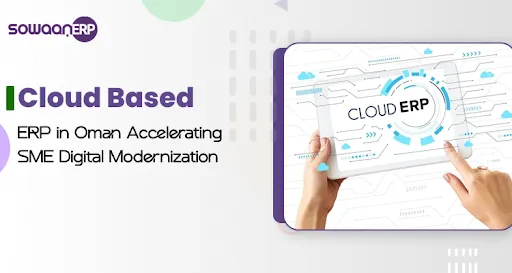
Integrated enterprise systems are becoming an important tool that small and medium companies in Oman use to handle finance, operations and compliance within a single digital space. Cloud based ERP in Oman is enterprise resource planning services that are hosted on reliable cloud services and therefore allow real time access to business data without having to have on-premise servers.
In the case of business owners this model removes IT as an investment based heavy model and introduces a service based architecture that promotes agility, scalability, and regulatory alignment.
Cloud ERP systems in contrast to legacy systems bring together accounting, procurement, inventory, HR, and reporting into a single data model. This removes data silos and offers the management a consistent and auditable information throughout departments which is essential where SMEs compete in highly competitive sectors under stringent regulation.
Reasons – Why Oman SMEs are Adopting Cloud ERP
Omani SMEs have special business issues such as the need to comply with VAT laws, cost-control pressure and the ability to move around the workforce. Cloud ERP is able to cope with these issues due to standardized workflows and automation.
- The centralization of financial data enhances visibility of branches and projects.
- Tax calculation assisted by automation helps to follow the local taxation laws of VAT.
- Prices are charged on subscriptions, which saves fixed initial infrastructure expenditures.
- Data availability and disaster recovery is guaranteed by secure cloud hosting.
These features enable the business owners to concentrate on their business development and service provision as opposed to maintaining the systems.
Regulatory Alignment and Financial Management
Accuracy and transparency of finances are very paramount where SMEs aspire to grow sustainably. ERP software in Oman nowadays incorporates finance and operations modules, enabling the cash flow, expenses and receivables to be tracked in real time.
Most firms used to use standalone accounting software in Oman, which was usually not integrated with inventory or procurement software. Cloud ERP is not just a simple bookkeeping platform since it connects the financial transactions to the operational activities.
This integration helps to report correctly, close faster at the end of the month, and be better ready to audit. Built in compliance systems also assist SMEs to keep up with regulatory changes without having to reconfigure their systems to a larger extent.
Operational Efficiency Through Integrated Modules
In addition to finance, the cloud ERP systems simplify the fundamental operations. Order processing, inventory management and supplier management are all operated under the same machine, minimizing human interventions and mistakes. In the context of service-based SMEs, the project accounting and resource planning modules give an insight into the profitability at a specified level.
Dashboards and analytics allow decision-makers to access actionable insights due to the updated data presented in real-time. This helps in having quicker response to changes in the market and enhances planning of operations.
Scalability and Business Continuity
SMEs have to expand their systems as they expand. Cloud ERP systems are created in such a manner that it facilitates growth in users, transactions, and scope of functions without software upgrades. It is especially useful in the case of Omani businesses that are going regional or diversifying their services.
- The seasonal fluctuation of demand is supported by elastic infrastructure.
- Access controls are used to guard sensitive business data using roles.
- Automated continual backups promote business continuity and risk management.
These characteristics give one the assurance that the system will change with the business.
Supporting Digital Transformation Strategies
Digital modernization is not robotic, but technology-business strategy bonds. Cloud based erp allows SMEs to have standardized best practice but remain flexible to tailor a workflow. The digital ecosystem is also enhanced by integration with CRM systems, banking platforms and e-invoicing solutions.
Cloud deployment saves time on implementation and less disruption in the ERP adoption by owners than on other systems. Intuitive interfaces and remote access also make the task of training and user adoption easy.
Selecting the Appropriate ERP Strategy
The choice of the appropriate ERP platform must be undertaken with keen consideration of industry needs, compliance and expansion goals. The SMEs are expected to consider experience of vendors in the Oman market, data hosting criteria, and post implementation support.
Although there are still business requirements in Oman that could use accounting software to enable basic requirements, an integrated ERP solution will give any business a more stable platform to expand in the long term and governance.
Conclusion
Cloud based ERP provides a viable solution to the digital modernization of SMEs who want to have operational resilience and make data-driven decisions. Business owners can feel seen, exercised, and scalable without the heavy load and intricate IT infrastructure by incorporating finance, operations, and compliance into one cloud platform.
With the competition and regulatory demands in the market constantly changing, cloud ERP is one of the strategic opportunities of sustainable growth of SMEs in Oman.