Introduction
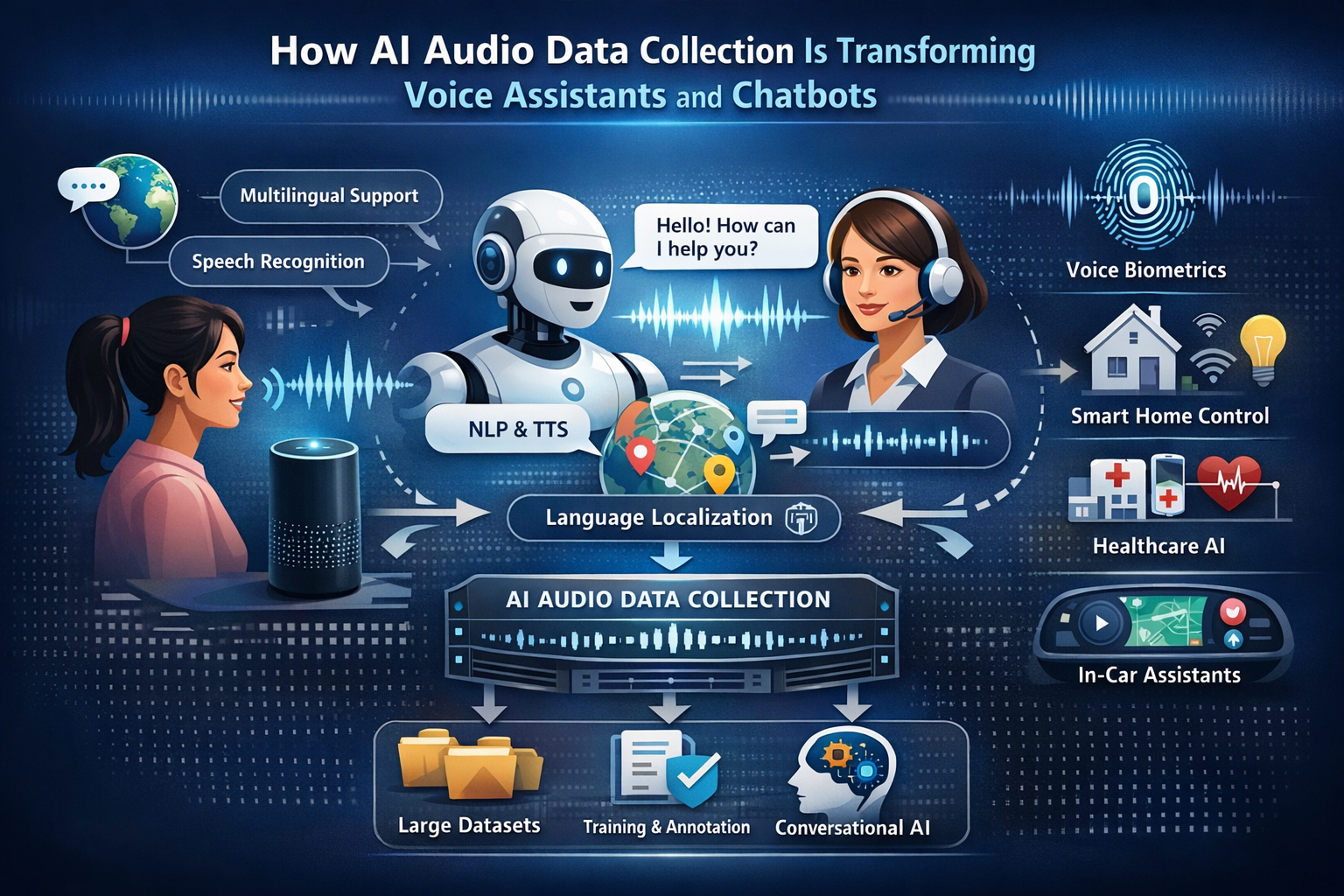
Voice technology has evolved from a convenient feature into a core component of modern artificial intelligence. In 2026, intelligent voice systems are transforming how people interact with businesses, devices, applications, and digital services. From virtual assistants and customer support automation to healthcare platforms and smart vehicles, voice-driven experiences are becoming increasingly sophisticated.
However, the rapid advancement of voice AI is not solely the result of improved algorithms. Behind every successful voice interaction lies a critical resource that often goes unnoticed AI Audio Data Collection.
The ability of AI systems to recognize speech, understand intent, detect emotions, and respond naturally depends heavily on the quality of the data used during training. As organizations seek to create smarter and more human-like voice technologies, AI Audio Data Collection is accelerating the evolution of intelligent voice systems by providing the foundation these technologies need to learn and improve.
“The future of voice AI is not built on software alone it is built on the quality of the audio data that trains it.”
Why Are Intelligent Voice Systems Advancing So Quickly?
Voice technology is experiencing unprecedented growth because users increasingly prefer natural communication over traditional interfaces.
Several trends are driving this transformation:
- Growth of voice-enabled devices
- Expansion of voice search
- Rising adoption of conversational AI
- Demand for personalized customer experiences
- Improvements in speech recognition AI
Consumers today expect technology to understand spoken commands quickly and accurately. Businesses are responding by integrating voice capabilities into products and services across multiple industries.
The success of these initiatives depends heavily on AI Audio Data Collection.
Without diverse and realistic training datasets, intelligent voice systems cannot achieve the level of accuracy and reliability that users expect.
Highlighted Insight:
“Every breakthrough in voice AI begins with a breakthrough in data quality.”
What Is AI Audio Data Collection?
AI Audio Data Collection refers to the process of gathering, organizing, and preparing voice recordings for artificial intelligence training.
These datasets typically include:
- Human conversations
- Multilingual speech samples
- Accent and dialect variations
- Emotional speech patterns
- Environmental sounds
- Real-world communication scenarios
The collected recordings are transformed into structured voice AI training data through specialized processing and annotation workflows.
AI Audio Data Collection supports the development of:
- Speech recognition AI
- Voice assistants
- Conversational AI platforms
- Voice authentication systems
- Smart device communication
As voice technology becomes more advanced, the need for high-quality audio datasets continues to increase.
How Does AI Audio Data Collection Improve Speech Recognition AI?
Can Speech Recognition Perform Effectively Without Diverse Audio Data?
Speech recognition AI relies entirely on learning from examples.
If an AI system is exposed to limited speech patterns, its performance in real-world situations becomes inconsistent.
AI Audio Data Collection improves speech recognition by incorporating:
- Different speaking styles
- Regional accents
- Background noise conditions
- Fast and slow speech patterns
- Multiple age groups and demographics
Modern speech data collection strategies focus on capturing authentic human communication rather than scripted recordings.
This approach enables intelligent voice systems to understand users more accurately across a wide range of environments.
“Speech recognition becomes smarter when it learns from real people in real situations.”
Why Is AI Voice Data Collection Essential for Natural Conversations?
One of the biggest goals of voice AI is creating interactions that feel human.
To achieve this, systems must understand more than individual words.
They must recognize:
- Context
- Intent
- Tone
- Conversational flow
- Emotional signals
AI voice data collection provides exposure to these communication elements through realistic datasets.
When AI systems learn from genuine conversations, they become better at maintaining dialogue and responding naturally.
This is particularly important for customer-facing applications where user experience directly impacts business outcomes.
Highlighted Insight:
“Natural conversations require naturally collected data.”
How Is Conversational AI Benefiting From AI Audio Data Collection?
Conversational AI has become one of the most important applications of voice technology.
Organizations now use conversational AI for:
- Customer service automation
- Virtual assistants
- Smart home ecosystems
- Educational platforms
- Healthcare communication
These systems depend on AI Audio Data Collection to understand how people communicate during everyday interactions.
Through high-quality speech data collection, conversational AI learns:
- User intent
- Common language patterns
- Conversation structures
- Emotional responses
As a result, interactions become more engaging, accurate, and personalized.
Why Are Multilingual Audio Datasets Becoming More Important?
Voice AI is increasingly being deployed on a global scale.
Businesses must serve users who communicate in different languages and dialects.
This is where multilingual audio datasets become essential.
AI Audio Data Collection now includes:
- Multiple languages
- Regional accents
- Cultural speech variations
- Code-switching conversations
For example, users often switch between languages during conversations, especially in multilingual regions.
Training AI systems on multilingual audio datasets improves accessibility and expands market reach.
“Global voice systems require global data diversity.”
What Role Do Audio Annotation Services Play?
Collecting voice recordings alone is not enough to train intelligent systems effectively.
The recordings must be converted into structured information through audio annotation services.
Annotation may involve:
- Speech transcription
- Speaker identification
- Intent tagging
- Emotion labeling
- Background sound classification
These processes transform raw recordings into valuable voice AI training data.
High-quality audio annotation services improve:
- Speech recognition accuracy
- Conversational AI performance
- Voice search effectiveness
- Contextual understanding
Without proper annotation, even large datasets may fail to produce reliable AI outcomes.
Highlighted Insight:
“Audio annotation is where raw speech becomes machine intelligence.”
Which Industries Are Leading the Adoption of Intelligent Voice Systems?
The impact of AI Audio Data Collection extends across multiple industries.
Customer Support
Businesses use voice AI to:
- Automate customer interactions
- Improve response times
- Monitor customer sentiment
- Enhance service quality
Healthcare
Healthcare providers rely on intelligent voice systems for:
- Medical transcription
- Clinical documentation
- Patient engagement
- Virtual healthcare support
Reliable speech data collection is critical in these environments.
Automotive Industry
Modern vehicles increasingly incorporate:
- Voice navigation
- Hands-free communication
- Driver assistance systems
These capabilities depend heavily on AI Audio Data Collection.
Banking and Financial Services
Financial institutions use voice technologies for:
- Voice authentication
- Fraud detection
- Automated support services
Strong voice AI training data supports both accuracy and security.
What Challenges Continue to Affect AI Audio Data Collection?
Despite significant progress, several challenges remain.
Data Privacy and Compliance
Voice recordings often contain personal information, requiring secure collection and storage practices.
Dataset Diversity
Limited demographic representation can affect AI fairness and performance.
Annotation Complexity
Advanced audio annotation services require expertise and quality control.
Scalability
Large-scale multilingual speech data collection remains resource-intensive.
“The challenge is no longer collecting more data it is collecting better and more representative data.”
How Can Businesses Build Better Voice AI Systems?
Organizations seeking to improve voice AI performance should focus on:
- Diverse AI Audio Data Collection
- High-quality speech data collection
- Accurate audio annotation services
- Multilingual audio datasets
- Continuous training and optimization
Many companies partner with specialized providers to develop scalable voice AI training data pipelines that support long-term innovation.
A strong data strategy creates stronger AI outcomes.
Final Thoughts
The evolution of intelligent voice systems is accelerating rapidly, and AI Audio Data Collection is at the center of this transformation.
From speech recognition AI and conversational AI to multilingual communication and smart devices, modern voice technologies depend on reliable, diverse, and well-annotated audio datasets.
Organizations that invest in AI voice data collection, speech data collection, and audio annotation services are building systems capable of delivering more accurate, natural, and meaningful interactions.
“The future of intelligent voice systems will be shaped not by the machines that speak the loudest, but by the systems that listen and learn the best.”
As voice technology continues to evolve, AI Audio Data Collection will remain one of the most important drivers of innovation across industries worldwide.
FAQs
What is AI Audio Data Collection?
AI Audio Data Collection is the process of gathering and organizing voice recordings used to train artificial intelligence systems for speech recognition and conversational intelligence.
Why is AI Audio Data Collection important for voice AI?
It helps AI systems understand speech patterns, accents, emotions, and natural conversations, improving overall performance.
What are multilingual audio datasets?
These are datasets containing speech recordings from multiple languages and accents used to train globally accessible AI systems.
How do audio annotation services improve AI models?
Audio annotation services label and structure speech recordings, helping AI systems understand context, intent, and speaker information.
Which industries benefit most from AI Audio Data Collection?
Healthcare, customer support, banking, automotive, and smart technology sectors rely heavily on AI Audio Data Collection for voice-enabled solutions.