Delivering relevant customer experiences has become one of the most important priorities for modern businesses. Today’s customers interact with brands across websites, mobile applications, email campaigns, digital advertisements, customer portals, and ecommerce platforms. At every touchpoint, they expect content that aligns with their interests, preferences, behaviors, and immediate needs.
However, meeting these expectations is becoming increasingly difficult. Organizations serve larger audiences, manage growing content libraries, operate across multiple channels, and engage customers whose preferences change rapidly. What was once manageable through manual segmentation and basic personalization rules is no longer sufficient for today’s digital environment.
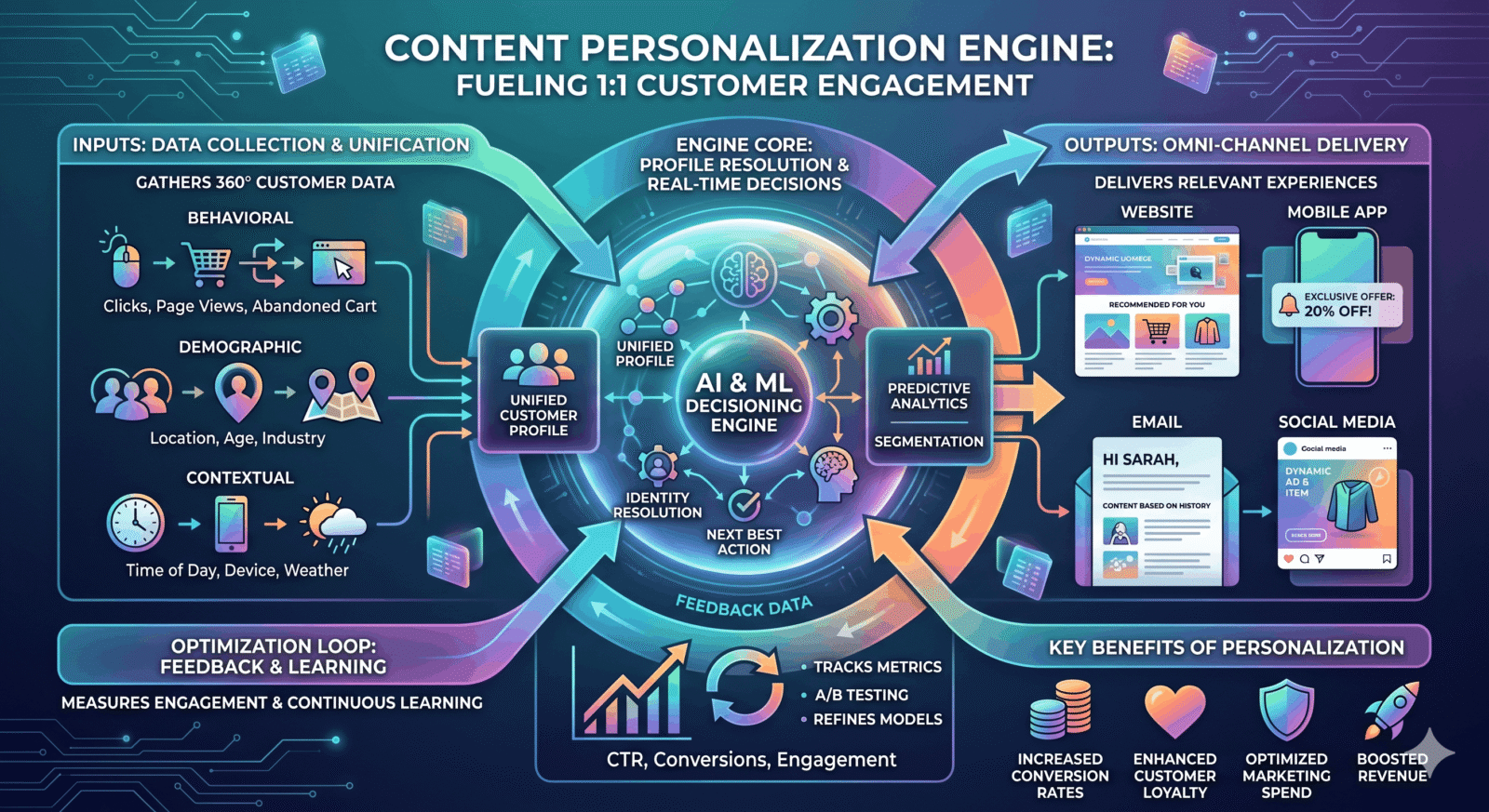
This challenge has accelerated the adoption of content personalization engine. These platforms use customer data, artificial intelligence (AI), machine learning, predictive analytics, and real-time decisioning to deliver personalized experiences to individual customers at scale. Rather than presenting the same content to every visitor, content personalization engines dynamically determine what content is most relevant for each interaction.
As organizations seek to improve engagement, conversions, retention, and customer satisfaction, content personalization engines are becoming essential for solving one of the biggest challenges in digital experience management: delivering relevant experiences at scale.
Why Content Relevance Matters
Content relevance directly influences customer engagement.
When customers encounter content that aligns with their needs and interests, they are more likely to:
- Engage with the brand
- Explore additional content
- Discover products
- Complete purchases
- Return for future interactions
Conversely, irrelevant content often leads to:
- Lower engagement
- Higher bounce rates
- Reduced conversions
- Customer frustration
Relevance has become a key competitive differentiator in digital experiences.
The Growing Complexity of Customer Expectations
Modern consumers have become accustomed to personalized digital experiences.
Leading platforms have trained customers to expect:
- Personalized recommendations
- Relevant content suggestions
- Context-aware interactions
- Consistent cross-channel experiences
As a result, generic content experiences increasingly fail to meet customer expectations.
Organizations must now deliver relevance across every stage of the customer journey.
Why Delivering Relevance at Scale Is Difficult
Creating personalized experiences for a small audience is relatively straightforward.
However, complexity increases dramatically when organizations must serve:
- Thousands of customers
- Millions of visitors
- Multiple customer segments
- Diverse content assets
- Numerous channels
Several challenges emerge as personalization efforts scale.
Expanding Content Libraries
Organizations continually create new content across multiple formats.
Examples include:
- Product pages
- Articles
- Videos
- Guides
- Promotional content
Managing relevance across these assets becomes increasingly difficult.
Growing Customer Data Volumes
Customer interactions generate vast amounts of information.
Examples include:
- Browsing behavior
- Purchase history
- Search activity
- Engagement metrics
- Loyalty interactions
Turning this data into meaningful experiences requires sophisticated decision-making capabilities.
Omnichannel Engagement
Customers interact across:
- Websites
- Mobile apps
- Customer portals
- Social channels
Maintaining consistent personalization across these touchpoints adds complexity.
Rapidly Changing Preferences
Customer interests evolve constantly.
Content that was relevant yesterday may not be relevant today.
Organizations must adapt quickly to remain effective.
What Is a Content Personalization Engine?
A content personalization engine is a technology platform that dynamically delivers personalized content experiences based on customer data, behavior, preferences, and contextual signals.
These engines can personalize:
- Website content
- Landing pages
- Product recommendations
- Educational resources
- Promotional messages
- Email content
- Mobile app experiences
The objective is to ensure customers receive content that is most relevant to them at a given moment.
How Content Personalization Engines Address Scalability Challenges
Creating Individualized Experiences
Traditional personalization often relies on broad audience segments.
Content personalization engines enable organizations to personalize experiences at the individual customer level.
This allows businesses to move beyond generic messaging and deliver more relevant interactions.
Leveraging Unified Customer Data
Effective personalization requires comprehensive customer understanding.
Content personalization engines often integrate with Customer Data Platforms (CDPs) to access:
- Purchase history
- Browsing behavior
- Search activity
- Loyalty engagement
- Customer preferences
Unified customer profiles improve personalization accuracy.
Using Real-Time Behavioral Signals
Customer behavior provides valuable context.
Examples include:
- Product views
- Search queries
- Content consumption
- Session activity
- Cart interactions
Content personalization engines continuously analyze these signals to adapt experiences dynamically.
This ensures content remains relevant as customer interests evolve.
AI-Powered Decision-Making
Artificial intelligence plays a central role in scalable personalization.
AI can:
- Analyze large volumes of customer data
- Identify preference patterns
- Predict future interests
- Recommend relevant content
Machine learning continuously improves personalization quality over time.
This enables organizations to personalize experiences for large audiences efficiently.
Dynamic Content Delivery
Traditional websites often present the same content to every visitor.
Content personalization engines dynamically modify experiences by adjusting:
- Headlines
- Featured content
- Product recommendations
- Promotional messages
- Calls to action
These changes occur automatically based on customer context and behavior.
Supporting Omnichannel Personalization
Customers expect consistent experiences regardless of channel.
Content personalization engines help coordinate content across:
- Websites
- Mobile applications
- Email campaigns
- Loyalty programs
- Customer portals
This creates more seamless customer journeys.
Adapting to Evolving Customer Preferences
Customer interests are constantly changing.
Content personalization engines monitor behavior continuously and adjust experiences accordingly.
This helps organizations remain relevant even as preferences evolve.
Improving Content Discovery
Large content libraries often create discovery challenges.
Content personalization engines help customers find relevant content more efficiently through:
- Content recommendations
- Personalized navigation
- Contextual suggestions
This improves engagement and content utilization.
Supporting Customer Journey Personalization
Different customers require different experiences depending on their stage in the journey.
Examples include:
New Visitors
Educational and introductory content.
Active Shoppers
Product information and recommendations.
Existing Customers
Loyalty and retention-focused content.
At-Risk Customers
Re-engagement experiences.
Personalization engines help deliver appropriate content at each stage.
Predictive Personalization
Advanced personalization engines increasingly leverage predictive analytics.
These systems can anticipate:
- Future content interests
- Purchase intent
- Product affinity
- Churn risk
Predictive capabilities help organizations engage customers proactively.
Benefits of Content Personalization Engines
Improved Content Relevance
Customers receive experiences aligned with their interests.
Higher Engagement Rates
Relevant content generates stronger interactions.
Better Conversion Performance
Personalized experiences support purchasing decisions.
Greater Customer Satisfaction
Experiences feel more valuable and intuitive.
Increased Customer Retention
Relevant engagement strengthens relationships.
Improved Operational Efficiency
Automation enables personalization at scale.
Common Challenges Organizations Face
Data Fragmentation
Customer information often resides across multiple systems.
Content Production Requirements
Personalization requires sufficient content variation.
Technology Integration Complexity
Multiple systems must work together effectively.
Privacy and Compliance Considerations
Customer data must be managed responsibly.
Addressing these challenges is essential for success.
Best Practices for Delivering Relevant Experiences at Scale
Build Unified Customer Profiles
Comprehensive data improves personalization quality.
Leverage Real-Time Behavioral Signals
Current customer actions provide valuable context.
Invest in AI and Machine Learning
Automation improves scalability and accuracy.
Personalize Across Channels
Consistency strengthens customer experiences.
Continuously Measure and Optimize
Customer behavior evolves over time.
Key Metrics to Track
Organizations should monitor:
- Content engagement rates
- Click-through rates
- Conversion rates
- Time on site
- Customer retention rates
- Revenue per visitor
- Personalization performance metrics
These indicators help evaluate personalization effectiveness.
Conclusion
Delivering relevant experiences at scale is one of the defining challenges of modern digital engagement. As customer expectations rise, content libraries expand, and digital interactions become more complex, traditional personalization methods struggle to keep pace.
Content personalization engines address this challenge by leveraging AI, machine learning, real-time customer data, and predictive analytics to create individualized experiences across large audiences and multiple channels. These capabilities help organizations improve content relevance, strengthen engagement, increase conversions, and support long-term customer loyalty.
As businesses continue to prioritize customer-centric growth strategies, content personalization engines will play an increasingly important role in helping organizations deliver meaningful and scalable digital experiences.