The reliability of a plumbing system depends not only on the quality of its pipes but also on the performance of its fittings. Composite fittings have gained popularity in modern plumbing because they create stronger, more consistent connections than many traditional fitting systems. Their compatibility with multilayer composite pipes, improved sealing technology, and resistance to pressure and temperature changes help reduce leaks and extend the lifespan of plumbing infrastructure.
Why Fittings Play a Critical Role in Plumbing Systems
Every plumbing network relies on fittings to connect pipe sections, change directions, and distribute water throughout a building.
Although pipes carry the water, connection points are often where failures occur.
Common causes of fitting failures include:
- Loose threaded connections
- Seal deterioration
- Pressure fluctuations
- Thermal expansion
- Corrosion
- Improper installation
According to the International Association of Plumbing and Mechanical Officials (IAPMO), using certified plumbing products that comply with recognized standards is essential for ensuring safe, durable, and code-compliant plumbing systems.
Understanding Composite Fittings
Composite fittings are engineered connectors specifically designed for multilayer composite piping systems such as PE-AL-PE pipes. Unlike many conventional fittings, they are developed to work as part of an integrated piping system rather than as standalone components.
Modern press-fit composite fittings create permanent mechanical joints that improve installation consistency while maintaining pressure integrity throughout the plumbing network.
Readers interested in understanding the pipe structure itself can explore How PE-AL-PE Multi-Layer Pipes Work to see why compatible fittings are essential for optimal performance.
Superior Leak Protection
One of the biggest advantages of composite fittings is their ability to create secure, leak-resistant joints.
Instead of depending entirely on threaded sealing compounds, modern press-fit systems use precision-engineered sealing rings and mechanical compression.
This helps:
- Maintain consistent sealing pressure
- Reduce installation errors
- Minimize joint movement
- Improve long-term leak resistance
The International Code Council (ICC) recognizes press-connect technology as a reliable joining method for modern plumbing systems because it creates permanent mechanical connections without welding or soldering.
Better Compatibility with Composite Pipes
Traditional fittings are often adapted for multiple pipe materials.
Composite fittings, however, are specifically engineered for multilayer composite pipes.
This compatibility improves:
- Joint accuracy
- Structural stability
- Pressure performance
- Hydraulic efficiency
- Long-term durability
Because both components are designed to function together, the entire plumbing system performs more consistently.
Greater Resistance to Pressure Fluctuations
Modern plumbing systems experience continuous pressure changes caused by:
- Water demand
- Booster pumps
- Multi-storey distribution
- Variable flow conditions
Composite fittings are designed to maintain reliable sealing under these operating conditions.
Key benefits include:
- Stable connections
- Better pressure resistance
- Reduced risk of joint failure
- Consistent water delivery
This makes them well suited for residential apartments, commercial buildings, hospitals, hotels, and institutional facilities.
Improved Thermal Stability
Hot and cold water systems constantly expose plumbing connections to temperature changes.
Repeated expansion and contraction can weaken conventional joints over time.
Composite fittings designed for multilayer pipes help accommodate these changes while maintaining reliable sealing performance.
As a result, they help:
- Protect connection points
- Reduce stress on joints
- Lower maintenance requirements
- Improve overall system lifespan
Faster Installation with Consistent Quality
Construction professionals increasingly prefer press-fit technologies because they simplify installation while improving reliability.
Compared with conventional joining methods, composite fittings typically provide:
- Faster installation
- No soldering or welding
- Cleaner work environments
- Reduced labour time
- Consistent installation quality
The American Society of Plumbing Engineers (ASPE) highlights the importance of proper product selection and installation practices in achieving reliable plumbing system performance.
Lower Maintenance Throughout the Building Lifecycle
Reliable fittings help reduce one of the most common causes of plumbing maintenance—connection failures.
Benefits include:
- Fewer emergency repairs
- Lower maintenance costs
- Reduced water damage
- Longer service intervals
- Improved lifecycle value
The U.S. Environmental Protection Agency (EPA) recommends lifecycle planning for infrastructure assets, recognizing that maintenance and operational costs often exceed initial installation expenses over time.
Composite Fittings vs Traditional Plumbing Fittings
|
Feature |
Composite Press Fittings |
Traditional Plumbing Fittings |
|
Leak Resistance |
Excellent |
Moderate |
|
Installation Consistency |
High |
Depends on workmanship |
|
Pressure Performance |
Excellent |
Moderate |
|
Thermal Stability |
High |
Moderate |
|
Maintenance Requirements |
Low |
Higher |
|
Compatibility with MLC Pipes |
Excellent |
Limited |
Why the Industry Is Adopting Composite Fittings
The plumbing industry is moving toward integrated piping systems that improve reliability from installation through long-term operation.
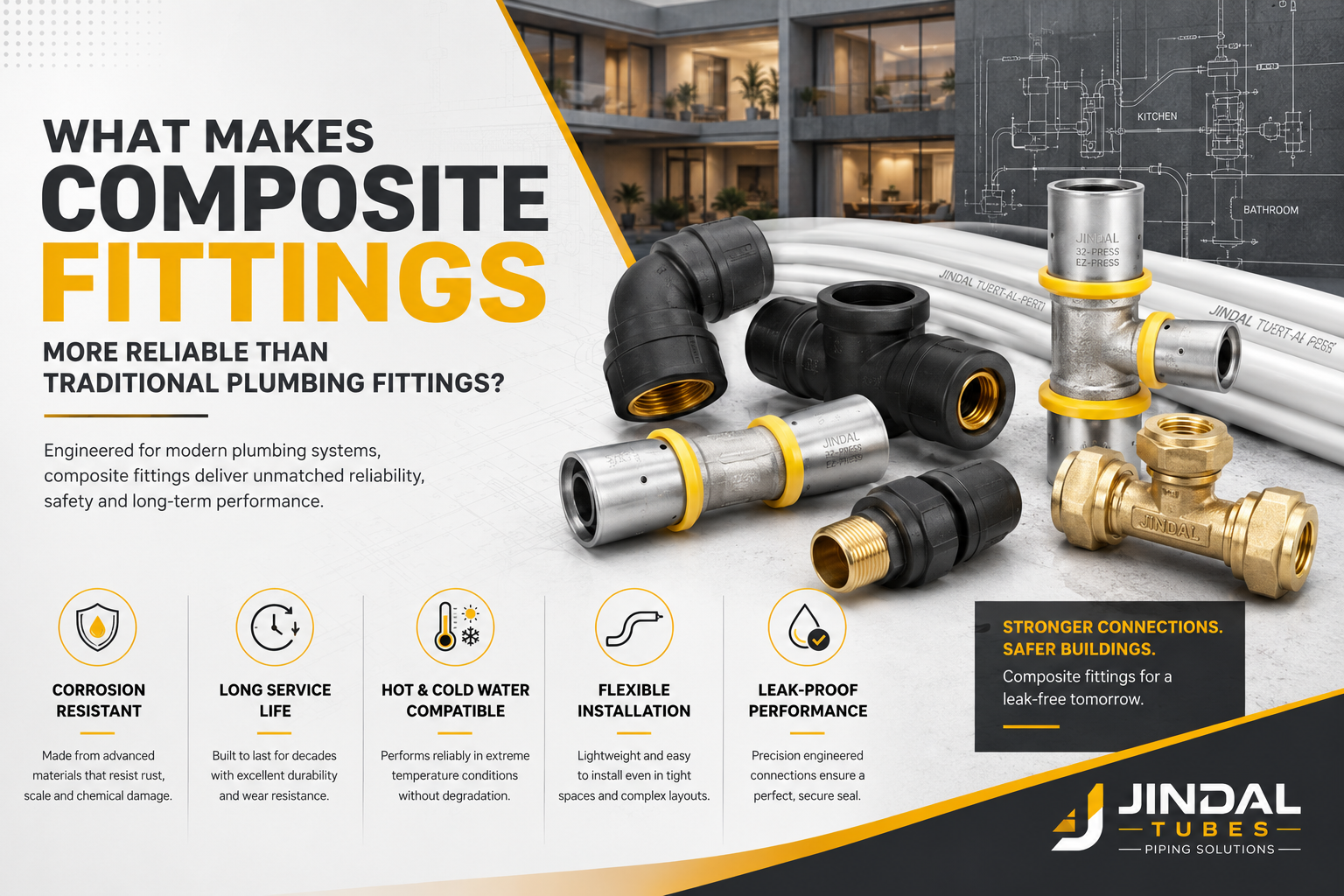
Manufacturers such as Jindal Tubes have contributed to this transition by developing EZ-PRESS composite fittings that are specifically designed for multilayer composite piping systems. Rather than treating fittings as simple accessories, these systems demonstrate how properly engineered connections can improve the overall durability and efficiency of modern plumbing infrastructure.
Frequently Asked Questions
Why are composite fittings considered more reliable?
They create secure mechanical joints, provide better compatibility with multilayer pipes, and maintain reliable sealing under changing pressure and temperature conditions.
Do composite fittings reduce plumbing leaks?
Yes. Properly installed composite press-fit fittings help minimize common causes of leakage by creating consistent, permanent mechanical connections.
Can composite fittings improve plumbing system lifespan?
Yes. By reducing joint failures and maintenance requirements, reliable fittings contribute to the long-term durability of the entire plumbing system.
Where are composite fittings commonly used?
They are widely used in residential, commercial, healthcare, hospitality, industrial, and institutional buildings that utilize multilayer composite piping systems.
Final Insight
Reliable plumbing systems depend on more than durable pipes—they require equally dependable connections. Composite fittings improve the integrity of plumbing networks by providing secure, leak-resistant joints that withstand the demands of modern buildings, including pressure fluctuations, temperature changes, and continuous operation.
As the construction industry increasingly prioritizes lifecycle performance and efficient installation, composite press-fit fittings have become an essential component of advanced plumbing systems, helping engineers and contractors build infrastructure designed for long-term reliability rather than short-term convenience.