Most trees drown in standing water. Roots pull oxygen from air pockets in the soil, and when those pockets stay full for weeks, the roots suffocate, and the tree declines from the ground up. That is why so many Chicago homeowners lose a maple planted in the low corner of the yard, then lose its replacement a few years later.
Bald cypress is the exception. It evolved in southern river bottoms and swamps, in conditions that kill almost everything else, and it has become one of the more dependable picks for the wet corners of Chicago-area properties.
A Conifer That Drops Its Needles
Bald cypress belongs to a small group of deciduous conifers. It produces soft, feathery needles that turn russet-orange in fall and then drop entirely, which catches homeowners off guard when they expect something more like a pine.
In permanently saturated ground, bald cypress can develop woody projections called knees that push above the soil surface. In an ordinary yard that gets soggy after storms but drains eventually, knees rarely form.
Where It Belongs in a Chicago Yard
The obvious candidates are the spots that stay wet: downspout outlets, drainage swales, the low corner of a lot, the strip along a fence where water sits for days after heavy rain. Bald Cypress Chicago homeowners plant in these locations will establish where other species sulk and die.
Bald cypress also handles dry ground perfectly well once established, since its natural range extends onto drier upland sites. Planting one does not lock you into keeping that area wet.
Matching the Tree to the Problem
Wet ground can be a difficult site condition in Chicago yards. A homeowner shopping for Arborvitae Chicago has a different problem than one fighting standing water, and the right species depends on which you actually have:
- Standing water after storms:Bald cypress, which tolerates saturation; few large trees survive
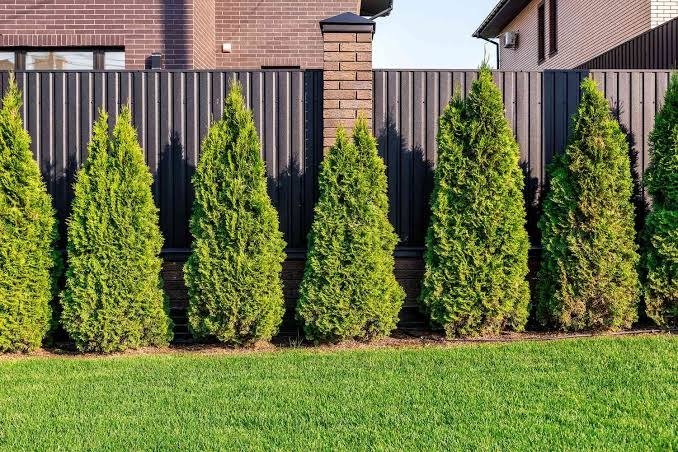
- Narrow strip along a property line: Arborvitae, which Chicago yards rely on for screening, is dense from the ground up, though one of the shorter-lived species
- Heavy clay that drains slowly: Bur oak or hackberry, both deciduous shade trees adapted to compacted soil
- Road salt exposure along a parkway: Spruce generally outperforms arborvitae, which browns from salt spray
Size, Spacing, and Soil pH
This is a big tree. Expect 50 to 70 feet tall with a spread of 20 to 30 feet, reached over several decades at a moderate to fast rate. Rear property lines, open lawn, and wide parkway strips all work. Setting one 15 feet from the foundation creates a headache for whoever owns the house in 2060.
Chicago-area soils frequently run alkaline where limestone-influenced material or construction backfill has raised the pH. Bald cypress prefers acidic to neutral ground and can develop chlorosis, a yellowing between the leaf veins caused by iron deficiency, in high-pH soil. Get a soil test first. Most county extension offices run them cheaply.
Living With a Deciduous Conifer
The needle drop in late fall is fine-textured, landing more like confetti than leaves and breaking down fast on a lawn instead of smothering it.
The second quirk generates a phone call every May. Bald cypress leaves out late, often weeks behind neighboring trees, and homeowners become convinced it died over winter. Scratch a twig with a fingernail, and if the tissue underneath is green, the tree is simply on its own schedule.
Conclusion
For a wet, poorly drained spot that has already swallowed a tree or two, bald cypress deserves serious consideration. It tolerates saturation that kills most species, adapts to ordinary soil moisture once established, and delivers fall color few conifers can match. Homeowners weighing what Bald Cypress in Chicago yards demand should test soil pH before ordering and plan for a tree that eventually wants real space.
iTrees.com is a trusted, family-operated source for quality trees across the greater Chicagoland area. Trees are sourced from highly reputable local nurseries and tree farms growing in northern Illinois conditions, so stock arrives already adapted to the soil and winters it will live in. Between reliable selection, hand planting by an experienced family team, and a full replacement warranty, iTrees.com remains one of the best options for homeowners who want quality trees and real value.