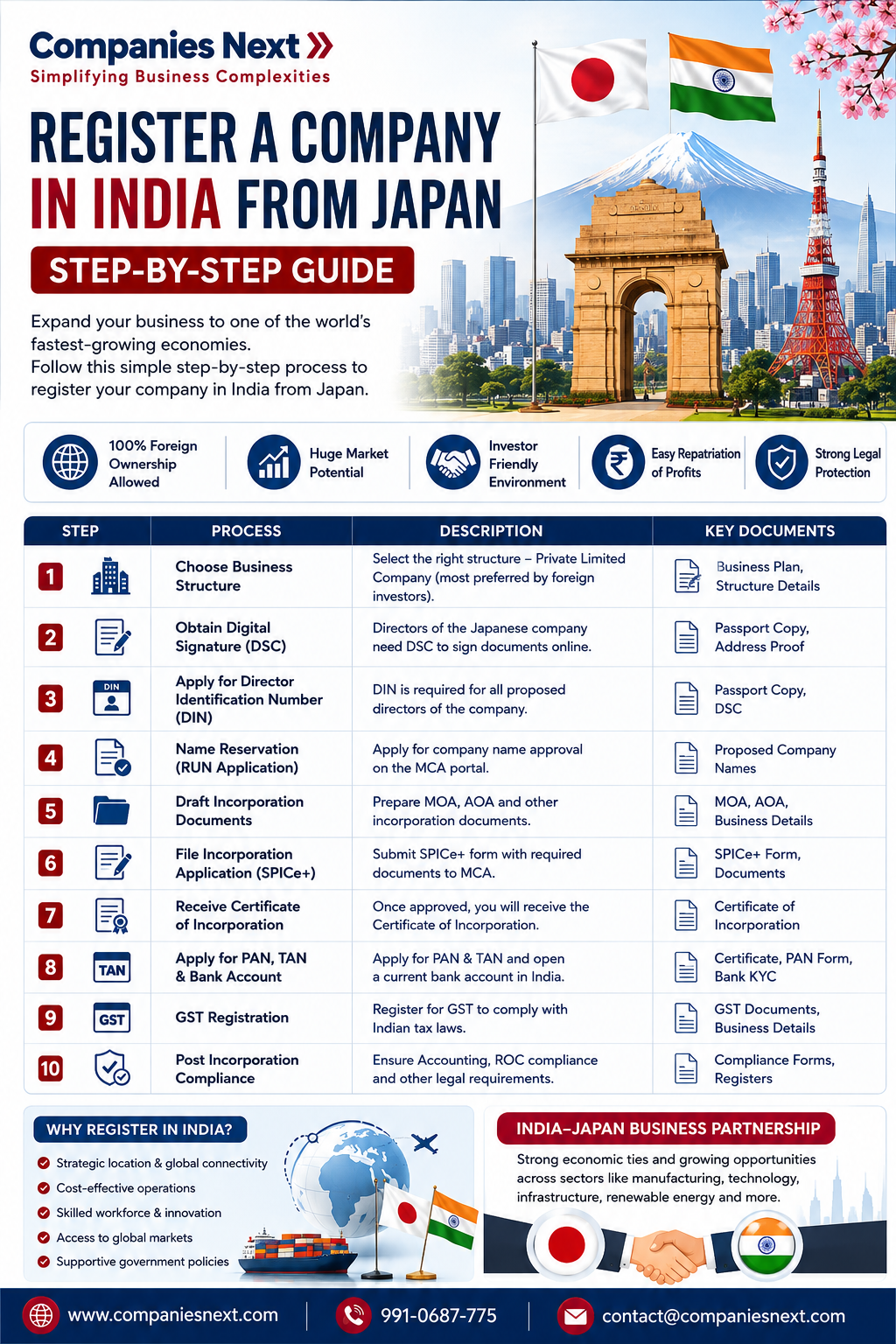
Japanese entrepreneurs and businesses looking to expand into the Indian market can establish a Private Limited Company in India. India offers opportunities across technology, manufacturing, trading, consulting, e-commerce, and many other sectors. However, foreign entrepreneurs need to understand Indian corporate laws, documentation requirements, foreign investment rules, and compliance obligations before starting the process.
For a Japanese citizen or company, company registration in india from japan can generally be completed without travelling to India for every stage. With the help of authorized professionals, many incorporation documents can be prepared, signed, notarized, apostilled, and submitted electronically.
Why Japanese Businesses Choose India
India has a large consumer market, a growing startup ecosystem, skilled professionals, and opportunities across several industries. Setting up an Indian company can help Japanese businesses establish a local presence, hire employees, enter into contracts, and conduct eligible business activities within the country.
A Private Limited Company is one of the most commonly selected structures because it provides limited liability and a separate legal identity. It can also be suitable for businesses planning to raise investment or expand operations.
What Is a Private Limited Company?
A Private Limited Company is a separate legal entity incorporated under the Companies Act, 2013. The company’s liabilities are generally separate from the personal liabilities of its shareholders.
A private company normally requires at least two shareholders and two directors. At least one director must satisfy the requirement of being resident in India under applicable company law. Japanese nationals can become shareholders and directors, subject to applicable legal and regulatory requirements.
The company must also have a registered office address in India.
Eligibility for Japanese Entrepreneurs
Japanese individuals and companies can invest in Indian businesses subject to India’s foreign direct investment regulations. Before incorporation, it is important to determine whether the proposed business activity is permitted under the automatic route or requires government approval.
The proposed business activity should therefore be reviewed before submitting incorporation documents. Sector-specific restrictions, investment limits, and other conditions may apply.
Documents Required from Japan
Proper documentation is one of the most important parts of company registration in india from japan. Japanese shareholders and directors generally need to provide documents such as:
- Valid passport
- Recent address proof
- Residential address details
- Passport-size photographs, where required
- Proof of registered address for a foreign corporate shareholder
- Corporate incorporation documents, where the shareholder is a Japanese company
- Board resolution or authorization, where applicable
- Apostilled documents
- Notarized documents where required
Documents issued outside India may need authentication or apostille according to the applicable requirements. Foreign-language documents may also require an appropriate English translation.
Step-by-Step Registration Process
1. Decide the Business Structure
The first step is to determine whether a Private Limited Company is the appropriate structure. The founders should consider ownership, investment plans, business activity, taxation, compliance requirements, and future expansion.
2. Select a Company Name
The proposed name should be unique and comply with Indian naming requirements. It should not create confusion with an existing registered company or trademark.
Choosing a suitable name early can make the incorporation process smoother.
3. Obtain Digital Signature Certificates
Company incorporation documents are filed electronically. Proposed directors and other relevant applicants generally require Digital Signature Certificates for signing forms electronically.
Foreign directors may also need to complete the applicable digital signature process based on their role and documentation.
4. Apply for Director Identification Number
A Director Identification Number, or DIN, is required for individuals appointed as directors of an Indian company. The DIN process is generally integrated with the incorporation procedure for new companies.
5. Prepare Incorporation Documents
The incorporation application requires information about the proposed company, directors, shareholders, registered office, business activities, share capital, and other details.
The Memorandum of Association and Articles of Association define important aspects of the company’s objectives and internal management.
6. File the Incorporation Application
The incorporation application is submitted electronically through the Ministry of Corporate Affairs system. The relevant forms and supporting documents must be completed correctly.
If the documents satisfy the applicable requirements, the Registrar of Companies processes the application and issues the Certificate of Incorporation.
7. Complete Post-Incorporation Formalities
After incorporation, the company may need to complete several additional requirements depending on its activities and ownership structure. These may include opening a corporate bank account, bringing in foreign investment through permitted channels, completing applicable tax registrations, and maintaining statutory records.
Role of a Resident Director
A Private Limited Company incorporated in India must generally have at least one director who meets the statutory resident-director requirement. Therefore, Japanese founders planning to manage an Indian company from Japan should consider this requirement before incorporation.
The resident director can help the company satisfy Indian corporate law requirements, while the Japanese founders may remain shareholders and directors subject to applicable rules.
Foreign Investment and FEMA Compliance
Foreign investment in an Indian company is governed not only by company law but also by India’s foreign exchange regulations. Japanese investors should therefore consider the applicable Foreign Exchange Management Act (FEMA) requirements.
The investment route, sectoral conditions, reporting requirements, valuation rules, and permitted instruments can vary according to the nature of the business and investment.
Professional guidance can help Japanese investors avoid delays caused by incorrect documentation or reporting.
Opening an Indian Bank Account
Once the company is incorporated, a corporate bank account can be opened with an appropriate Indian bank. Banks may request the company’s incorporation documents, constitutional documents, KYC information, board resolutions, details of directors and shareholders, and information about the source and purpose of funds.
For a Japanese shareholder, additional KYC and authentication documents may be requested by the bank.
Tax and Compliance Requirements
Incorporation is only the beginning of operating a company in India. A Private Limited Company has continuing legal, accounting, taxation, and reporting obligations.
Depending on the business, the company may need to consider:
- Income tax compliance
- Goods and Services Tax registration, where applicable
- Tax deducted at source requirements
- Annual financial statements
- Annual returns
- Accounting and bookkeeping
- Statutory audit
- Payroll and employment-related compliance
- FEMA reporting for foreign investment
- Other industry-specific registrations
Maintaining compliance from the beginning can help prevent penalties and regulatory complications.
How Long Does Registration Take?
The incorporation timeline depends on the accuracy of documents, availability of proposed names, government processing, foreign document authentication, and whether additional clarification is required.
Foreign founders should prepare their documents in advance because apostille, notarization, translation, and KYC procedures can take additional time.
Common Mistakes to Avoid
Japanese investors starting company registration in india from japan should avoid submitting incomplete or inconsistent documents. Common issues include incorrect address details, differences between passport and incorporation documents, inadequate authentication of foreign documents, unsuitable company names, and failure to understand sector-specific foreign investment rules.
Another common mistake is focusing only on incorporation while ignoring post-registration tax, accounting, FEMA, and annual compliance requirements.
Benefits of Professional Assistance
Professional assistance can make company registration in india from japan easier by helping with documentation, incorporation forms, foreign investor requirements, registered-office arrangements, and post-incorporation compliance.
For Japanese founders unfamiliar with Indian corporate procedures, professional support can also reduce communication difficulties and help coordinate between the investor, government authorities, banks, and other service providers.
Conclusion
Setting up a Private Limited Company can be an effective way for Japanese entrepreneurs and businesses to establish a long-term presence in India. The process involves choosing the right structure, preparing authenticated documents, appointing eligible directors, filing incorporation forms, complying with foreign investment regulations, and completing post-incorporation requirements.
With proper preparation, company registration in india from japan can be managed efficiently even when the founders are based in Japan. Understanding Indian company law, FEMA requirements, taxation, and ongoing compliance is essential for building a legally compliant and sustainable Indian business.