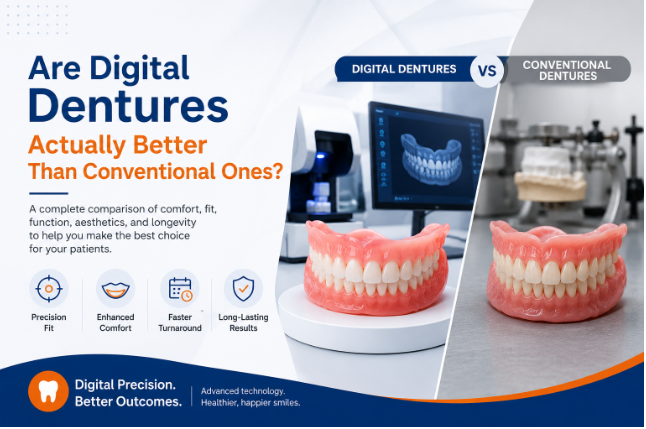
Digital dentures win on appointment count, reproducibility, and record storage. Conventional technique still wins on one measurable point: retention of the maxillary denture. A clinical crossover study found that border-molded impressions with posterior palatal seal compression produced better retention than intraoral scans, with both milled and 3D printed bases. The practical answer for most laboratories is a hybrid: take the impression conventionally, then scan it and fabricate digitally.
That single distinction decides most cases, and it gets left out of nearly every comparison written on the subject.
The Problem With How This Question Usually Gets Answered
Most comparisons of digital and conventional dentures are written by companies selling one or the other. The result is a choice framed as new against old, when the real decision happens at a specific point in the workflow.
The question is not whether to go digital. It is which step to digitize.
What that framing obscures:
- Digital denture fabrication and digital impression taking are two separate decisions, often conflated
- A denture can be designed and milled digitally from a conventional impression, which is what most laboratories actually do
- The evidence favours digital on some outcomes and conventional on others, and the split is predictable by step
- Appointment reduction is the strongest documented benefit, and it comes from the workflow, not the material
What the Clinical Evidence Actually Shows
A prospective randomized crossover study comparing digital and conventional complete dentures evaluated both types in the same patients using the Sato score for denture quality and OHIP-20 for quality of life.
The findings split cleanly by category:
- Denture quality: digital scored higher on average, 73.2 ± 12.3 against 67.4 ± 11.8, though the difference did not reach significance (p = 0.16)
- Upper stability: significantly better in digital dentures (p = 0.03)
- Lower stability: favoured digital but did not reach significance (p = 0.10)
- Surface polish: significantly better in conventional dentures (p = 0.03)
- Patient-reported quality of life: no meaningful difference between the two (p = 0.33)
Patient satisfaction, in other words, did not separate the techniques. Clinical assessment leaned digital on stability and conventional on finish.
Adjustment visits tell a similar story. A pilot study on patient satisfaction with digital complete dentures recorded fewer post-delivery adjustment appointments for digitally fabricated dentures than for conventional ones, which is where most of the practical time saving sits.
Where the Appointment Savings Come From
A conventional complete denture protocol runs four to five clinical appointments: preliminary impression, definitive impression, centric relation record, try-in, and insertion. Digital workflows compress that sequence, mostly by combining records and by using a printed try-in that can be modified without restarting.
The reduction matters more for some patients than others.
- Elderly patients with limited mobility, for whom each visit carries real cost
- Patients travelling long distances to the practice
- Medically compromised patients where appointment tolerance is limited
- Practices where operatory time is the constraint rather than laboratory fees
The saving is not free. Digital protocols shift work from the chair to the design stage, which means a laboratory reviewing records earlier and flagging problems before the try-in.
The Retention Finding That Changes the Workflow
This is the part that most comparisons omit.
A clinical controlled crossover study on denture base fit and retention tested twenty edentulous maxillae. Each patient received bases made two ways: from a conventional border-molded impression with a custom tray, and from a direct intraoral scan. Both were produced as milled and as 3D printed bases, and retention was measured with a traction dynamometer.
Conventional impressions produced better retention. That held for both milled and printed bases.
The reason is mechanical rather than digital. Border molding records functional tissue movement, and posterior palatal seal compression displaces soft tissue to create the seal that holds a maxillary denture. An intraoral scan captures the mucosa at rest. It cannot compress tissue, and it cannot record function.
What this means in practice:
- Direct intraoral scanning of an edentulous maxilla is still the weakest link in a fully digital denture workflow
- The mandibular arch is less affected, since retention there depends less on a peripheral seal
- Scanning a border-molded impression or the poured cast retains the digital advantages without losing the seal
- Fully digital capture is more defensible for immediate dentures, duplicates, and reline references than for a definitive maxillary complete denture
Base adaptation figures support the same conclusion. A systematic review cited in the same study placed digital denture base adaptation between 0.058 and 0.29 mm, inside the range generally considered acceptable, while noting that no agreed clinical threshold for base adaptation exists.
That last point is worth sitting with. The profession does not yet have a published number for what counts as an acceptable denture base gap, which is why fit arguments between practices and laboratories on removable cases are harder to settle than they are on crowns.
Digital and Conventional Compared by Step
|
Workflow step |
Conventional |
Digital |
Better option |
|
Maxillary impression |
Border molding, custom tray, PPS compression |
Intraoral scan, tissue at rest |
Conventional |
|
Mandibular impression |
Custom tray, functional molding |
Intraoral scan |
Roughly equal |
|
Centric record |
Wax rims, adjusted chairside |
Digital or scanned rims |
Roughly equal |
|
Try-in |
Wax setup, destroyed if reset |
Printed try-in, modified and reprinted |
Digital |
|
Base fabrication |
Pack and process, polymerisation shrinkage |
Milled or printed from design file |
Digital |
|
Surface finish |
Hand polished, better documented result |
Milled or printed finish |
Conventional |
|
Adjustment visits |
More post-insertion appointments |
Fewer post-insertion appointments |
Digital |
|
Replacement |
New impression, full remake |
Reprinted from stored file |
Digital |
What Practices Actually Gain From the Digital Side
The reproducibility argument is the one that holds up best over time, and it rarely appears in marketing material.
- A lost or fractured denture can be remade from the stored design file without putting an elderly patient through a full impression sequence again
- A successful denture becomes a reference for the next one, rather than a result that has to be recreated from memory
- Tooth position and vertical dimension from a well-tolerated existing denture can be carried forward exactly
- Try-in changes are reversible, since a printed setup can be modified and reprinted rather than reset in wax
- Design records give the laboratory something concrete to review when a patient reports a problem
For practices restoring implant-supported overdentures, the stored design also carries attachment positions forward, which matters when a housing needs replacing years later.
Where Digital Still Falls Short
Neither technique is better across the board, and a laboratory claiming otherwise is not reading the evidence.
- Maxillary retention from a direct intraoral scan, as covered above
- Surface polish, which scored measurably better on conventionally processed dentures
- Long-term material performance, where printed base and tooth materials have less service history than heat-polymerised PMMA
- Highly resorbed ridges, where the absence of anatomical landmarks makes scan registration unreliable
- Cost, which does not always fall, since equipment and material costs offset the reduced chair time
Frequently Asked Questions
Does a practice need an intraoral scanner to order digital dentures?
No. Most laboratories scan conventional impressions or poured casts into the same digital pipeline. Given the retention evidence on the maxilla, this route is often the better one regardless of what equipment the practice owns.
Do digital dentures fit better than conventional ones?
Base adaptation falls within accepted clinical range at 0.058 to 0.29 mm, and clinical assessment favoured digital on stability. Retention from a direct scan of the maxilla is worse than from a border-molded impression, so fit and retention are not the same question here.
How many appointments does a digital denture save?
Conventional protocols run four to five appointments. Digital workflows reduce that number and also reduce post-insertion adjustment visits, which is where the larger saving sits.
Are printed dentures as durable as processed ones?
Printed base and tooth materials have improved but carry less long-term clinical data than heat-polymerised PMMA. Milled bases sit between the two.
Which patients benefit most from a digital workflow?
Patients who struggle to attend multiple appointments, patients likely to need a replacement denture, and anyone with an existing denture they tolerate well that can be duplicated and improved.
Final Insight
The useful question is not digital against conventional. It is which step in the sequence each technique handles better.
Impression taking on the edentulous maxilla remains a clinical skill that no scanner has replaced. Everything downstream of that impression, the design, the try-in, the fabrication, and the permanent record, is handled better digitally. Laboratories producing complete and partial dentures at volume mostly arrived at the same hybrid position, because the evidence points there rather than to either extreme.
A denture made from a poor impression will fit poorly whether it is packed in a flask or milled from a puck.