AI Is Rewriting the IT Services Industry in 2026
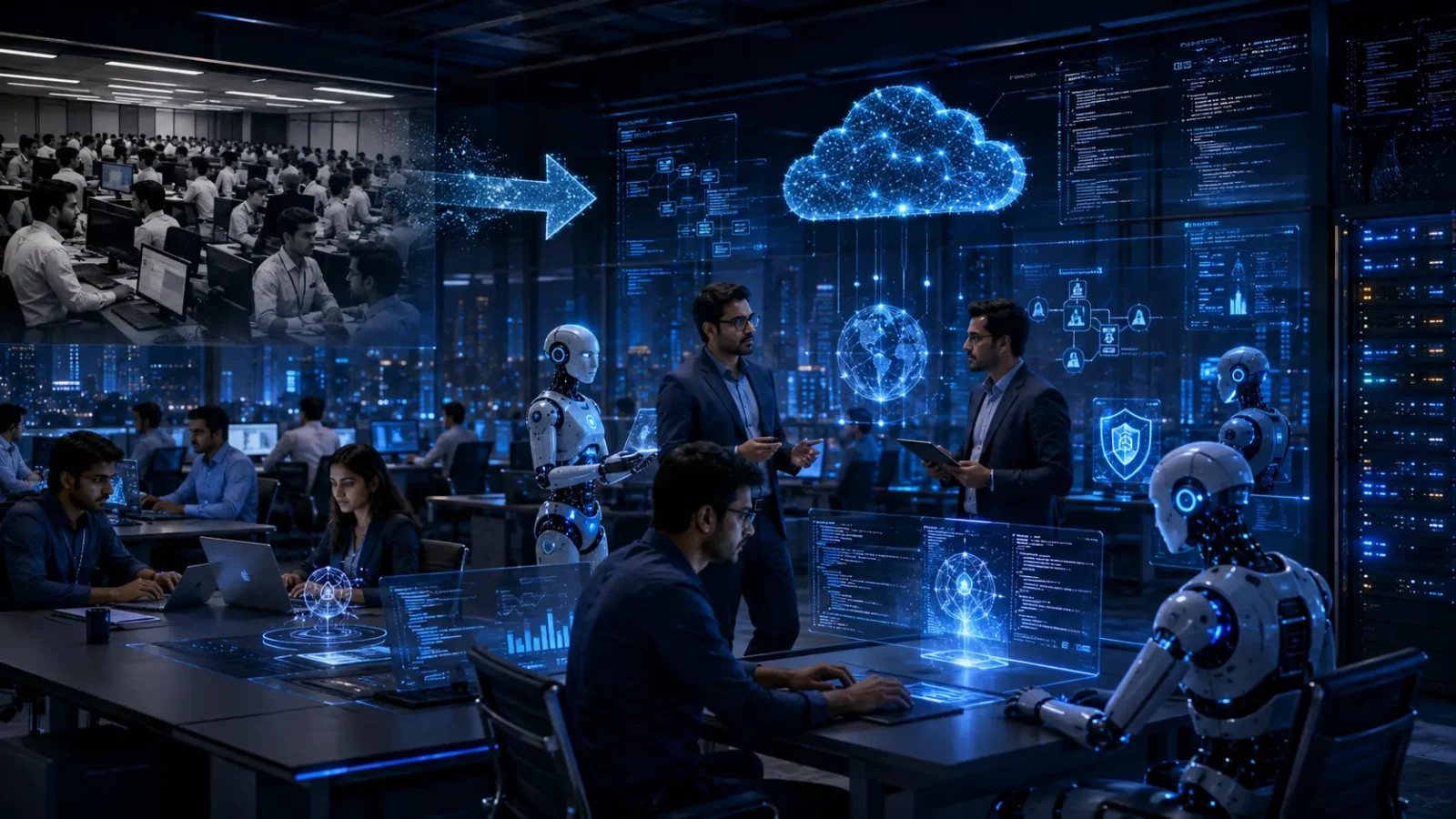
For decades, the global IT services industry was built around a relatively simple model.
Companies needed technology expertise, so they hired external teams to build software, maintain systems, manage infrastructure and provide technical support.
The commercial model was often based on people, projects and billable hours.
But artificial intelligence is changing that equation.
In 2026, enterprise customers are increasingly asking a different question:
“How much business value can technology deliver?”
Rather than simply paying for a large team of developers or support professionals, businesses increasingly want automation, faster implementation, AI-powered operations and measurable outcomes.
This shift is creating a fundamental transformation across the IT services industry.
And for India’s massive IT services ecosystem, the change could be particularly important.
The IT Services Model Is Entering a New Phase
Traditional IT outsourcing was largely based on human expertise.
A client might outsource:
- Software development
- Application maintenance
- Infrastructure management
- Testing
- Customer support
- Business process operations
- Data management
- Consulting
The service provider would allocate employees to the project and charge based on contracts, project scope, or time and materials.
AI is now allowing many of these processes to be automated or accelerated.
This does not mean human professionals are disappearing.
Instead, the economics of delivering IT services are changing.
One skilled employee supported by AI can potentially accomplish work that previously required a larger team.
That has significant implications for productivity, pricing, margins and workforce planning.
Why AI Is Disrupting IT Services
The biggest change is not simply that companies are using AI.
It is that AI can automate portions of the work that IT-services companies traditionally performed.
Modern AI systems can assist with:
- Code generation
- Software testing
- Documentation
- Application modernization
- Data analysis
- Cybersecurity monitoring
- Customer support
- IT operations
- Cloud management
- Enterprise research
AI agents are pushing this even further by allowing software systems to perform multiple steps instead of simply generating an answer.
This creates pressure on traditional models that depend heavily on human effort.
EY’s latest analysis specifically highlights that AI is changing IT-services economics and that the quality and sustainability of earnings are becoming increasingly important as the industry transforms.
From Billable Hours to Business Outcomes
One of the biggest changes could be the gradual movement away from pure time-based billing.
Imagine two models.
Traditional Model
100 developers × hours worked × billing rate = revenue
AI-Enabled Model
AI + smaller expert team + automation = faster business outcome
The second model could potentially deliver the same or better result with fewer human hours.
That creates a challenge for service providers.
If clients need fewer billable hours, companies cannot depend entirely on increasing headcount to grow revenue.
They need to create new value.
This is why outcome-based IT services are becoming increasingly important.
Instead of selling hours, providers can increasingly sell:
- Faster software delivery
- AI transformation
- Automated operations
- Cybersecurity outcomes
- Cloud optimization
- Business-process automation
- AI implementation
The focus moves from “How many people are working?” to “What result did we deliver?”
Indian IT Services Companies Face a Major Transformation
India has built one of the world’s largest IT-services industries.
Companies such as TCS, Infosys, Wipro, HCLTech and Tech Mahindra have historically benefited from global demand for technology outsourcing.
But AI is changing the competitive environment.
The challenge is not that businesses suddenly no longer need technology services.
Quite the opposite.
They may need more technology than ever.
The question is who will deliver it and how efficiently it will be delivered.
Indian IT companies now have to compete not only with other service providers but also with:
- AI platforms
- Software vendors
- Cloud companies
- AI-native startups
- Internal enterprise teams
- Global capability centres
This makes the transition to AI-first services strategically important.
AI Could Create a New IT Services Market
It would be wrong to view AI only as a threat.
AI is also creating new demand.
Businesses need help implementing AI.
They need to:
- Build AI strategies
- Connect AI with existing systems
- Deploy AI agents
- Secure AI applications
- Manage data
- Train employees
- Modernize legacy systems
- Build AI infrastructure
- Monitor AI performance
This creates a huge new market for IT service providers.
The opportunity is therefore shifting from doing work manually to helping clients automate and transform that work.
AI Agents Could Change Enterprise IT
AI agents are becoming particularly important.
A traditional AI assistant might answer:
“How do I reset this user’s account?”
An AI agent could potentially:
- Identify the user.
- Check permissions.
- Verify the request.
- Perform the reset.
- Update the ticket.
- Notify the user.
- Close the workflow.
This changes the role of IT service providers.
Instead of maintaining teams that manually perform every step, companies can build and manage intelligent systems that execute workflows.
That creates demand for AI-agent deployment and management services.
The Rise of AI Deployment Engineers
The industry is already responding to this shift.
Reuters reported in July that TCS was building a team of up to 8,900 forward-deployed AI engineers and looking at AI acquisitions as part of its strategy.
The significance goes beyond one company.
It shows how IT services are evolving from traditional software delivery toward AI implementation at the enterprise level.
Companies will need professionals who understand both:
AI technology + business operations
This combination could become one of the most valuable skill sets in the industry.
GCCs Are Changing the IT Services Landscape
Another major development is the growth of Global Capability Centres (GCCs).
Large multinational companies are increasingly building their own technology and operations centres in India.
These centres can perform:
- Software development
- AI development
- Data science
- Product engineering
- Customer operations
- Cybersecurity
- Finance
- Research
Recent reporting indicates that Indian GCCs are increasingly becoming command centres for AI-led customer service, with significant portions of customer interactions potentially suitable for self-service.
This creates another challenge for traditional outsourcing companies.
Some work that was previously outsourced may increasingly move into captive enterprise centres.
But GCC Growth Can Also Create Opportunities
GCC expansion is not necessarily bad news for the IT services industry.
GCCs themselves require technology partners.
They need:
- Cloud infrastructure
- AI platforms
- Cybersecurity
- Data engineering
- Software development
- Enterprise integration
- AI consulting
- Managed services
IT service providers can therefore move from being general outsourcing vendors to becoming specialized transformation partners.
The relationship becomes more strategic.
India’s IT Workforce Is Also Changing
AI is changing the skills companies need.
Traditional IT skills will remain important, but professionals increasingly need additional capabilities.
High-demand areas include:
AI Engineering
Building and deploying AI systems.
Data Engineering
Preparing reliable data for AI applications.
Cloud Computing
Operating scalable AI and enterprise infrastructure.
Cybersecurity
Protecting AI systems, applications and data.
AI Governance
Managing compliance, risk and responsible AI use.
AI Agent Development
Designing autonomous enterprise workflows.
Product Engineering
Building technology products rather than simply delivering projects.
The future IT professional may therefore need to combine technical expertise with AI literacy.
AI Will Not Eliminate Every IT Job
One of the biggest concerns surrounding the industry is employment.
The reality is more nuanced.
AI is likely to reduce demand for some repetitive activities.
But it can simultaneously increase demand for new capabilities.
For example:
A company may need fewer people manually writing routine code.
But it may need more professionals who can:
- Design AI systems
- Review AI-generated code
- Build AI workflows
- Integrate enterprise systems
- Manage AI security
- Validate AI outputs
The job mix can change even if technology spending continues to grow.
The New IT Services Employee
The traditional model often looked like:
Developer → Task → Code → Delivery
The AI-enabled model could increasingly look like:
AI Agent + Developer → Supervision → Validation → Business Outcome
The developer becomes less of a manual producer and more of an:
AI orchestrator, reviewer and problem solver.
This shift could make productivity a much more important competitive advantage.
Cybersecurity Becomes Even More Important
As AI adoption increases, security becomes a bigger concern.
AI agents may receive access to:
- Company data
- Customer records
- Emails
- Databases
- Internal applications
- Financial systems
That creates new security risks.
Organizations need to know:
- Which AI agents have access?
- What can they do?
- What information can they see?
- Can their actions be audited?
- How are prompt injections handled?
- What happens when an agent makes an error?
The importance of AI security is already becoming visible in the market. For example, Netwrix announced new identity-security capabilities specifically extending protection to AI agents in Microsoft Entra ID.
This creates another growth opportunity for IT services companies.
Sovereign AI Is Becoming Important
Another emerging theme is sovereign AI.
Governments and regulated organizations increasingly want control over:
- Data
- AI models
- Infrastructure
- Encryption
- Deployment environments
This is particularly important in sectors such as:
- Banking
- Healthcare
- Insurance
- Government
- Defence
Indian companies are increasingly developing AI platforms designed around local deployment and data sovereignty.
One recent example is ShepHertz’s AgentAnywhere platform, which focuses on enterprise agentic AI with customer-controlled infrastructure, encryption and compliance capabilities.
For IT service providers, sovereign AI could become a significant specialization.
AI Infrastructure Is Another Major Opportunity
AI services need infrastructure.
That means demand is growing for:
- GPUs
- Data centres
- Storage
- Networking
- Cooling
- Power management
- Cloud infrastructure
Current industry coverage shows that AI server demand is already affecting storage and data-centre infrastructure, while next-generation GPU systems are pushing data centres toward new power architectures.
This means the IT-services opportunity extends beyond software.
Infrastructure integration, cloud optimization and AI data-centre services could become increasingly valuable.
Why Traditional IT Services Companies Still Have an Advantage
Despite the disruption, established IT services companies have several advantages.
They already have:
- Global enterprise relationships
- Large engineering teams
- Industry expertise
- Data and infrastructure capabilities
- Consulting practices
- Long-term contracts
- Domain knowledge
The challenge is converting these advantages into an AI-first business model.
The winners may not necessarily be the companies with the largest workforce.
They may be the companies that can combine AI with their existing enterprise knowledge most effectively.
The Shift From Outsourcing to Transformation
The future of IT services could therefore be less about:
“Give us your work and we will do it.”
And more about:
“Tell us the business problem and we will use technology and AI to solve it.”
That is a major strategic shift.
IT companies increasingly need to become:
- Transformation partners
- AI consultants
- AI implementation specialists
- Managed AI providers
- Industry-specific technology partners
What IT Services Companies Should Do Now
Companies that want to remain competitive should focus on several priorities.
1. Build AI Capabilities
AI should become part of everyday service delivery.
2. Invest in AI Talent
Training existing employees can be as important as hiring new specialists.
3. Develop Proprietary AI Platforms
Owning reusable technology can create differentiation.
4. Move Toward Outcome-Based Pricing
Revenue models should increasingly reflect business value rather than only employee hours.
5. Build Industry-Specific AI Solutions
A generic AI solution is easy to copy.
An AI platform deeply integrated into banking, healthcare, manufacturing or retail can be much harder to replace.
6. Strengthen Cybersecurity
AI adoption without strong security controls can create serious enterprise risks.
What Clients Should Expect From IT Service Providers
Businesses purchasing IT services in 2026 will increasingly expect more than traditional development.
They may ask providers:
- How much can AI automate?
- How quickly can you deploy AI?
- What productivity gains can you deliver?
- Can your AI agents integrate with our systems?
- How will you protect our data?
- Can you measure ROI?
- Can you modernize our legacy systems?
This means IT companies need to demonstrate business outcomes, not simply technical capabilities.
The Future of IT Outsourcing
Outsourcing is unlikely to disappear.
Instead, it is likely to evolve.
Yesterday
People + Processes + Outsourcing
Today
People + Cloud + Automation + AI
Tomorrow
AI Agents + Expert Teams + Autonomous Workflows + Business Outcomes
This is not an overnight transformation.
It will happen gradually as enterprises move AI projects from experimentation into production.
The Biggest Opportunity May Be AI Transformation
The companies that can help enterprises move from AI experimentation to real-world implementation could have a major advantage.
Many businesses have already experimented with generative AI.
The harder part is:
How do you integrate AI into a real business?
That involves:
- Data
- Legacy systems
- Security
- Compliance
- Workflow redesign
- Employee adoption
- Monitoring
- ROI measurement
This is exactly where experienced IT service providers can play an important role.
What Will IT Services Look Like by 2030?
It is difficult to predict exactly, but several trends appear likely.
IT teams could become smaller but more productive.
AI agents could handle repetitive workflows.
Developers could supervise AI-generated software.
Consultants could use AI to analyze complex enterprise problems.
Customer support could become increasingly automated.
Cybersecurity systems could continuously monitor AI-driven threats.
And service providers could increasingly charge for outcomes rather than hours.
The IT services company of the future may therefore look less like a staffing organization and more like a technology platform.
Final Thoughts
The IT services industry is not disappearing.
It is being redesigned.
Artificial intelligence is challenging the economics of traditional outsourcing while simultaneously creating new markets around AI implementation, automation, cybersecurity, cloud infrastructure and enterprise transformation.
For Indian IT companies, this is both a risk and an opportunity.
Companies that continue relying primarily on headcount and billable hours could face increasing pressure.
Companies that successfully combine AI, human expertise, enterprise knowledge and measurable business outcomes could unlock a much larger opportunity.
The most important question for the IT services industry is therefore no longer:
“Will AI change our business?”
It already is.
The real question is:
“Can we change faster than the business model around us?”
And in 2026, that may be the difference between being an IT services provider and becoming an AI-powered technology partner.
Frequently Asked Questions
What is the biggest IT services trend in 2026?
AI-led transformation is one of the biggest trends, particularly the movement from traditional outsourcing toward AI-powered, automation-driven and outcome-based services.
How is AI changing IT services?
AI is automating and accelerating activities such as coding, testing, customer support, data analysis, infrastructure management and enterprise workflows.
Will AI replace IT service jobs?
AI is likely to automate some repetitive tasks, but it is also creating demand for AI engineers, AI-agent developers, cybersecurity specialists, data engineers and AI transformation professionals.
What are AI agents in IT services?
AI agents are systems that can plan and execute multi-step tasks using connected software, data and tools, potentially reducing the amount of manual work required for certain workflows.
Why are GCCs important for India’s IT industry?
Global Capability Centres are increasingly handling technology, AI, engineering and operations for multinational companies. This creates competition for traditional outsourcing providers but also generates demand for specialized technology partners.
What is outcome-based IT services?
Outcome-based IT services focus on measurable business results—such as faster software delivery, automation, cost reduction or improved customer experience—rather than charging primarily according to the number of people or hours involved.
Is AI a threat or opportunity for Indian IT companies?
It is both. AI can reduce the amount of human effort required for traditional services, but it also creates large opportunities in AI implementation, consulting, automation, cybersecurity, cloud and enterprise transformation.