Why Logistics Apps Matter
Freight doesn’t move on paper anymore. A shipment today gets booked, tracked, routed, and invoiced through software long before a truck ever leaves the yard, and the companies that have digitized this process are the ones winning on delivery speed and cost control. Real-time visibility into where a shipment is, what it’s costing, and when it will arrive has gone from a competitive edge to a basic customer expectation.
None of this happens with off-the-shelf tools stitched together. Logistics operations are complex — multiple carriers, warehouses, drivers, and customers all need to see the same data at the same time, and any gap between systems shows up as a missed delivery or a billing error. That’s why working with an experienced logistics app development company matters: the right partner understands freight, warehousing, and fleet operations well enough to build software that fits how the business actually runs, not just a generic tracking screen.
Key Features of Modern Logistics App Development
Most logistics platforms need to handle a similar core set of jobs — moving goods, tracking vehicles, and keeping everyone informed — but how well those jobs are built determines whether the software actually gets used on the ground.
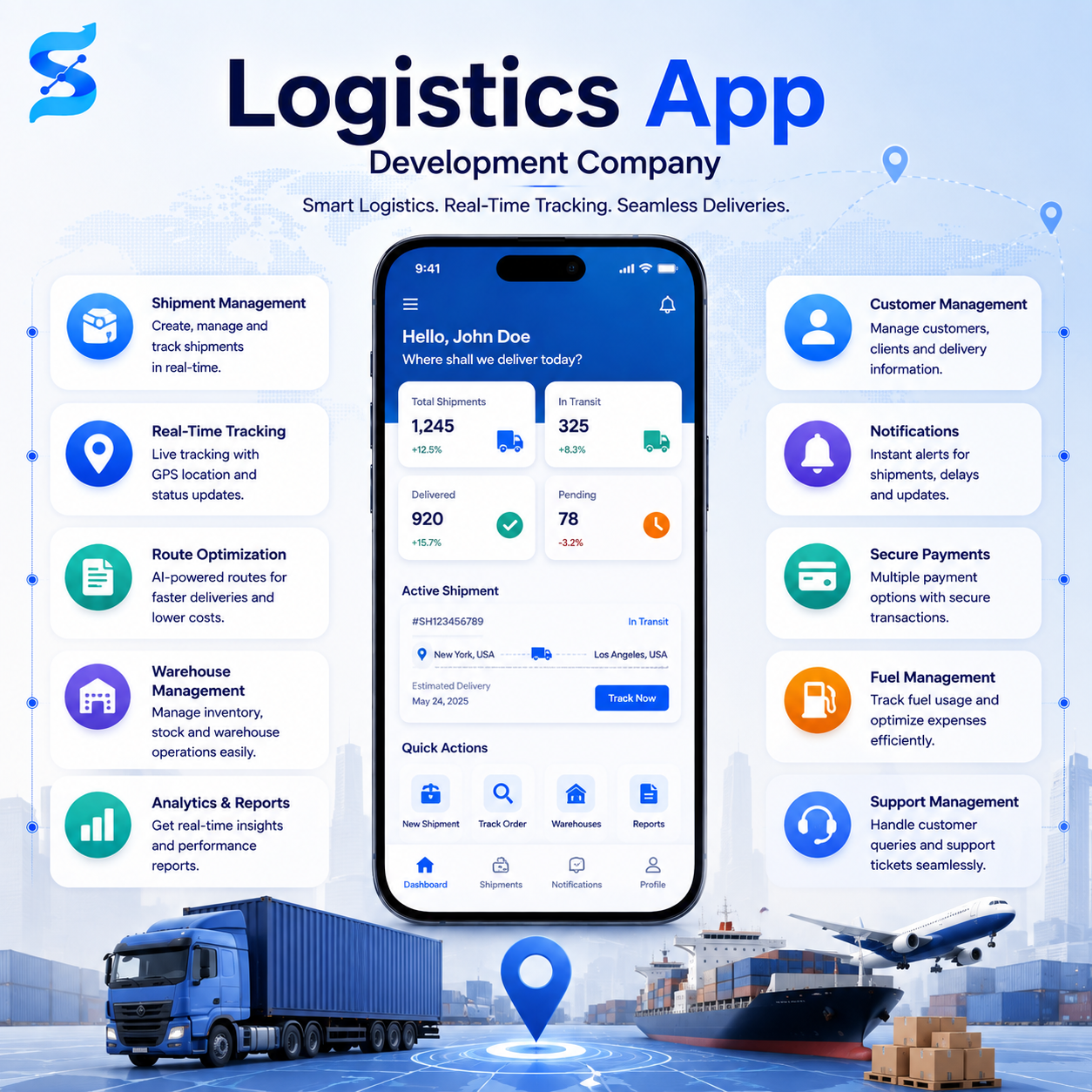
- Shipment booking and order management — Lets customers or dispatchers create, edit, and confirm shipments without back-and-forth phone calls or spreadsheets.
- Real-time GPS tracking — Gives customers and dispatchers live visibility into where a vehicle or shipment is at any moment, which is often the single most requested feature in logistics software.
- Route optimization — Calculates the most efficient path based on traffic, delivery windows, and vehicle capacity, cutting fuel costs and driver hours.
- Fleet and driver management — Tracks vehicle maintenance schedules, driver hours, licenses, and performance from one dashboard.
- Warehouse and inventory management — Keeps stock levels, storage locations, and order fulfillment status synced in real time across facilities.
- Automated dispatch — Assigns jobs to the nearest or best-suited driver automatically, based on location, capacity, and availability.
- Digital proof of delivery — Captures signatures, photos, and timestamps at drop-off, reducing disputes and paperwork.
- Billing and invoicing — Generates accurate invoices tied directly to completed shipments, cutting down on manual reconciliation.
- Customer and carrier portals — Give each party visibility into just the information relevant to them, without exposing the whole system.
Building this well takes a team that understands how dispatch, warehouse, and finance teams actually work together day to day, not just how to wire up a map and a database.
Logistics Software Development: Security, AI & Technology
Logistics platforms move a lot of sensitive data — customer addresses, shipment values, contracts, and payment details — so security has to be built in from the start rather than patched on before launch. That means secure authentication for every user role, encrypted data in transit and at rest, and access controls that make sure a driver, a warehouse manager, and a customer only see what they’re supposed to see.
The technical backbone matters just as much. Custom TMS, WMS & fleet management software needs to integrate cleanly with GPS providers, carrier APIs, ELD devices, and accounting systems, and it needs a backend architecture that can handle spikes in order volume without slowing down. AI is increasingly useful here too, powering demand forecasting, predictive maintenance alerts for fleet vehicles, and smarter route planning, while cloud infrastructure gives logistics companies the scalability to add new warehouses or expand fleet size without rebuilding the system from scratch.
How to Choose the Right Logistics App Development Company
Plenty of software vendors will say they can build a logistics platform, but fewer actually understand the operational details that make one work in practice. Industry experience matters here — a team that has built TMS, WMS, or fleet tracking software before will already know the edge cases around multi-stop routes, split shipments, and carrier integrations that a generalist team would only discover mid-project.
Technical depth matters just as much as domain knowledge. Look for a partner who can speak clearly about API integrations, real-time data handling, and scalability, and who treats security and compliance as a starting requirement rather than a late addition. Ask about their development process, how they handle testing across web and mobile, and what post-launch support looks like, since logistics software needs regular updates as carrier APIs change and the business grows.
Custom Logistics Software Development Services
A strong logistics technology partner should be able to support the full range of what a shipping, freight, or fleet business needs, not just one app. That typically includes custom logistics software built around a specific operation’s workflow, TMS platforms for managing transportation and carrier relationships, and WMS systems for tracking inventory across one or more warehouses.
Fleet management software helps businesses monitor vehicles, drivers, and maintenance schedules, while dispatch and route optimization tools cut delivery times and fuel costs. Customer and carrier portals extend visibility to the people outside the core team, and API integrations connect all of it to GPS providers, accounting platforms, and e-commerce systems already in use. Custom logistics software development services mean a business gets one connected system instead of a patchwork of disconnected tools.
Why Choose Web Squalix for Logistics App Development?
Web Squalix treats logistics software as infrastructure a business will depend on for years, not a one-off project. The team starts by understanding how shipments, warehouses, and drivers actually move through a client’s operation, then builds custom TMS, WMS, and fleet management software around that reality rather than a generic template.
Security and scalability are built in from the first sprint, integrations with GPS, carrier, and accounting systems are handled as a core part of the build, and AI is used where it genuinely improves route planning or forecasting rather than as a marketing feature. Testing runs throughout development, and support continues after launch as carrier requirements and business needs change. If you’re planning a logistics platform, fleet management system, or warehouse software, reach out to Web Squalix to talk through your idea and see how real logistics development experience can help move it forward.