The power supply is the component that most PC builders spend the least time thinking about. Choose enough wattage, check the efficiency rating, pick a brand with good reviews, and move on. For many builds this approach works out fine. But inside a quality power supply is a level of engineering complexity that most buyers never consider. The difference between a reliable unit that lasts a decade and a cheap unit that fails in three years is not just a matter of brand name. It comes down to specific engineering choices made in the design and manufacturing of the unit.
Choosing reliable power supply units is one of the highest-impact decisions in any build. A quality PSU protects every component connected to it. A poor one puts every component at risk. Understanding what makes a PSU reliable changes how you evaluate them and why the best units cost what they do.
AC to DC Conversion: The Primary Job of a PSU
Your wall outlet delivers alternating current at either 110V or 230V depending on your country. PC components need stable direct current at much lower voltages. 12V for major components, 5V and 3.3V for various logic circuits. The PSU converts the high-voltage AC input into the low-voltage DC outputs that each component requires.
This conversion happens in several stages. The first stage is electromagnetic interference filtering. The AC input passes through a filter circuit that removes electrical noise from the power line. This noise, if not filtered, would contaminate the PSU output and cause instability in connected components. Quality PSUs use more stages of EMI filtering with higher-grade components. Budget PSUs often reduce this stage to cut costs.
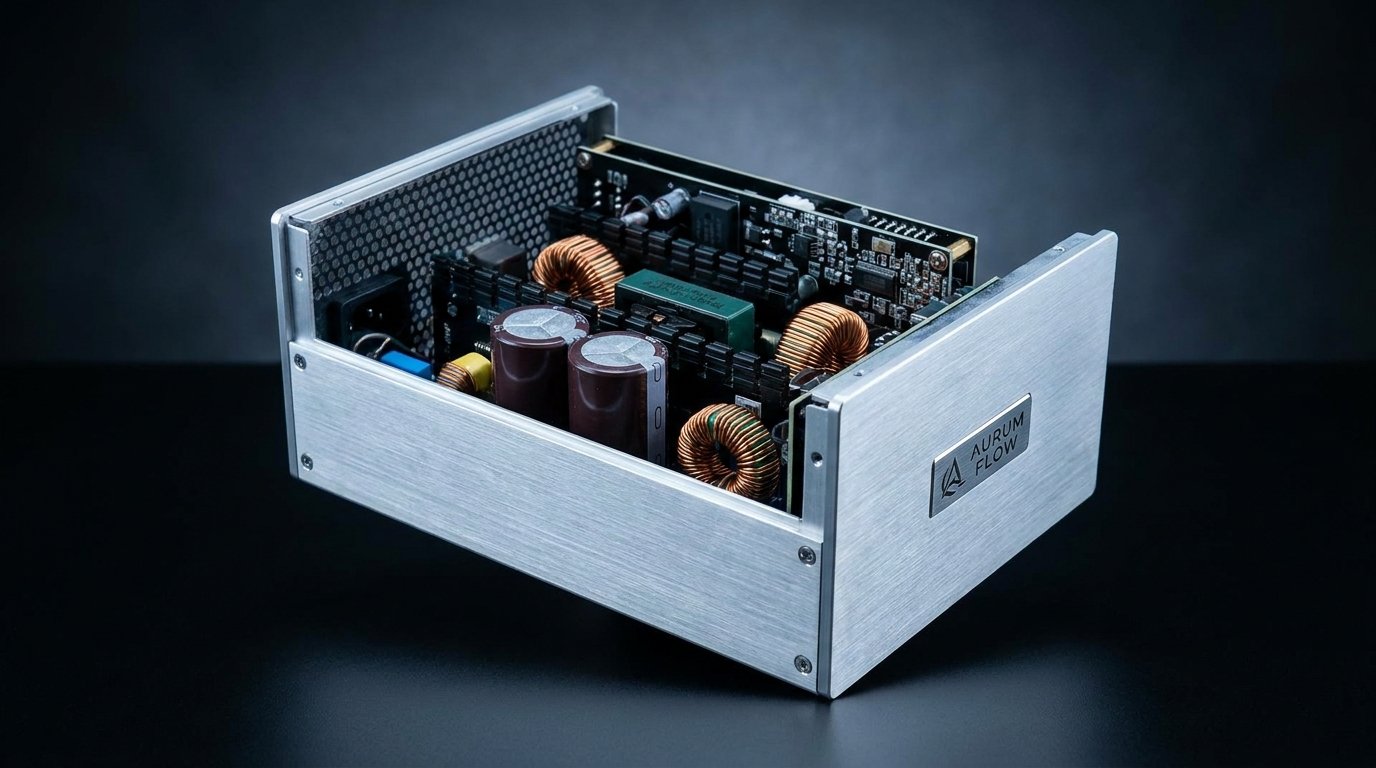
After filtering, a bridge rectifier converts the AC waveform to pulsed DC. This pulsed DC is then filtered by large capacitors to produce a smoother DC voltage. The quality of these bulk capacitors is one of the most important factors in PSU reliability. They must handle high voltages, significant ripple currents, and elevated temperatures continuously.
The Main Conversion Stage: Full Bridge Topology
The high-voltage DC after the rectifier stage is still too high for direct use and must be transformed and regulated precisely. Modern quality PSUs use a full-bridge or LLC resonant converter topology for this stage. The high-voltage DC is switched on and off at high frequency by a bank of MOSFETs. This creates a high-frequency AC signal that is passed through a transformer.
The transformer steps the voltage down to levels closer to the required outputs. It also provides electrical isolation between the input and output, which is a safety requirement. On the secondary side of the transformer, additional rectification and filtering produce the final DC outputs.
LLC resonant converters, used in virtually all high-quality modern PSUs, achieve very high efficiency by operating the switching transistors at zero voltage or zero current switching points. This means the transistors switch when there is no voltage or current across them. Switching losses drop to near zero. Less energy is wasted as heat. This is how modern Gold and Platinum rated PSUs achieve efficiencies above 90 percent.
Capacitor Quality: The Single Most Important Component Choice
Inside a PSU, electrolytic capacitors serve as energy reservoirs and ripple filters at multiple stages. They smooth out voltage variations that would otherwise appear on the outputs. The quality of these capacitors determines both the electrical performance and the longevity of the PSU.
Electrolytic capacitors contain a liquid electrolyte that gradually evaporates over time. The rate of evaporation accelerates with heat. Japanese capacitor manufacturers including Rubycon, Nichicon, and Panasonic produce capacitors with higher-temperature ratings and tighter manufacturing tolerances than many lower-cost alternatives. A capacitor rated for 105 degrees Celsius lasts dramatically longer at real-world operating temperatures than one rated for 85 degrees.
The marketing term most associated with capacitor quality is the all-Japanese capacitor designation. A PSU that uses Japanese capacitors throughout its design, from the primary bulk capacitors to the secondary output filter capacitors, is communicating something meaningful about its build quality. This is not pure marketing. The components are genuinely better-specified and longer-lasting. High-end PSUs from brands like Seasonic, Corsair, and be quiet! use Japanese capacitors throughout. This contributes directly to their long warranty periods and reliable performance over many years.
Voltage Regulation and Ripple Suppression
The DC output from a PSU is never perfectly constant. Load changes cause brief voltage fluctuations. The switching frequency creates ripple superimposed on the DC output. Protection circuits and control loops must react to load changes quickly to maintain stable output voltages.
The ATX specification defines allowable voltage tolerances for each rail. The 12V rail must stay within plus or minus five percent. But the best PSUs hold tolerances much tighter than this. A PSU that holds the 12V rail to within one percent of nominal under varying loads delivers cleaner power to CPU and GPU voltage regulators. Cleaner input power makes their job easier and allows them to maintain more stable processor voltages.
Ripple is the AC component remaining on the DC output. High ripple stresses downstream components. Capacitor aging is accelerated. Voltage regulator MOSFETs operate less efficiently. The best PSUs use output filter designs that suppress ripple to very low levels at all load conditions. This is measured in millivolts and becomes relevant for the most demanding and noise-sensitive workloads.
Protection Circuits: What Saves Components When Something Goes Wrong
A reliable PSU is not just one that performs well under normal conditions. It is one that fails safely when abnormal conditions occur. Quality PSUs implement multiple protection circuits that monitor outputs continuously and shut the unit down safely if any parameter exceeds safe limits.
Over-voltage protection shuts the PSU down if any output rail rises above a defined threshold. This prevents a malfunctioning PSU from damaging connected components. Under-voltage protection does the same if outputs fall too low, which could cause data corruption or instability. Over-current protection limits current on each rail to prevent overloading. Short-circuit protection detects a dead short on any output and shuts down immediately. Over-temperature protection monitors internal temperatures and shuts down if they exceed safe limits.
Budget PSUs often implement fewer protection circuits or implement them with less precision. A PSU without proper over-voltage protection that experiences a regulation failure can send damaging voltages to the motherboard, CPU, GPU, and storage simultaneously. The value of these protection circuits is realized only when something goes wrong. But when it does go wrong, their presence is the difference between a failed PSU and a failed system.
The Fan and Thermal Management
The PSU fan manages internal temperatures to extend the life of all the components inside. Quality PSU fans use fluid dynamic bearings or ball bearings rather than sleeve bearings. These handle the warm internal environment of the PSU better over long periods.
Premium PSUs implement semi-passive fan operation. The fan does not spin at all under light to moderate loads. The PSU runs silently. The fan activates only when internal temperatures rise enough to require active cooling. This reduces fan wear, reduces noise, and extends the fan’s operational lifespan since it only runs when genuinely needed.
The thermal design of the PSU housing also matters. Adequate ventilation, component placement that avoids hot spots, and the use of components rated for higher operating temperatures all contribute to keeping internal temperatures manageable. A PSU that runs cool operates its capacitors and other components at temperatures where their rated lifespan is fully achievable.
Why Warranty Length Is a Real Quality Signal
Premium PSU manufacturers offer warranties of seven to ten years. Seasonic offers ten years on its flagship products. This is not just a marketing gesture. A ten-year warranty means the manufacturer has designed and tested the unit to last that long. It commits the manufacturer financially to support that expectation. A manufacturer confident in a five-year average lifespan does not offer a ten-year warranty.
Budget PSUs often carry one to three year warranties. This tells you something honest about the manufacturer’s expectation of the product’s lifespan. A one-year warranty on a product used continuously for years is coverage that expires long before the risk of failure peaks.
The engineering inside a reliable power supply represents a level of investment in component quality, circuit design, and protection implementation that cheap alternatives skip in order to hit a lower price point. For a component that every other part of the system depends on for stable, clean power over its entire operational life, that investment is the most important money spent in any build.