
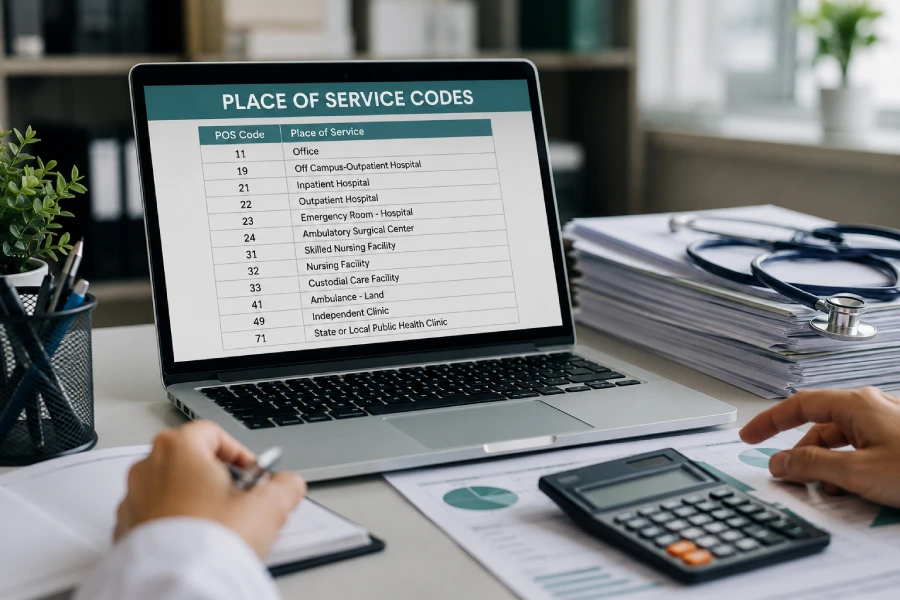
Ask any experienced medical biller what field on a claim form causes the most confusion for new staff, and many will point straight to the two-digit box that identifies where the visit happened. It looks simple. It isn’t. Providers work across offices, hospitals, surgical centers, nursing facilities, and now telehealth platforms, and each setting has its own code with its own payment logic behind it. Learning to reference all POS Codes in Medical Billing correctly is one of the fastest ways a practice can reduce denials and stop leaving money on the table, yet it’s often the piece new billers get the least training on.
This guide breaks down what these codes cover, why so many practices misuse them without realizing it, the risks tied to getting them wrong, and a practical framework to keep your team accurate no matter how many locations your providers work in.
Why One Field Carries This Much Responsibility
A place of service code isn’t just a label. It’s a signal to the payer about cost structure. Every setting comes with a different overhead reality. A private office covers its own rent, equipment, and staffing costs. A hospital outpatient department shares those costs differently, since the facility itself submits a separate claim for its share of the expense.
Because of that, payers calculate two different reimbursement amounts for many procedures: a non-facility rate and a facility rate. The code you use tells the payer which one applies. Pick the wrong one, and you either shortchange your own practice or trigger a payment that doesn’t match what actually happened, both of which create problems down the line.
The Categories Most Practices Deal With Regularly
While the full CMS list includes dozens of settings, most practices only need to master a handful that come up constantly.
Office and outpatient settings. This includes the standard physician’s office, urgent care centers, and independent clinics. These typically carry the non-facility payment rate, since the practice absorbs its own overhead.
Hospital-based settings. Inpatient hospital, outpatient hospital, and emergency room codes all fall here. These use facility-based payment logic because the hospital bills separately for its portion of the encounter.
Surgical and specialty settings. Ambulatory surgical centers have their own distinct code and payment structure, separate from both office and hospital rates.
Long-term and skilled care settings. Nursing facilities, skilled nursing facilities, and custodial care settings each have their own codes, and payment rules here can vary significantly depending on the payer and the patient’s coverage type.
Telehealth settings. This category has grown the fastest and changed the most in recent years. Depending on the payer, the code used can depend on whether the patient was at home, in a healthcare facility, or somewhere else during the virtual visit.
Home and community settings. Home visits, assisted living, and other non-clinical locations each carry their own code, often overlooked by practices that don’t frequently see patients outside a clinical setting.
Missing the nuance between these categories, especially the split between facility and non-facility settings, is where most billing errors start.
A Realistic Example of How Confusion Creeps In
Take an orthopedic practice where physicians perform some procedures in their own office and others at a partnering ambulatory surgical center down the street. A new billing hire, still learning the ropes, assumes that because the physician’s name and NPI are the same either way, the POS code should stay consistent too.
Every claim for weeks gets coded as POS 11, office, regardless of where the procedure actually took place. For office-based procedures, this is correct. For the surgical center cases, it isn’t. The physician ends up billed at the higher non-facility rate for procedures that should have carried the lower facility rate, since the ASC was separately billing its own facility fee for the same encounters.
For a while, claims process without obvious rejection. But eventually, the payer’s system flags the pattern, since the ASC’s facility claims and the physician’s professional claims don’t line up correctly for the same dates and patients. What started as a simple training gap turns into a formal review, with the practice needing to justify months of billing and, in this case, repay a portion of what it had already collected.
This kind of mistake is rarely intentional. It usually comes from insufficient training combined with no system in place to catch the error before the claim goes out.
What Happens Legally When These Errors Pile Up
Occasional mistakes happen in every billing department, and payers generally understand that. The trouble starts when a pattern forms and nobody in the practice notices or corrects it. Many practices only discover how deep this risk runs after working with an experienced billing partner, and it’s exactly the kind of oversight Practice Revenue Partners is designed to catch before it becomes a bigger problem, since prevention is far less costly than a retroactive fix.
Recoupment demands. If a payer determines that claims were paid at a higher rate than the actual place of service justified, they can demand the difference back. In many cases, this isn’t limited to individual claims but extrapolated across a broader sample, multiplying the financial impact significantly.
False Claims Act exposure. Billing that consistently favors a higher-paying setting code, especially when documentation doesn’t support it, can be interpreted as upcoding under federal law. This exposes the practice to penalties well beyond simple repayment, including fines calculated per claim and potential program exclusion in severe cases.
Audit escalation. A pattern of POS mismatches is one of the easier things for payer analytics systems to detect, since it involves comparing facility and professional claims against each other. Once flagged, practices often face broader audits that extend well past the original issue.
Operational disruption. Beyond formal penalties, practices under active audit frequently deal with delayed payments, increased administrative burden, and damaged relationships with payers that can affect contract negotiations down the line.
Red Flags That Should Prompt a Closer Look
Certain signs tend to show up before a full-blown audit does. Practices that catch these early save themselves significant time and money.
- Repeated denials citing place of service or location inconsistency.
- Facility claims and physician claims for the same date of service that don’t match on location.
- Reimbursement amounts noticeably different from what your fee schedule predicts for a given code and setting.
- Providers who regularly work across multiple settings but whose claims all show the same code regardless of where the visit actually happened.
- Telehealth claims that deny or underpay compared to expectations.
- Any formal request from a payer for documentation supporting the location of service.
None of these guarantee a serious problem on their own, but a pattern of two or more is worth investigating right away.
Building a Reliable Process Around POS Accuracy
The goal isn’t perfection on every single claim. It’s building a system where errors get caught before they leave your office, not months later when a payer catches them instead.
Create a settings reference guide unique to your practice
Document every location your providers actually work in and pair each one with its correct code. Keep it updated as your practice grows or adds new partnerships with facilities.
Train scheduling staff as seriously as billing staff
The location of a visit is determined at scheduling, not at billing. If your front-office team doesn’t accurately capture where a visit will happen, your billers are working with incomplete information from the start.
Build in a verification step for multi-location providers
If a physician splits time between an office and a facility, add a manual or automated check confirming the correct code is used based on the actual schedule for that date, not a default setting.
Stay updated on telehealth-specific rules
Telehealth POS guidance has shifted multiple times across different payers in recent years. Assign ownership of this specific area to someone on your team so updates don’t slip through unnoticed.
Review denial patterns monthly
Track denials by reason code, not just by whether they eventually got paid. A recurring POS-related denial pattern signals a root cause that needs fixing, not just a claim that needs resubmitting.
Conduct periodic internal audits
A quarterly sample review comparing billed codes against actual provider schedules and documentation catches problems long before a payer’s audit team does.
Keep supporting documentation organized
If a payer questions your billing pattern, having clean records tying each visit to its actual location protects your practice and speeds up resolution significantly.
The Bigger Picture
Place of service accuracy doesn’t get the same attention as coding for procedures or medical necessity, but it deserves just as much focus. It touches every claim your practice submits, and errors compound quietly over time rather than announcing themselves immediately.
Practices that build POS accuracy into their regular billing hygiene, the same way they handle eligibility verification or claim scrubbing, protect themselves on two fronts at once. They keep revenue flowing at the correct rate, and they avoid the far more expensive risk of an audit triggered by a pattern nobody caught in time.
Frequently Asked Questions
How many place of service codes exist, and does a practice need to know all of them? CMS maintains a full list covering dozens of settings, but most practices only need to consistently apply the handful relevant to where their providers actually see patients, such as office, hospital, ASC, and telehealth codes.
Why do facility and non-facility rates differ for the same procedure? The non-facility rate accounts for the physician’s practice covering its own overhead. The facility rate is lower because the facility itself bills separately for its portion of the cost.
Can a practice be audited specifically because of place of service errors? Yes. Payer analytics systems often compare facility and professional claims for the same encounters, making POS mismatches relatively easy to detect and a common audit trigger.
Is repayment the only consequence of a POS coding pattern issue? No. Beyond repayment, practices can face extrapolated audits, increased scrutiny on future claims, and in serious cases, liability under the False Claims Act.
What’s the biggest source of POS errors in most practices? Inconsistent communication between scheduling and billing. If the actual location of a visit isn’t clearly documented at the point of scheduling, billers often default to whatever code was used previously, even when it’s incorrect.
How often should a practice review its POS coding practices? A quarterly internal audit is a reasonable standard, with more frequent spot checks whenever a new location, provider, or service type is added to the practice.