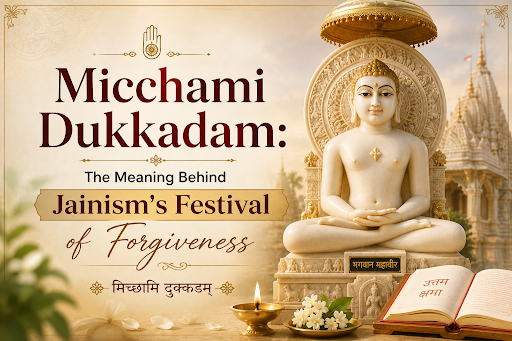
Forgiveness is often associated with saying sorry and moving forward. In Jain philosophy, however, forgiveness is a deeper spiritual practice. It calls for honest self-reflection, humility and the willingness to let go of resentment. This spirit finds its most profound expression during Paryushan, when Jains observe Samvatsari, a day dedicated to introspection, repentance and seeking forgiveness.
At the heart of this observance is the phrase Micchami Dukkadam, traditionally exchanged at the conclusion of Paryushan. Its message extends beyond a simple apology. It represents a conscious effort to acknowledge one’s mistakes, seek forgiveness and resolve to avoid repeating actions that may have caused harm.
What Does Michhami Dukkadam Mean?
Michhami Dukkadam is a Prakrit expression traditionally understood as an appeal that one’s harmful or wrongful actions may become fruitless. It is said after reflecting upon one’s conduct and acknowledging that harm may have been caused knowingly or unknowingly.
The phrase is therefore closely connected with Pratikraman, the Jain practice of reviewing one’s thoughts, words and actions. Rather than placing the responsibility for forgiveness entirely on another person, it begins with looking within. A person recognises their own shortcomings, expresses genuine remorse and seeks forgiveness from those they may have hurt.
This makes the practice particularly meaningful during Paryushan, a period devoted to spiritual purification and turning inward.
Why Is Forgiveness Important in Jainism?
Forgiveness occupies an important place in the Jain religion because Jain philosophy places great emphasis on freeing the soul from karmic bondage. Anger, pride, deceit and greed are among the passions understood to contribute to karmic accumulation. Cultivating forgiveness helps an individual become more aware of these inner tendencies and work towards overcoming them.
Forgiveness in Jain thought is not simply about excusing another person’s behaviour. It is also about releasing one’s own attachment to anger, hurt and resentment. Seeking forgiveness requires humility, while offering forgiveness requires letting go of animosity. Both can contribute to inner transformation.
The traditional prayer associated with this spirit expresses the aspiration to forgive all living beings, seek forgiveness from all living beings, maintain friendship with everyone and harbour animosity towards none.
The Connection Between Michhami Dukkadam and Ahimsa
The practice of seeking forgiveness is closely connected with Ahimsa, one of the foundational principles of Jain philosophy. Ahimsa is commonly understood as non-violence, but its deeper practice involves developing sensitivity towards all forms of life and becoming mindful of how our thoughts, words and actions affect others.
Harm does not always have to be physical. Harsh words, anger, deliberate deception or actions driven by resentment can also cause suffering. By reflecting on these behaviours, Michhami Dukkadam encourages a person to recognise the many ways in which harm can arise.
This makes forgiveness an extension of Ahimsa. Instead of allowing hurt or hostility to continue, the practice creates an opportunity to restore goodwill and consciously choose compassion.
Why Is It Said on Samvatsari?
For Shvetambar Jains, Samvatsari marks the final day of the eight-day Paryushan observance. It is traditionally associated with Samvatsari Pratikraman, during which devotees reflect upon their conduct over the past year and seek forgiveness for transgressions.
After this reflection, Michhami Dukkadam may be shared with family members, friends, colleagues and others. The practice can involve personal conversations, messages, phone calls or other sincere expressions of apology.
The intention is not to mechanically repeat a familiar phrase. Its value lies in the awareness and sincerity behind it. A meaningful apology acknowledges one’s actions and carries an intention to change.
More Than Saying Sorry
One of the most important lessons of Michhami Dukkadam is that forgiveness begins with self-awareness. It asks questions that can be uncomfortable but necessary: Did my words hurt someone? Did anger influence my actions? Did pride prevent me from understanding another person’s perspective? Have I continued carrying resentment from something that happened long ago?
These questions make the practice relevant beyond Paryushan. They encourage a person to develop greater awareness in everyday relationships and become more mindful of the consequences of their actions.
The deeper purpose of Michhami Dukkadam can also be explored through the teachings of Pujya Gurudevshri Rakeshji, founder of Shrimad Rajchandra Mission Dharampur. His discourses on forgiveness encourage seekers to look beyond the act of merely saying sorry and examine the inner emotions that prevent genuine forgiveness.
Carrying the Spirit Beyond Paryushan
The true essence of the festival of forgiveness lies in allowing its message to influence life beyond a single day. Asking for forgiveness can soften pride, while forgiving others can loosen the hold of resentment. Together, these practices can create space for greater compassion, humility and peace.
“Michhami Dukkadam” therefore represents more than an annual greeting. It is an invitation to look within, acknowledge one’s imperfections, make amends where possible and cultivate friendship towards all living beings. In doing so, it reflects a central aspiration of Jain spirituality: to reduce harm, purify one’s inner life and move closer to the true nature of the soul.